Culinary Explorer

A cooking platform built around craft, culture, and the stories behind what we eat.
Discover Culinary Explorer
Pollo Asado Sonorense al Carbon

Pollo Asado Sonorense al Carbon

Created by

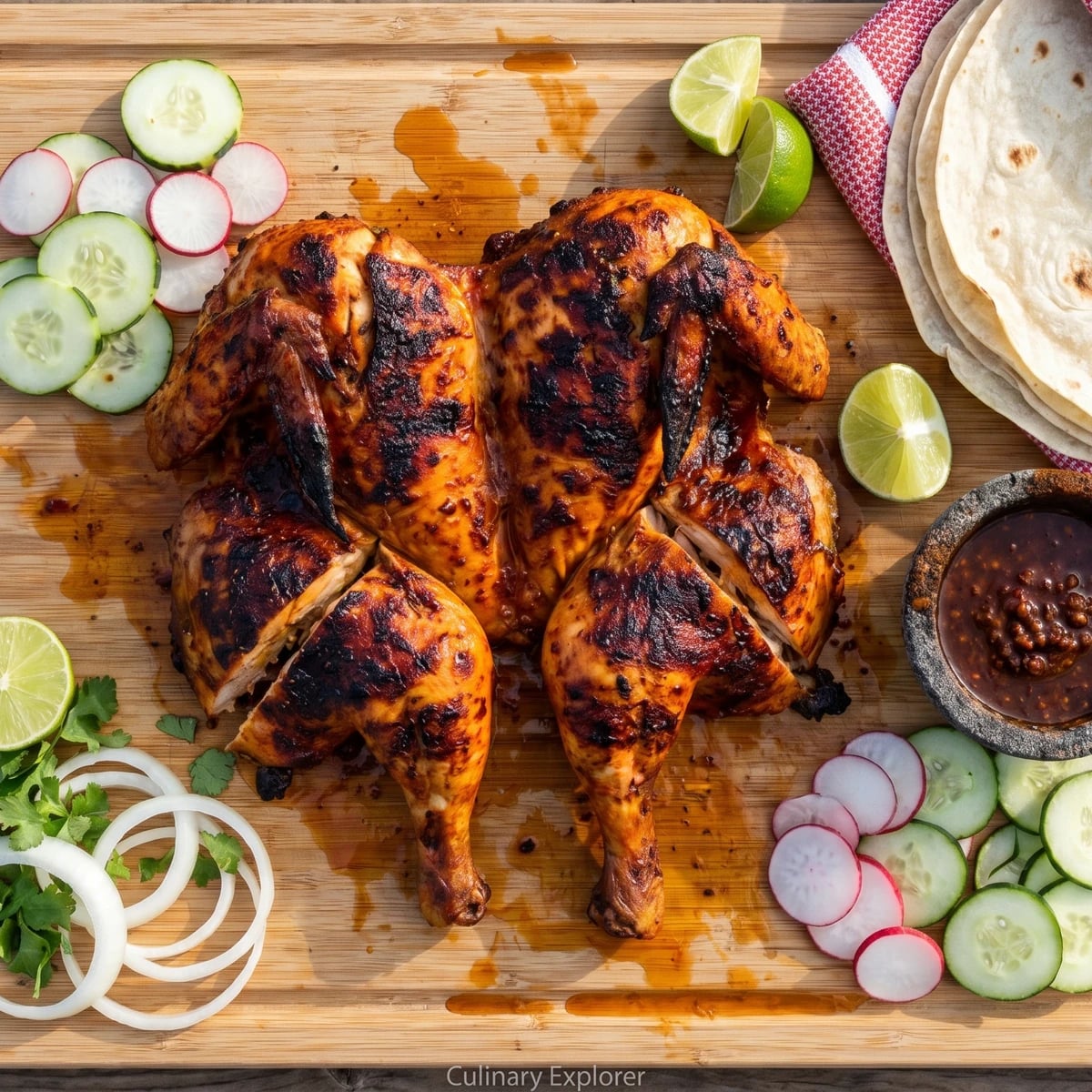
Sonora's mesquite-grilled spatchcocked chicken, marinated in achiote, sour orange, and lime, charred over open flame and served with the giant flour tortillas only the north makes right.

Main Dishes
Mexican
BBQ
Outdoor Dining
Comfort Food
30 min
Active Time
45 min cook5 hr 15 min total
Yield6 servings

This is from Sonora. Northwest Mexico, desert country, cattle country, mesquite country. The cuisine of the north is not the cuisine of the south, and people who know only Mexico City or Oaxaca are sometimes surprised that flour tortillas are Mexican at all. They are. They are sonorense. The wheat fields of the Yaqui valley have been feeding northern kitchens since the Jesuits planted them in the 1600s, and the tortilla de harina, paper-thin and the size of a record album, is one of the great achievements of Mexican home cooking.

The pollo asado is the Saturday-afternoon bird. Every carniceria from Hermosillo to Ciudad Obregon has a wood-fired grill out back, and on weekend afternoons the line forms early. The chicken is spatchcocked flat, marinated in achiote and sour orange and lime, and grilled over mesquite coals until the skin is mahogany and the meat smells of desert wood. You buy it whole, wrapped in butcher paper, and you carry it home with a stack of flour tortillas, a tub of frijoles puercos, and a jar of salsa de chiltepin from the wild chile bushes that grow along the foothills.

The mesquite is not optional. Gas grill pollo asado is a different dish, fine but not Sonoran. If you cannot get mesquite charcoal, find hardwood mesquite chunks at any hardware store and add them to whatever fire you have. The smoke is half the recipe. The achiote does the visual work, that deep brick-red color that announces a northern grill from across the parking lot, but the smoke is what makes a Sonoran tell you yes, that is right.

My mother was from Jalisco, not Sonora. She did not cook this. I learned it in 2009 from a woman named Rosario who ran a carniceria in Ures, a small town in the Sonora river valley. She let me sit by her grill for three afternoons and asked me only that I not write down her exact ratio of achiote to citrus. I did not. What follows is mine, built from her teaching and from a dozen other northern grills. Cada estado, su propia cocina, and Sonora's belongs to mesquite.

Sonoran cuisine diverged from central Mexican cooking in the 17th century, when Jesuit missionaries introduced wheat, beef cattle, and dairy to the northwestern frontier, transforming a region that had relied on corn, mesquite pods, and game into one of the few wheat-based culinary zones in Mexico. Achiote (annatto) traveled north from its Yucatecan and Mayan origins along colonial trade routes and was absorbed into the northern grilling vocabulary by the 19th century, paired with the sour Seville oranges (naranja agria) brought by the Spanish. The pollo asado al carbon as a weekend market institution emerged in the mid-20th century alongside Sonora's beef-export economy, when neighborhood carnicerias built mesquite-fired parrillas to extend their offerings beyond carne asada to whole birds.

The technique, the tradition, and the story behind every dish.

Discover Culinary Explorer

Ingredients

whole chicken

Quantity

1 (about 4 pounds)

spatchcocked with the backbone removed

achiote paste

Quantity

3 tablespoons

fresh sour orange juice

Quantity

1/2 cup

or 1/4 cup orange juice mixed with 1/4 cup lime juice

fresh lime juice

Quantity

1/4 cup

garlic cloves

Quantity

6

peeled

dried Mexican oregano

Quantity

1 teaspoon

ground cumin

Quantity

1 teaspoon

black peppercorns

Quantity

1 teaspoon

whole cloves

Quantity

2

white vinegar

Quantity

1 tablespoon

mild olive oil or melted lard

Quantity

2 tablespoons

kosher salt

Quantity

1 tablespoon

mesquite charcoal or hardwood mesquite chunks

Quantity

for the grill

flour tortillas sonorenses (optional)

Quantity

for serving

warmed, the large thin kind

salsa de chile chiltepin (optional)

Quantity

for serving

guacamole (optional)

Quantity

for serving

frijoles puercos (optional)

Quantity

for serving

lime wedges (optional)

Quantity

for serving

sliced raw white onion (optional)

Quantity

for serving

sliced cucumber and radish (optional)

Quantity

for serving

Equipment Needed

  • Sharp kitchen shears for spatchcocking
  • Charcoal grill with a lid
  • Chimney starter for the mesquite charcoal
  • Cast iron comal for toasting the spices
  • High-powered blender
  • Instant-read thermometer

Instructions

  1. 1

    Spatchcock the bird

    Place the chicken breast-side down on a cutting board. With sharp kitchen shears, cut along both sides of the backbone and remove it. Save the backbone for caldo. Flip the bird breast-side up and press hard on the breastbone with the heel of your hand until the chicken lies flat. This is the cut you see at every carniceria from Hermosillo to Caborca. The bird cooks evenly and the skin crisps everywhere instead of just on the breast.

    If your butcher does not know what spatchcock means, ask for a pollo en mariposa. Same cut, the name a Mexican butcher will recognize.
  2. 2

    Toast and grind the spices

    Heat a dry comal over medium. Toast the peppercorns, cumin, cloves, and oregano for about 45 seconds, just until fragrant. Tip them into a molcajete or spice grinder and grind to a coarse powder. Toasting wakes the oils. Skip it and the marinade tastes flat.

  3. 3

    Build the marinade

    In a blender, combine the achiote paste, sour orange juice, lime juice, garlic, vinegar, olive oil, ground spices, and salt. Blend until smooth. The marinade should be a deep brick-red, almost orange, the color of the Sonoran sunset that this bird is named after. Taste it. It should taste assertive, sour, salty, slightly bitter from the achiote. If it tastes shy, add more salt.

  4. 4

    Marinate the chicken

    Place the spatchcocked chicken in a large baking dish or heavy-duty zip bag. Pour the marinade over and rub it under the skin of the breasts and thighs with your fingers. Cover and refrigerate for at least 4 hours and up to 12. Less than 4 hours and the achiote will not penetrate. More than 12 and the lime starts to mush the texture of the breast meat. Cuatro horas, minimo. No me vengas con atajos.

    Achiote stains everything it touches. Wear gloves. Use a glass dish, not aluminum. The acid will eat the metal and your bird will taste of it.
  5. 5

    Build the mesquite fire

    This is a mesquite dish. The Sonoran desert is full of mesquite trees and the smoke from that wood is the signature flavor of the region. Light a chimney of mesquite charcoal until it glows red and ashes over. Pour the coals onto one side of the grill, leaving the other side empty. You want a two-zone fire: hot direct heat on one side, indirect heat on the other. Add two or three chunks of hardwood mesquite to the coals once the grill is hot. The smoke is half the dish.

  6. 6

    Sear skin-side down

    Pull the chicken out of the marinade and let the excess drip off. Place it skin-side down over the cooler indirect side of the grill. Cover. Cook for 25 minutes, rotating the bird once for even color. The achiote should darken to a deep mahogany. Watch for flare-ups, the marinade has sugar in the achiote and it will char fast over direct flame. Move the bird if you see flames licking the skin.

  7. 7

    Finish bone-side down

    Flip the chicken bone-side down and slide it over the hot side of the grill. Cook another 15 to 20 minutes, until the thickest part of the thigh reaches 165F and the juices run clear when you pierce it. The skin should be crackling, deep red-brown, with darker char where the marinade caught the flame. That char is what you want. La parrilla sonorense no es para timidos.

  8. 8

    Rest and serve

    Move the bird to a cutting board and tent loosely with foil. Rest for 10 minutes. Cutting too soon dumps the juices on the board and you lose them. While it rests, warm the flour tortillas directly on the cooler edge of the grill until they puff and char in spots. Cut the chicken into pieces with kitchen shears: legs, thighs, wings, breast halves quartered. Serve on a wide platter with the warm tortillas, salsa de chiltepin, guacamole, frijoles puercos, lime wedges, raw white onion, and sliced cucumber and radish. Each person builds their own taco. Asi se hace en Sonora, y punto.

Chef Tips

  • Sour orange (naranja agria) is the right citrus for this marinade. If you can find it at a Latin or Caribbean market, use it. If you cannot, the standard substitution is two parts orange juice to one part lime juice with a splash of grapefruit juice. It is a compromise, not an upgrade, but it works.
  • The flour tortillas need to be the right kind. Sonoran flour tortillas are thin enough to read a newspaper through and large enough to wrap a forearm. Mass-market grocery store flour tortillas are not the same dish. Find a Mexican panaderia or a Sonoran tortilleria. If neither exists where you live, make them yourself. The recipe is flour, lard, salt, and warm water.
  • Chiltepin is the wild chile of the Sonoran desert, tiny, round, and viciously hot. The salsa is just dried chiltepin crushed with salt, garlic, and a little vinegar or lime. If you cannot find chiltepin, chile de arbol is the closest substitute, but tell people what you are serving so they understand.

Advance Preparation

  • The marinade can be made up to 2 days ahead and refrigerated. The achiote color deepens overnight and the flavor improves.
  • The chicken needs at least 4 hours in the marinade and benefits from a full overnight (up to 12 hours). Past 12 hours the lime starts to break down the breast meat texture.
  • Frijoles puercos and salsa de chiltepin can both be made a day ahead. Reheat the beans gently with a splash of water or pork broth before serving.

Frequently Asked Questions

Nutrition Information

1 serving (about 185g)

Calories
385 calories
Total Fat
27 g
Saturated Fat
7 g
Trans Fat
0 g
Unsaturated Fat
18 g
Cholesterol
115 mg
Sodium
920 mg
Total Carbohydrates
3 g
Dietary Fiber
1 g
Sugars
1 g
Protein
30 g

Note: Chef personas and recipes are created with AI assistance. Cook with care: follow safe food-handling practices, check doneness with a thermometer when needed, and adapt for allergies and your kitchen.

Where cooking meets culture.

Culinary guides, cultural storytelling, and the editorial depth that makes cooking meaningful.

Discover Culinary Explorer

More from Noroeste Main Dishes

Browse the full collection