Culinary Explorer

A cooking platform built around craft, culture, and the stories behind what we eat.
Discover Culinary Explorer
Poke Meika (Cook Islands Banana Poke, Baked Banana Pudding)

Poke Meika (Cook Islands Banana Poke, Baked Banana Pudding)

Created by

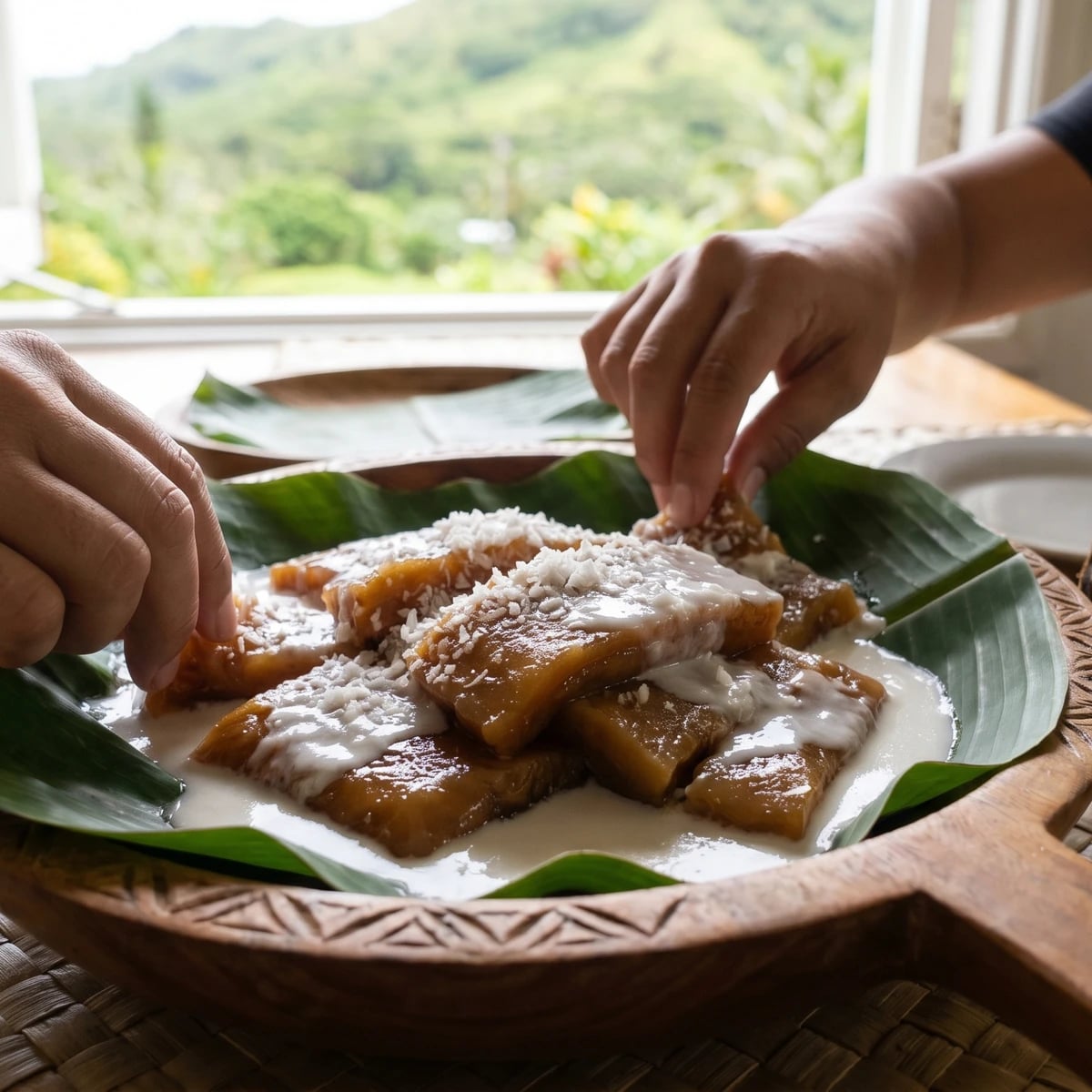
The Cook Islands sweet called poke meika, over-ripe banana bound with pia and baked until glossy, then served in soft slabs with boiled coconut cream poured over.

Desserts
Polynesian, Cook Islands
Comfort Food
Celebration
Make Ahead
25 min
Active Time
55 min cook1 hr 25 min total
Yield8 servings

The canoe carried roots and cuttings, but it carried sweetness too. In the Cook Islands, poke meika, banana pudding, is the kind of dessert a relative sets down without fuss: ripe meika, banana, mashed soft with pia, Polynesian arrowroot, baked until it turns glossy and amber, then covered with boiled coconut cream. First thing I tell my Hawaiʻi people is this is not our poke with fish and limu, seaweed. Same spelling in English. Different island, different hand.

A Cook Islands auntie taught it to me at a table where the bowl stayed in the middle and nobody acted precious about it. She looked at the bananas going black on the counter and said, in her way, Eat what you have. That is the law of this pudding. The fruit must be past pretty, soft enough to collapse under your hand, because the starch needs that ripe sweetness and moisture to set right.

Across the Triangle it has cousins, but not twins. Tahiti has poʻe, fruit pudding cooked with starch and coconut. Hawaiʻi has kūlolo, taro and coconut baked dense and deep. The Cook Islands have poke, and this one is poke meika. One ocean, one canoe, one root does not mean one dish, yeah? It means we name each hand and let the family show.

So don't rush the bake. If the pudding looks pale and pasty, it isn't ready. When it turns darker, glossy, a little elastic under the spoon, then the pia has done its work. Pour the coconut cream over with a generous hand. This is comfort food, celebration food, make-ahead food, old knowledge brought right into the kitchen you actually have.

In Cook Islands Māori, poke names a pudding, not the Hawaiian raw-fish dish; common versions use meika, pumpkin, pawpaw, or breadfruit bound with pia, the Polynesian arrowroot starch old island kitchens relied on before imported flours became common. The dish sits close to Tahitian poʻe, another fruit-and-starch pudding served with coconut, showing how one ocean carried related crops and methods while each island kept its own hand. Its modern pantry versions with tapioca or cornstarch and canned coconut cream are not a failure of memory; they are how Cook Islands families kept the dish cooking through mission, migration, and work-week kitchens.

The technique, the tradition, and the story behind every dish.

Discover Culinary Explorer

Ingredients

very ripe bananas (meika)

Quantity

6 large

black-spotted, about 2 pounds peeled

arrowroot starch (pia) or tapioca starch

Quantity

3/4 cup, plus up to 1/4 cup more

as needed for the set

sugar (optional)

Quantity

1/4 cup

only if the bananas need help

sea salt

Quantity

1/4 teaspoon

coconut oil or neutral oil

Quantity

1 tablespoon

for the baking dish

banana leaf (optional)

Quantity

1

for lining the baking dish

thick coconut cream

Quantity

2 cups

fresh-squeezed if you can, or one 13.5-ounce can

sugar

Quantity

2 tablespoons

for the coconut cream

sea salt

Quantity

1/4 teaspoon

for the coconut cream

arrowroot or tapioca starch slurry (optional)

Quantity

1 tablespoon starch mixed with 2 tablespoons cold water

for a thicker coconut sauce

freshly grated mature coconut (optional)

Quantity

2 tablespoons

for serving

Equipment Needed

  • 8-inch square baking dish or 2-quart shallow baking pan
  • Potato masher or large fork
  • Medium heavy saucepan for the coconut cream
  • Flexible spatula for scraping and spreading the banana mixture

Instructions

  1. 1

    Heat and line

    Heat the oven to 350F. Rub an 8-inch square baking dish or 2-quart shallow pan with coconut oil. If you have banana leaf, soften it over a burner or under hot water until it bends, then line the dish with it. If not, oil alone is fine. Eat what you have.

  2. 2

    Mash the meika

    Peel the bananas and mash them in a wide bowl until soft and pulpy, with a few small fibers still showing. You want about 3 cups of mash. The smell should be deep and sweet, not green. If the bananas are only yellow and firm, wait another day. No blame the bananas if you asked them to work before they were ready.

    Black spots are your friend here. Poke meika needs bananas that look too far gone for a lunch box but are still clean, sweet, and not fermented.
  3. 3

    Work in pia

    Whisk the pia, sugar if using, and salt together so the starch has no hard pockets, then stir it into the banana mash. Let it stand 10 minutes, then stir again. It should be thick and spreadable, falling from the spoon in heavy ribbons. If it looks loose, add more pia 1 tablespoon at a time. If it stands stiff like paste, loosen it with a spoonful of coconut cream.

  4. 4

    Bake until glossy

    Spread the banana mixture into the prepared dish and smooth the top. Bake 45 to 55 minutes, until the pudding darkens to amber-brown, the surface shines, the edges pull slightly from the dish, and the center gives back softly when pressed. A knife should come out sticky but not wet. If the inside tastes chalky, the starch is not cooked yet. Give it more time.

  5. 5

    Boil the cream

    While the pudding rests, bring the coconut cream, sugar, and salt to a gentle boil in a heavy saucepan, stirring often. Lower the heat and simmer 4 to 5 minutes, just until glossy and rounded in flavor. If you want a thicker sauce, whisk in the starch slurry and cook another minute until it coats the spoon. Keep it gentle. A hard boil can split the cream and make it oily.

    Fresh-squeezed coconut cream carries the soul of this kind of food. A good thick can does the weeknight job, no shame, but stir it smooth before it hits the pot.
  6. 6

    Cut and share

    Let the poke rest 10 to 15 minutes so it settles, then cut it into squares or scoop it in soft slabs. Spoon the warm coconut cream over and around it, enough that the pudding sits in a little pool. Serve warm, room temperature, or chilled the next day. The texture should be glossy, dense, and a little elastic, sweet banana held together by the old starch.

Chef Tips

  • Pia gives the clean old set, glossy and a little springy. Tapioca starch is the closest everyday stand-in. Cornstarch will work if that's all you have, but it sets softer and more cloudy.
  • The Cooks also make poke with pumpkin, pawpaw, and breadfruit. Same family, different fruit, different water content. Once you learn the texture of banana poke, those cousins make more sense.
  • This is Cook Islands poke. Don't blur it with Hawaiian poke, and don't sell it as a generic island pudding. Name the hand and the table opens wider.
  • If your coconut cream separates, keep the heat low and whisk in a spoonful of water. We no throw it out unless it has soured. Ugly sauce can still feed people.

Advance Preparation

  • Bake the poke up to 2 days ahead, cool it completely, cover, and refrigerate. Slice it cold, then serve chilled or warm it covered in a 300F oven until soft again.
  • Make the coconut cream sauce up to 1 day ahead. Rewarm it gently and whisk in a splash of water or coconut cream if it thickens too much.
  • Over-ripe bananas can be peeled and frozen up to 3 months. Thaw them fully and use the syrupy liquid too, unless there is so much water that the mash looks thin.

Frequently Asked Questions

Nutrition Information

1 serving (about 190g)

Calories
400 calories
Total Fat
23 g
Saturated Fat
20 g
Trans Fat
0 g
Unsaturated Fat
3 g
Cholesterol
0 mg
Sodium
155 mg
Total Carbohydrates
51 g
Dietary Fiber
5 g
Sugars
25 g
Protein
3 g

Note: Chef personas and recipes are created with AI assistance. Cook with care: follow safe food-handling practices, check doneness with a thermometer when needed, and adapt for allergies and your kitchen.

Where cooking meets culture.

Culinary guides, cultural storytelling, and the editorial depth that makes cooking meaningful.

Discover Culinary Explorer

More from Cook Islands Poke, Takihi & Sweets

Browse the full collection