
Chef Fai
Dry Egg Noodles (Ba Mee Haeng)
The four pillars live at the bottom of the bowl before the noodles ever touch it: nam pla for salt, sugar for sweet, vinegar for sour, chili for heat. Every noodle cart in Bangkok runs on this principle.
A cooking platform built around craft, culture, and the stories behind what we eat.
Created by
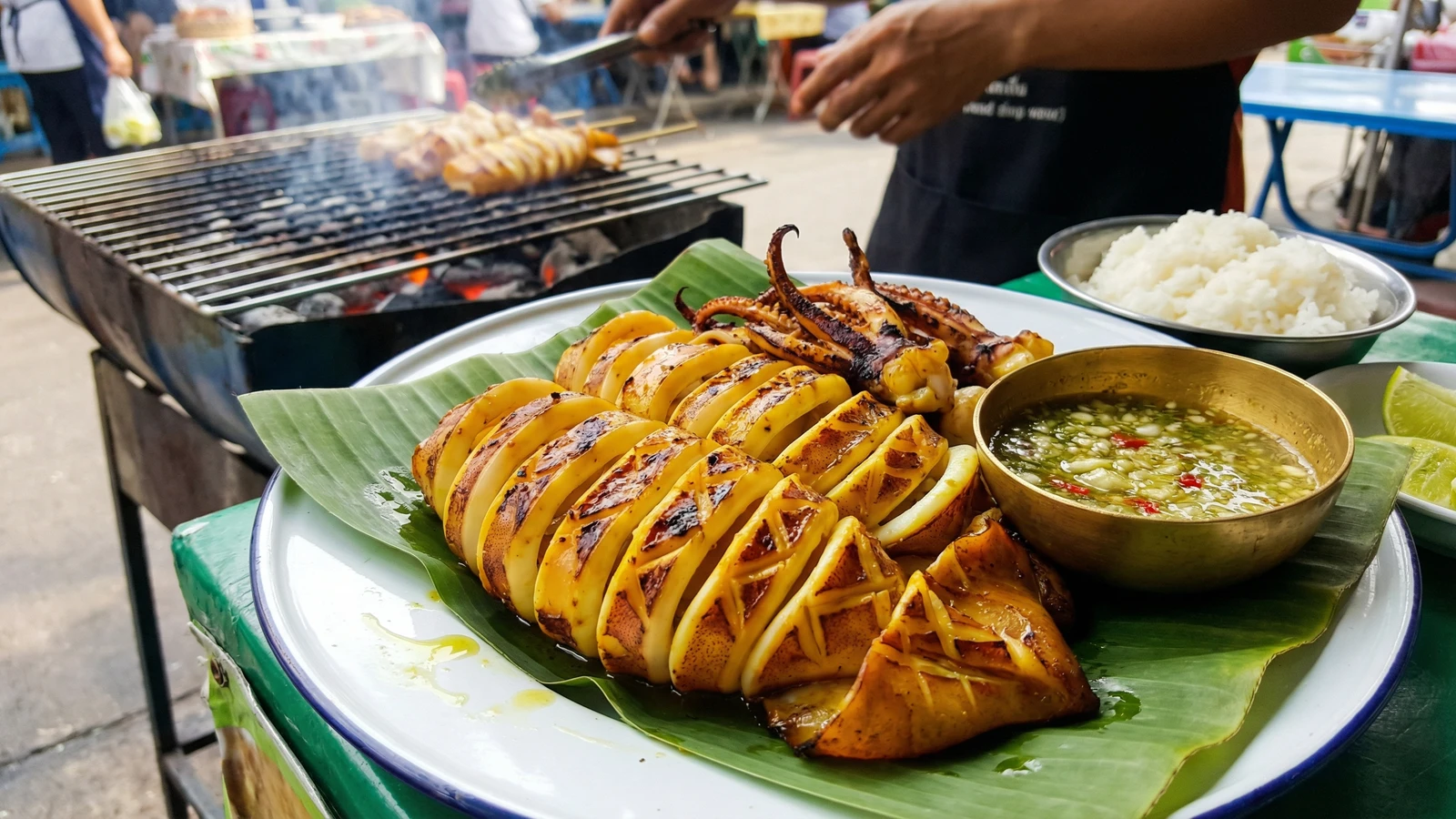
Scored squid over screaming-hot charcoal, turmeric-stained and smoky, served with nam jim talay that delivers all four pillars in a single spoonful. Southern Thai fire cooking at its most direct.
Fire and protein. That's it. Pla muk yang strips Thai cooking down to its most elemental act: something from the sea, scored with a knife, stained with turmeric, thrown over coals. No paste. No wok. No coconut cream. Just heat and timing.
But here's what separates a rubber band from a perfect piece of grilled squid: thirty seconds. Squid is almost pure protein. The moment it hits heat, the muscle fibers contract. Give it two minutes per side and you've got something tender, with char lines and a faint chew. Give it four and you're eating a flip-flop. Ajarn always said: "The ingredient tells you when it's done. You just have to listen." With squid, listening means watching. The flesh turns opaque, the scored crosshatch opens like a flower, and the edges curl. Pull it. Now.
The turmeric marinade is Southern Thai to its bones. Down on the Andaman coast and along the Gulf, kamin (turmeric) replaces galangal as the dominant rhizome. It stains everything gold. Your cutting board, your hands, the squid. That golden color on charcoal-grilled seafood is the visual signature of the Southern peninsula, from Krabi to Nakhon Si Thammarat. It's not decorative. Turmeric is antimicrobial (critical in tropical heat) and contributes a warm, earthy bitterness that balances the sweetness of fresh squid.
The real star is the nam jim talay. This is where the four pillars do their work. Fish sauce for salt. Lime for sour. Palm sugar for sweet (sparingly, this is Southern food, not Central). Bird's eye chilies for heat, and plenty of them. Garlic pounded in the mortar. Cilantro root for depth. It's a kreung tam in spirit: pounded aromatics forming the foundation of flavor. The squid is the vehicle. The sauce is the destination.
Pla muk yang is ubiquitous along both of Thailand's coastlines but finds its purest expression in the Southern provinces, where fishing communities grill the day's catch over coconut-husk charcoal at beachside stalls. The turmeric marinade is a Southern Thai and Malay Peninsula tradition with practical origins: kamin's antimicrobial curcumin compound helped preserve seafood in pre-refrigeration tropical climates. Nam jim talay (literally "water for dipping, seafood") is the Southern grillmaster's universal condiment, a pounded sauce that varies stall to stall but always anchors itself in the four-pillar balance of salty, sour, sweet, and spicy.
Quantity
600g (about 4 medium)
cleaned, tentacles separated
Quantity
1 tablespoon
or 2 tablespoons fresh turmeric, grated
Quantity
2 tablespoons
Quantity
1 teaspoon
ground
Quantity
1 teaspoon
Quantity
4 cloves
minced
Quantity
8
pounded
Quantity
3
finely pounded
Quantity
3 tablespoons
Quantity
4 tablespoons (about 3-4 limes)
Quantity
1 tablespoon
Quantity
2 tablespoons
chopped
Quantity
for serving
| Ingredient | Quantity |
|---|---|
| whole squidcleaned, tentacles separated | 600g (about 4 medium) |
| turmeric powder (kamin)or 2 tablespoons fresh turmeric, grated | 1 tablespoon |
| vegetable oil | 2 tablespoons |
| white peppercorns (prik thai)ground | 1 teaspoon |
| fish sauce (nam pla) for marinade | 1 teaspoon |
| garlicminced | 4 cloves |
| bird's eye chilies (prik khi nu)pounded | 8 |
| cilantro roots (rak phak chi)finely pounded | 3 |
| fish sauce (nam pla) for sauce | 3 tablespoons |
| lime juice (nam manao) | 4 tablespoons (about 3-4 limes) |
| palm sugar (nam tan pip) | 1 tablespoon |
| cilantro leaves (phak chi)chopped | 2 tablespoons |
| jasmine rice | for serving |
Lay each squid tube flat, inner side up. With a sharp knife held at a 45-degree angle, score diagonal lines across the flesh about 5mm apart. Don't cut all the way through. You want to go about two-thirds deep. Rotate the squid 90 degrees and score again, creating a crosshatch diamond pattern. This isn't decoration. The crosshatch does three things: it increases surface area for the marinade, creates channels where char and smoke can penetrate, and causes the squid to curl open on the grill so heat distributes evenly. Physics, not presentation.
In a bowl, combine the turmeric, vegetable oil, ground white pepper, and the teaspoon of fish sauce. Rub this mixture over every surface of the scored squid tubes and tentacles. Your hands will turn yellow. That's how you know you're doing it right. Let it sit for 15 minutes at room temperature. The turmeric needs time to penetrate the score marks and bond with the protein. Don't skip this. Unmarinated squid on a grill is just... cooked squid. The kamin gives it that golden Southern Thai color and a layer of warm, earthy bitterness that balances the natural sweetness of fresh squid.
While the squid marinates, make the sauce. In a mortar, pound the garlic, cilantro roots, and chilies to a rough paste. Not smooth. You want texture, small pieces that will suspend in the liquid. Scrape the paste into a bowl. Add the fish sauce, lime juice, and palm sugar. Stir until the sugar dissolves. Taste it. The balance for Southern Thai should lean sour and spicy, with salt supporting and sweetness barely there. This isn't Central Thai. The palm sugar is a whisper, not a presence. If the lime doesn't hit you first, add more. If the chilies don't build heat in the back of your throat, you didn't use enough. Stir in the chopped cilantro leaves last.
Get your charcoal grill ripping hot. You want direct, intense heat. If you're using a gas grill, crank it to maximum and let the grates heat for ten minutes. Brush the grates with oil. Lay the squid tubes scored-side down first. Don't touch them. Two minutes. The scored flesh will open up, the edges will char, the turmeric will darken to a deep amber. Flip once. One more minute on the other side. The tentacles go on at the same time, they cook faster, maybe ninety seconds total, turning once. Pull everything the moment the flesh is opaque and the char lines are defined.
Transfer the squid to a cutting board. Let it rest for thirty seconds, no more. Slice each tube into rings or strips about 1cm wide. The crosshatch scoring should be visible on each piece, curled open and showing the char pattern. Arrange on a plate with the tentacles. Serve the nam jim talay alongside in a small bowl. Jasmine rice on the side. That's it. Fire and the sea, nothing in between. Let the sauce do the work. Dip every piece.
1 serving (about 175g)
Culinary guides, cultural storytelling, and the editorial depth that makes cooking meaningful.
Discover Culinary ExplorerChef Fai
The four pillars live at the bottom of the bowl before the noodles ever touch it: nam pla for salt, sugar for sweet, vinegar for sour, chili for heat. Every noodle cart in Bangkok runs on this principle.

Chef Fai
The kreung tam fried in cracked coconut cream until the oil bleeds red. That's the technique. Concentrated, semi-dry, spooned thick over crispy fish. This is what happens when the four pillars meet restraint.

Chef Fai
Isan foraging in a bowl: wild taro stems stripped of their sting, simmered in padaek broth with a pounded chili paste and yanang leaf extract. The land feeds you if you know the rules.

Chef Fai
Lanna's kreung tam breaks from Central Thai rules: ginger over galangal, cumin and coriander from Burmese spice routes, tamarind for sour instead of lime. The North has its own system, and this curry is its crown.