
Chef Thomas
A Proper Ploughman's Board
A board of good cheddar, thick ham, proper pickle, hard-boiled eggs, and crusty bread. Not cooking so much as assembling with conviction, and one of the finest lunches the English kitchen has ever produced.
A cooking platform built around craft, culture, and the stories behind what we eat.
Created by Chef Thomas
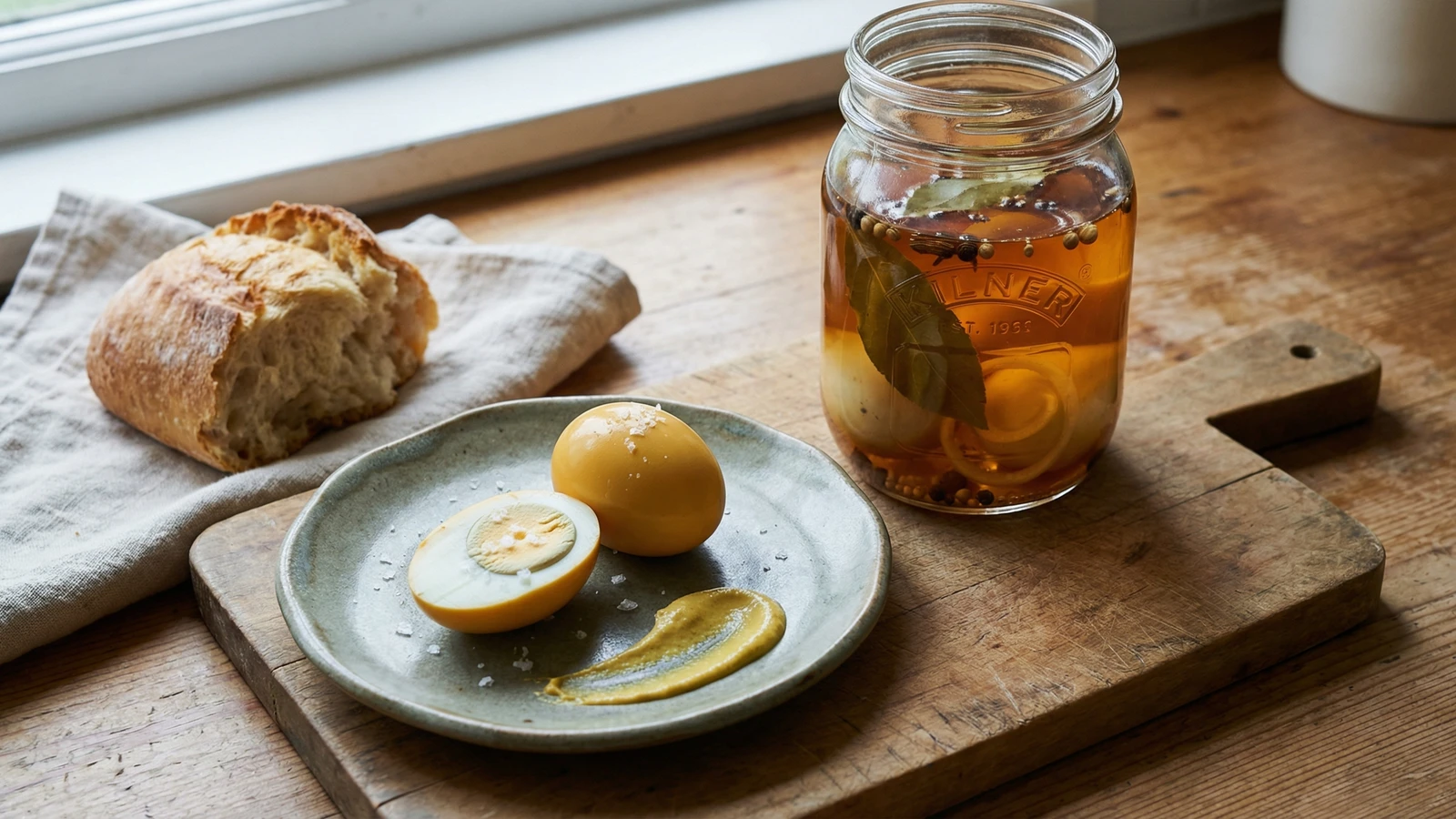
Hard-boiled eggs steeped slowly in spiced malt vinegar until they turn golden and sharp, the kind of honest, old-fashioned thing that belongs in a jar on the kitchen shelf and never quite lasts as long as you planned.
There's a jar of these on the shelf above the kettle. There has been, on and off, for years. The vinegar catches the light in the afternoon and the eggs sit there like something from another decade, which in a way they are. Pickled eggs belong to a time before the fridge, before cling film, before anyone worried about what to call a snack. They're just eggs in vinegar. They last for weeks and they taste better the longer you leave them alone.
I first ate one from a jar on a pub counter when I was too young to be in the pub. The barman fished it out with a long fork, dropped it on a saucer, and pushed it across without ceremony. It was sharp and cool and faintly spiced, and I thought it was the most peculiar thing I'd ever tasted. I ate two more.
The recipe, if you can call it that, is barely a recipe. You boil eggs. You make a spiced vinegar. You put one into the other and wait. The waiting is the only technique involved, and it's the one most people find hardest. Three days gives you something decent. A week gives you something worth writing down. I wrote it in the notebook once: "Pickled eggs. Tuesday. Finally perfect on Saturday." A recipe is a conversation, not a contract, but this one does ask for patience.
They're good with a cold beer on a warm evening, or with bread and cheese and a smear of mustard when you want something that feels like lunch without any real cooking. The kind of food that looks after itself.
Quantity
6 large
Quantity
500ml
Quantity
1 tablespoon
Quantity
1 teaspoon
Quantity
1 teaspoon
Quantity
1 teaspoon
Quantity
4
Quantity
2
Quantity
1 small
left whole
Quantity
1 teaspoon
Quantity
1 small
peeled and sliced into rings
| Ingredient | Quantity |
|---|---|
| free-range eggs | 6 large |
| malt vinegar | 500ml |
| granulated sugar | 1 tablespoon |
| fine sea salt | 1 teaspoon |
| black peppercorns | 1 teaspoon |
| yellow mustard seeds | 1 teaspoon |
| whole cloves | 4 |
| bay leaves | 2 |
| dried chillileft whole | 1 small |
| ground turmeric | 1 teaspoon |
| onionpeeled and sliced into rings | 1 small |
Lower the eggs gently into a pan of boiling water. Set a timer for ten minutes. Not nine, not twelve. Ten. You want a yolk that is fully set but still has a faint give at its centre, a shade darker than pale. When the time is up, lift them out with a slotted spoon and drop them straight into a bowl of cold water. Leave them there until they're completely cool. This is the only precise step, so give it your attention.
Pour the malt vinegar into a saucepan and add the sugar, salt, peppercorns, mustard seeds, cloves, bay leaves, the dried chilli, and the turmeric. Bring it to a simmer and let it bubble gently for five minutes. The kitchen will smell sharp and warm and old-fashioned, like the back room of a pub in a market town. Take it off the heat and let it cool completely. Don't rush this. Hot vinegar on cold eggs cracks the whites and turns them rubbery.
Peel the cooled eggs carefully. Tap each one against the worktop, roll it gently under your palm until the shell is crazed all over, then peel from the wide end where the air pocket sits. The membrane should come away with the shell if you get underneath it cleanly. Rinse off any clinging fragments. You want smooth, white eggs with no nicks or craters, though a few battle scars won't matter once the vinegar has done its work.
Place the peeled eggs in a clean glass jar, a wide-mouthed one that lets you get your hand in. Tuck the onion rings between and around the eggs. Pour the cooled pickling liquor over the top, spices and all, until everything is submerged. If the eggs float, weigh them down with a small piece of crumpled baking parchment pressed into the neck of the jar. Seal tightly.
Refrigerate the jar and leave it alone for at least three days. A week is better. Two weeks is better still. The vinegar works slowly, staining the whites a pale amber and pushing its tang deeper into the egg with each passing day. When you finally fish one out, cut it in half lengthways. The white should be firm and faintly golden, the yolk still a little creamy at its core. Eat it with a pinch of flaky salt, a dab of English mustard, and good bread if you like. Or just eat it standing at the kitchen counter, which is how most pickled eggs get eaten.
1 serving (about 60g)
Culinary guides, cultural storytelling, and the editorial depth that makes cooking meaningful.
Discover Culinary ExplorerChef Thomas
A board of good cheddar, thick ham, proper pickle, hard-boiled eggs, and crusty bread. Not cooking so much as assembling with conviction, and one of the finest lunches the English kitchen has ever produced.

Chef Thomas
Puff pastry twisted with anchovy and Parmesan, baked until golden and shattering and salty, the kind of thing you put out with drinks that disappears before anyone sits down.

Chef Thomas
Fresh oysters wrapped in crisp streaky bacon and grilled until the salt of the sea meets the smoke of the cure, served on hot buttered toast the way the Victorians intended, only simpler and at home.

Chef Thomas
Boiled eggs wrapped in a dark, spiced coat of sausage meat and crumbled black pudding, fried to a deep gold. The kind of thing you eat standing up in the kitchen, still warm, with mustard on your thumb.