
Chef Graziella
Agrodolce alla Siciliana
The sweet-sour sauce that proves Sicily is where East meets West, where Arab traders left their mark on Italian cooking. A syrup of vinegar and honey, studded with pine nuts and raisins.
A cooking platform built around craft, culture, and the stories behind what we eat.
Created by
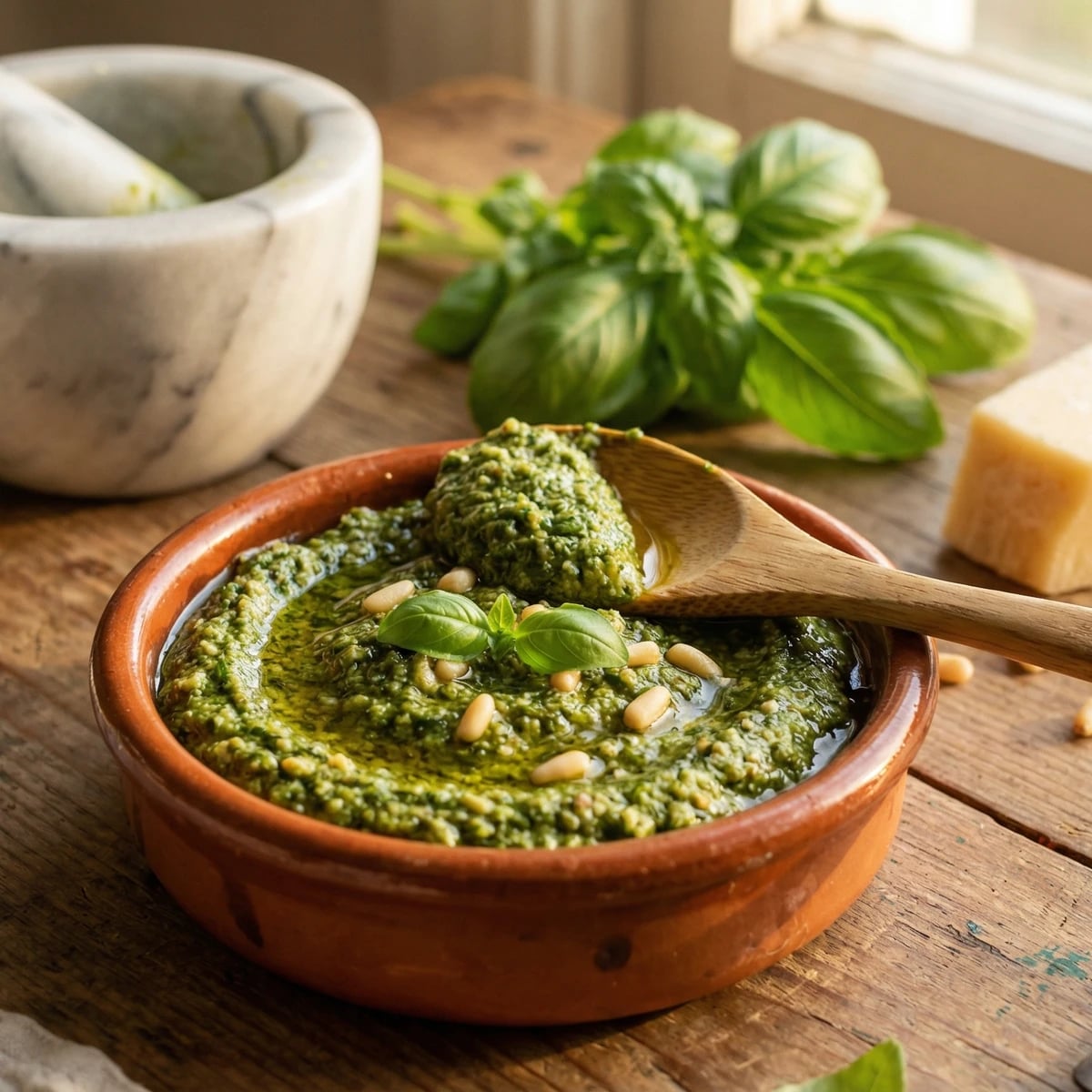
The green sauce of Genoa, pounded by hand until basil leaves surrender their fragrant oils without a trace of bitterness. What the blender destroys, the mortar preserves.
Pesto means pounded. Not processed, not blended, not buzzed in a machine that heats the basil and turns it bitter within seconds. The mortar and pestle exists for a reason. When you crush basil leaves against stone with a wooden pestle, you bruise the cells and release their oils gently. When you spin them in a blade, you shred them, generate heat through friction, and oxidize the chlorophyll before it reaches the bowl. The color tells the truth: hand-pounded pesto stays bright. Machine pesto turns army green.
The Genovesi are particular about their pesto, and they have earned the right. The basil of Prà, a small district west of Genoa, grows in the salt air of the Ligurian coast and produces leaves so tender and fragrant that other basils taste coarse by comparison. You may not have access to this basil. Use the youngest, smallest leaves you can find, preferably grown in poor soil. Rich soil makes big, tough leaves with less flavor.
I will tell you now that this takes time. Fifteen minutes at the mortar, perhaps twenty. Your arm will tire. This is the price of doing things properly. If you are not willing to pay it, you are not ready for pesto alla Genovese.
Pesto appeared in Genoa in the mid-19th century, though its ancestor, agliata, a garlic and walnut sauce, dates to medieval times. Basil replaced walnuts as the dominant ingredient only when Ligurian farmers began cultivating it intensively in the coastal hills. The sauce remained a local secret until after World War II, when tourism brought visitors to the Riviera and they carried the recipe home.
Quantity
2 cups tightly packed (about 2 ounces)
young and tender, washed and thoroughly dried
Quantity
2 cloves
Quantity
2 tablespoons
Quantity
1/2 teaspoon, plus more to taste
Quantity
1/4 cup
freshly grated
Quantity
2 tablespoons
freshly grated
Quantity
1/2 cup
preferably Ligurian
| Ingredient | Quantity |
|---|---|
| fresh basil leavesyoung and tender, washed and thoroughly dried | 2 cups tightly packed (about 2 ounces) |
| garlic | 2 cloves |
| pine nuts | 2 tablespoons |
| coarse sea salt | 1/2 teaspoon, plus more to taste |
| Parmigiano-Reggianofreshly grated | 1/4 cup |
| Pecorino Fiore Sardo or Pecorino Romanofreshly grated | 2 tablespoons |
| extra virgin olive oilpreferably Ligurian | 1/2 cup |
Wash the basil gently in cold water and dry it completely. This is critical. Water on the leaves will dilute the pesto and encourage oxidation. Use a salad spinner, then spread the leaves on a clean towel and let them air-dry for at least 30 minutes. The leaves must be absolutely dry before they touch the mortar.
Place the garlic cloves and coarse salt in the mortar. Pound and grind with the pestle, using a rotating motion against the sides of the bowl, until the garlic becomes a smooth paste. The salt acts as an abrasive. This takes two to three minutes. The paste should have no visible chunks.
Add the pine nuts to the mortar. Pound them into the garlic paste until they are completely broken down and incorporated. You should see no whole pieces. The mixture will become slightly creamy from the oils in the nuts. This takes another two to three minutes.
Add the basil leaves a handful at a time. Press each addition against the sides of the mortar with the pestle, using a gentle grinding motion rather than violent pounding. The leaves should be bruised and crushed, releasing their oils, not shredded or torn. Work each handful into a paste before adding more. This is the longest step, ten to fifteen minutes. Your arm will protest. Continue.
When the basil has become a uniform green paste, add the grated Parmigiano-Reggiano and Pecorino. Work them in with the pestle until fully incorporated. The mixture will become thicker and more cohesive. The two cheeses serve different purposes: Parmigiano provides depth and sweetness, Pecorino adds sharpness and salt.
Add the olive oil in a thin, steady stream while stirring continuously with the pestle or a wooden spoon. The pesto should emulsify into a thick, bright green sauce that clings to the spoon. Taste and add more salt if needed. The finished pesto should be vibrant, fragrant, and slightly coarse in texture. This is correct. Smooth pesto comes from machines.
Use the pesto immediately for best color and flavor. To store, transfer to a jar and pour a thin layer of olive oil over the surface to prevent oxidation. Press plastic wrap directly onto the surface before sealing. Refrigerate for up to one week. The color will darken slightly. This is unavoidable but does not significantly affect flavor.
1 serving (about 29g)
Culinary guides, cultural storytelling, and the editorial depth that makes cooking meaningful.
Discover Culinary Explorer
Chef Graziella
The sweet-sour sauce that proves Sicily is where East meets West, where Arab traders left their mark on Italian cooking. A syrup of vinegar and honey, studded with pine nuts and raisins.

Chef Graziella
The citrus marinade of the Southern Italian coast, where lemons hang heavy on the terraces and the fish comes straight from morning boats. Two forms of citrus, good oil, restraint.

Chef Graziella
The warm bath of Piedmont, where anchovies and garlic surrender to butter and oil over gentle heat. A communal pot, raw vegetables, and the harvest tradition of the Langhe hills.

Chef Graziella
The mother sauce of Italian baked pastas, transformed from simple butter, flour, and milk into silk through patient whisking and the essential warmth of nutmeg.