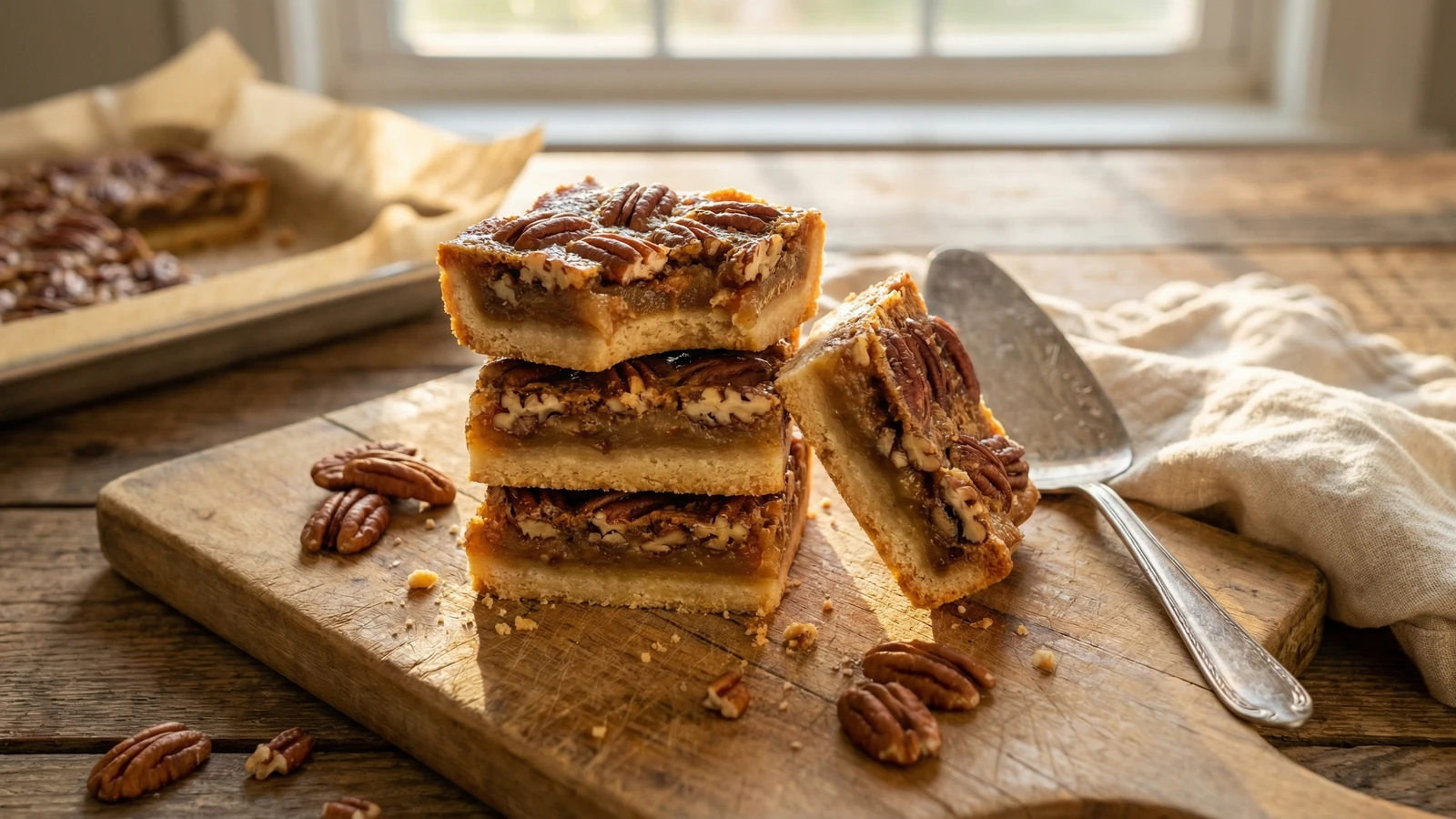
Buttery shortbread crust beneath a layer of gooey, caramelized pecans, all the magic of grandmother's pecan pie made portable for potlucks, holidays, and any occasion that calls for something sweet and Southern.
Pastries & Cookies
Southern
Potluck
Holiday
Thanksgiving
Make Ahead
25 min
Active Time
50 min cook•1 hr 15 min total
Yield24 bars
Pecan pie is Louisiana religion. My grandmother Evangeline made one every Thanksgiving, every Christmas, and for any Sunday she decided needed celebrating. The problem was always the same: one pie, too many cousins, and arguments about who got the gooey center pieces versus the edges. These bars solve that problem forever.
The secret here is the crust. You want a shortbread base that is sturdy enough to hold that rich filling but tender enough to melt in your mouth. At Lagniappe, we press it thin and bake it until just golden before the filling goes on. This gives you structure without toughness. Skip this step and you get a soggy bottom that falls apart when you try to pick it up.
Now, the filling is where the magic happens. Brown sugar, butter, a touch of corn syrup for that classic chew, and more pecans than seems reasonable. You cook it just enough to dissolve the sugar, pour it over your crust while both are still warm, and let the oven do the rest. When it comes out, that top should be glossy and caramelized, the pecans toasted and fragrant, the whole thing bubbling like it has something to tell you.
These bars are better than pie for one simple reason: every single piece has the perfect ratio of crust to filling. No more fighting over the center. That's the bayou way of keeping peace at the table.
The technique, the tradition, and the story behind every dish.
Line a 9x13 inch baking pan with parchment paper, leaving a 2-inch overhang on the long sides. These handles are essential for lifting the bars out cleanly after baking. A little softened butter under the parchment keeps it in place while you work.
2
Make the shortbread crust
Pulse the flour, powdered sugar, and salt in a food processor until combined. Add the cold cubed butter and pulse in short bursts until the mixture resembles coarse sand with some pea-sized pieces remaining. This takes about 15 to 20 pulses. You want cold butter distributed throughout, not a smooth paste.
No food processor? Use your fingers to work the cold butter into the dry ingredients, pinching and rubbing until you get that sandy texture. My grandmother did it this way her whole life.
3
Press and bake the crust
Turn the mixture into your prepared pan and press firmly into an even layer using the bottom of a measuring cup or your hands. The crust should be compact and level, pushed into the corners and up the sides about half an inch. Refrigerate for 15 minutes while you preheat the oven to 350F. Bake the chilled crust for 18 to 22 minutes until the edges turn light golden and the center looks dry and set. The crust will still feel soft when hot. That is correct.
4
Toast the pecans
While the crust bakes, spread all 3 cups of pecans on a separate baking sheet. Toast in the oven for 6 to 8 minutes, shaking the pan halfway through, until fragrant and slightly darkened. You will smell them before you see the color change. Toasting deepens the flavor considerably. Roughly chop the 2 cups designated for the filling, leaving the topping pecans as halves.
5
Build the filling
Combine the brown sugar, cane syrup, butter, and salt in a medium saucepan over medium heat. Stir constantly until the butter melts and the sugar dissolves completely. The mixture should be smooth and glossy, no grittiness when you rub a drop between your fingers. Remove from heat and let cool for 5 minutes.
Cane syrup gives you that authentic Louisiana flavor, but light corn syrup works fine. Steen's is the gold standard if you can find it.
6
Add eggs and pecans
Whisk the eggs and vanilla together in a small bowl. Slowly drizzle the egg mixture into the slightly cooled sugar mixture, whisking constantly. If the sugar mixture is too hot, you will scramble your eggs. The result should be smooth and pourable. Fold in the chopped toasted pecans.
7
Fill and top
Pour the filling over the warm crust, spreading evenly to the edges. Arrange the reserved pecan halves in neat rows across the top, pressing them gently into the filling. This is where you make it beautiful. Take your time. The pecans should cover the surface generously.
8
Bake until set
Return the pan to the oven and bake for 25 to 30 minutes. The filling should be puffed slightly at the edges, set around the perimeter, but still have a gentle wobble in the center when you shake the pan. It will firm up as it cools. Overbaking makes the filling grainy and hard. Underbaking leaves you with a runny mess.
9
Cool completely before cutting
Let the bars cool in the pan for at least 2 hours at room temperature, or refrigerate for 1 hour if you are impatient. Use the parchment handles to lift the whole slab onto a cutting board. Cut into 24 bars with a sharp knife, wiping the blade between cuts for clean edges. The bars should be firm enough to pick up but still slightly gooey in the center. That is exactly right.
Chef Tips
•Louisiana pecans are worth seeking out. They are smaller and sweeter than the Georgia varieties, with a richer flavor that shines in desserts like this. At Lagniappe, we get ours from a farmer in Natchitoches Parish.
•The filling should wobble like set gelatin when done, not slosh like liquid. Trust this test over any timer. Every oven runs different.
•For cleaner cuts, refrigerate the bars until cold, then slice with a thin sharp knife dipped in hot water and wiped dry between cuts.
•A sprinkle of flaky sea salt over the top before serving turns these from excellent to unforgettable. That sweet and salty combination is pure Louisiana.
•These bars travel beautifully, which is why they became my go-to potluck contribution. Pack them in a single layer and they will survive any journey.
Advance Preparation
•The crust can be pressed into the pan and refrigerated overnight before baking. Add 2 to 3 minutes to the initial bake time since it will be very cold.
•Baked bars keep at room temperature in an airtight container for up to 5 days. The texture actually improves after a day as the flavors meld.
•Bars freeze beautifully for up to 2 months. Wrap individual bars in plastic, then store in a freezer bag. Thaw at room temperature for 30 minutes before serving.
Frequently Asked Questions
Nutrition Information
1 bar (about 55g)
Calories
290 calories
Total Fat
20 g
Saturated Fat
8 g
Trans Fat
0 g
Unsaturated Fat
12 g
Cholesterol
50 mg
Sodium
50 mg
Total Carbohydrates
27 g
Dietary Fiber
2 g
Sugars
18 g
Protein
3 g
Where cooking meets culture.
Culinary guides, cultural storytelling, and the editorial depth that makes cooking meaningful.