Culinary Explorer

A cooking platform built around craft, culture, and the stories behind what we eat.
Discover Culinary Explorer
Pay de Nuez de Castilla Poblano

Pay de Nuez de Castilla Poblano

Created by

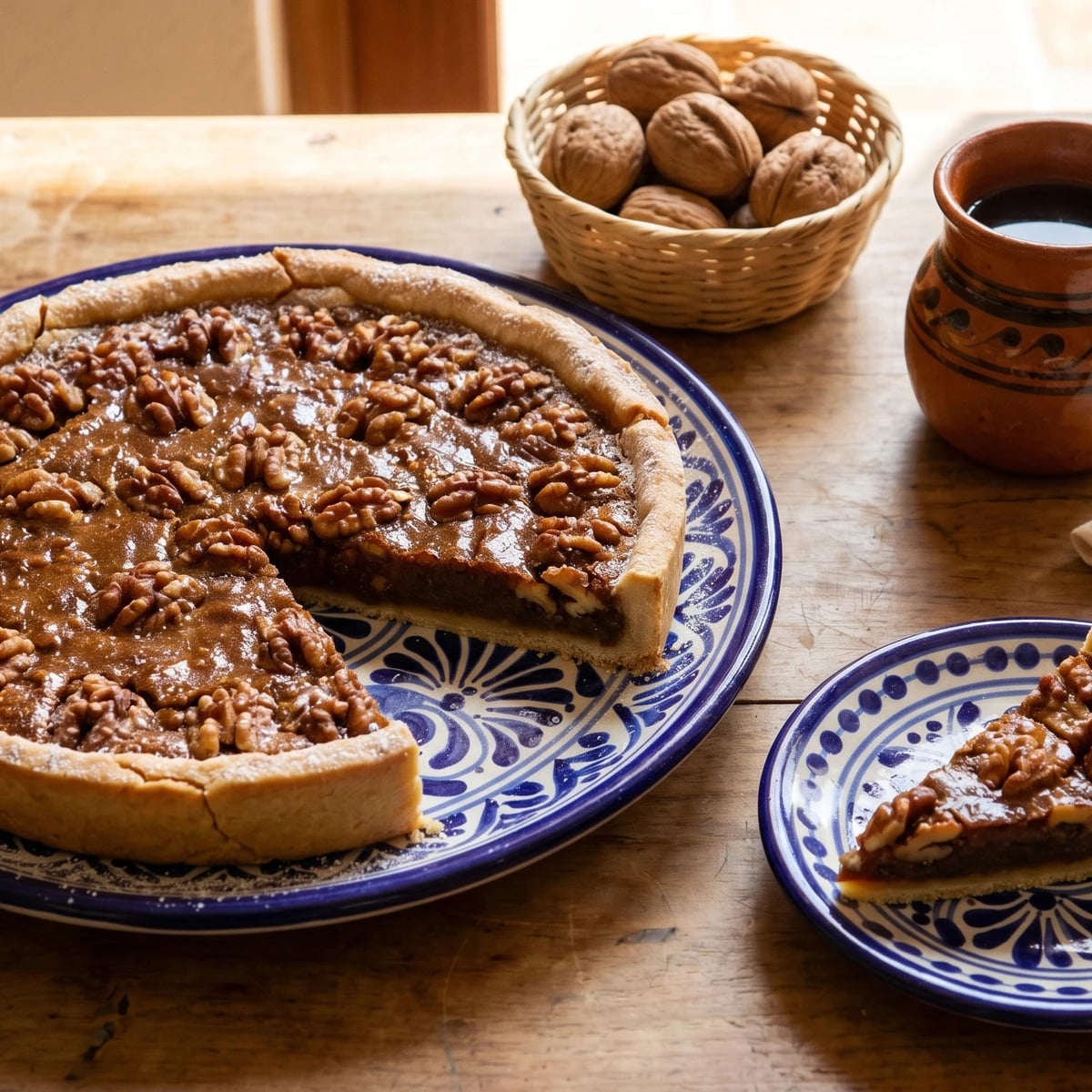
Puebla's walnut pay, made with the same nuez de Castilla that gives chiles en nogada its soul, baked into a dense, dark filling inside a tender pastry shell.

Pastries & Cookies
Mexican
Special Occasion
Holiday
Make Ahead
45 min
Active Time
55 min cook2 hr 40 min total
Yield8 servings

Puebla de los Angeles owns this pay because Puebla owns the discipline of sweets from the convent kitchen. This is not a northern pecan pie wearing another name. This is nuez de Castilla, the walnut that also appears in chiles en nogada when August and September bring the right fruit to the mercado.

The filling should be dense, glossy, and almost fudgy, with piloncillo and toasted walnut doing the work. No chile here. Not every Mexican dish needs chile, and anyone who thinks Mexican cooking is only heat has not paid attention. Puebla knows sugar, spice, nuts, eggs, wheat flour, and patience. That is its own architecture.

I first copied a version of this pay from a woman near the Mercado de Sabores in Puebla capital, and she corrected me twice before I finished writing. Toast the walnut lightly. Do not burn it. Chill the dough. Do not argue. The shell has to hold a heavy filling without turning greasy or tough. Recetas probadas y garantizadas, but only if you respect the order.

Serve it on talavera, in narrow slices, with cafe de olla if you know what you are doing. Cada estado, su propia cocina.

Walnut sweets in Puebla grew from the colonial convent kitchens of the 17th and 18th centuries, where Spanish wheat pastry techniques met New Spain's sugar economy and local market ingredients. Nuez de Castilla became especially tied to Puebla through chiles en nogada, a seasonal dish associated with the August harvest and the 1821 Independence-era mythology of Agustin de Iturbide's visit. Pay itself reflects later household adoption of European and American pie forms, but Puebla's version stays connected to the older convent tradition of egg-rich nut fillings, piloncillo, cinnamon, and carefully worked pastry.

The technique, the tradition, and the story behind every dish.

Discover Culinary Explorer

Ingredients

all-purpose flour

Quantity

1 1/2 cups, plus more for rolling

granulated sugar

Quantity

1 tablespoon

fine sea salt

Quantity

1/2 teaspoon

cold unsalted butter

Quantity

10 tablespoons

cut into small cubes

large egg yolk

Quantity

1

ice water

Quantity

3 to 4 tablespoons

nuez de Castilla

Quantity

1 3/4 cups

shelled and lightly toasted

grated piloncillo

Quantity

3/4 cup

dark brown sugar

Quantity

1/4 cup

heavy cream

Quantity

1/2 cup

unsalted butter

Quantity

4 tablespoons

cajeta or dulce de leche

Quantity

2 tablespoons

large eggs

Quantity

2

large egg yolk

Quantity

1

Mexican vanilla extract

Quantity

1 teaspoon

ground Ceylon cinnamon

Quantity

1/2 teaspoon

fine sea salt

Quantity

1/4 teaspoon

aged dark rum or brandy (optional)

Quantity

1 tablespoon

powdered sugar (optional)

Quantity

for a light dusting

Equipment Needed

  • 9-inch tart pan or shallow ceramic pay dish
  • Rolling pin
  • Baking sheet for toasting nuez de Castilla
  • Pie weights or dry beans
  • Small heavy saucepan

Instructions

  1. 1

    Make the dough

    Whisk the flour, sugar, and salt in a bowl. Rub in the cold butter with your fingertips until the mixture looks like coarse crumbs with a few pea-sized pieces left. Stir the egg yolk with 3 tablespoons ice water, then drizzle it over the flour and mix just until the dough holds when pressed. If it crumbles, add the last tablespoon of water. Do not knead it like bread. This is pastry, not bolillo.

  2. 2

    Chill and roll

    Press the dough into a flat disk, wrap it, and chill for at least 45 minutes. Roll it on a lightly floured table into a 12-inch round. Fit it into a 9-inch tart pan or shallow pay dish, pressing it into the corners without stretching. Trim the edge. Chill the shell for 20 minutes more. Cold dough gives you clean sides and a tender bite.

  3. 3

    Toast the walnuts

    Heat the oven to 350F. Spread the nuez de Castilla on a baking sheet and toast for 7 to 9 minutes, until the nuts smell warm and deep but have not darkened much. Cool them, then chop 1 cup finely and leave the remaining 3/4 cup in larger pieces for the top. Walnut burns fast. Watch it. Bitter walnut will ruin the whole pay.

    If the walnuts taste dusty or rancid before you bake, do not use them. Old nuts make old-tasting pay. Preguntale a las senoras del mercado.
  4. 4

    Blind bake shell

    Line the chilled shell with parchment and fill with pie weights or dry beans. Bake for 15 minutes. Lift out the parchment and weights, then bake 6 to 8 minutes more, until the bottom looks dry and pale gold. This protects the pastry from the heavy filling. Skip it and the center turns soft. No me vengas con atajos.

  5. 5

    Cook the syrup

    Combine the grated piloncillo, dark brown sugar, heavy cream, butter, cajeta, cinnamon, and salt in a small saucepan. Cook over medium-low heat, stirring, until the piloncillo dissolves and the mixture turns glossy, about 5 minutes. Let it cool for 10 minutes. If you pour hot syrup into eggs, you get sweet scrambled eggs. Nobody needs that lesson twice.

  6. 6

    Build the filling

    Whisk the eggs, egg yolk, vanilla, and rum or brandy if using. Slowly whisk in the cooled piloncillo mixture. Stir in the finely chopped toasted nuez de Castilla. The filling should look thick, dark, and speckled with walnut. Pour it into the warm shell, then scatter the larger walnut pieces over the surface.

  7. 7

    Bake until set

    Bake at 350F for 32 to 38 minutes, until the edges are set and the center still has a small, slow wobble when you move the pan. The top should be deep brown and shiny in patches, not dry. It will finish setting as it cools. Pull it too late and the filling turns hard. Puebla's sweets ask for attention.

  8. 8

    Cool and serve

    Cool the pay completely, at least 1 hour, before slicing. A warm slice will collapse because the filling has not settled. Dust very lightly with powdered sugar if you want, or leave it plain. Serve in narrow pieces on talavera with cafe de olla. Saber cocinar es saber vivir.

Chef Tips

  • Use nuez de Castilla when you can find it, especially in late summer around the chiles en nogada season. Regular English walnuts are the closest substitute outside Mexico, but they are a compromise, not an upgrade.
  • Piloncillo gives the filling its dark mineral sweetness. Brown sugar alone makes the pay flatter. If your piloncillo is too hard to grate, shave it with a knife or warm it briefly near the oven.
  • A tart pan gives a cleaner edge, but a shallow ceramic pay dish works too. In Puebla, the table matters. Put it on talavera if you have it.
  • Do not add chocolate chips. Do not add corn syrup. Those belong to another dessert. This pay is about walnut, piloncillo, egg, cream, and patience.

Advance Preparation

  • The pastry dough can be made two days ahead and kept refrigerated, or frozen for one month.
  • The finished pay keeps well for two days at cool room temperature, covered loosely. Refrigerate after that, but let slices come back to room temperature before serving.
  • Toast the nuez de Castilla one day ahead and store it in a sealed jar once fully cool.

Frequently Asked Questions

Nutrition Information

1 serving (about 130g)

Calories
620 calories
Total Fat
43 g
Saturated Fat
19 g
Trans Fat
1 g
Unsaturated Fat
22 g
Cholesterol
165 mg
Sodium
260 mg
Total Carbohydrates
53 g
Dietary Fiber
2 g
Sugars
32 g
Protein
9 g

Note: Chef personas and recipes are created with AI assistance. Cook with care: follow safe food-handling practices, check doneness with a thermometer when needed, and adapt for allergies and your kitchen.

Where cooking meets culture.

Culinary guides, cultural storytelling, and the editorial depth that makes cooking meaningful.

Discover Culinary Explorer

More from Central Mexican Pan Dulce & Pastries

Browse the full collection