Culinary Explorer

A cooking platform built around craft, culture, and the stories behind what we eat.
Discover Culinary Explorer
Pastel Atropellado de Camote y Coco Yucateco

Pastel Atropellado de Camote y Coco Yucateco

Created by

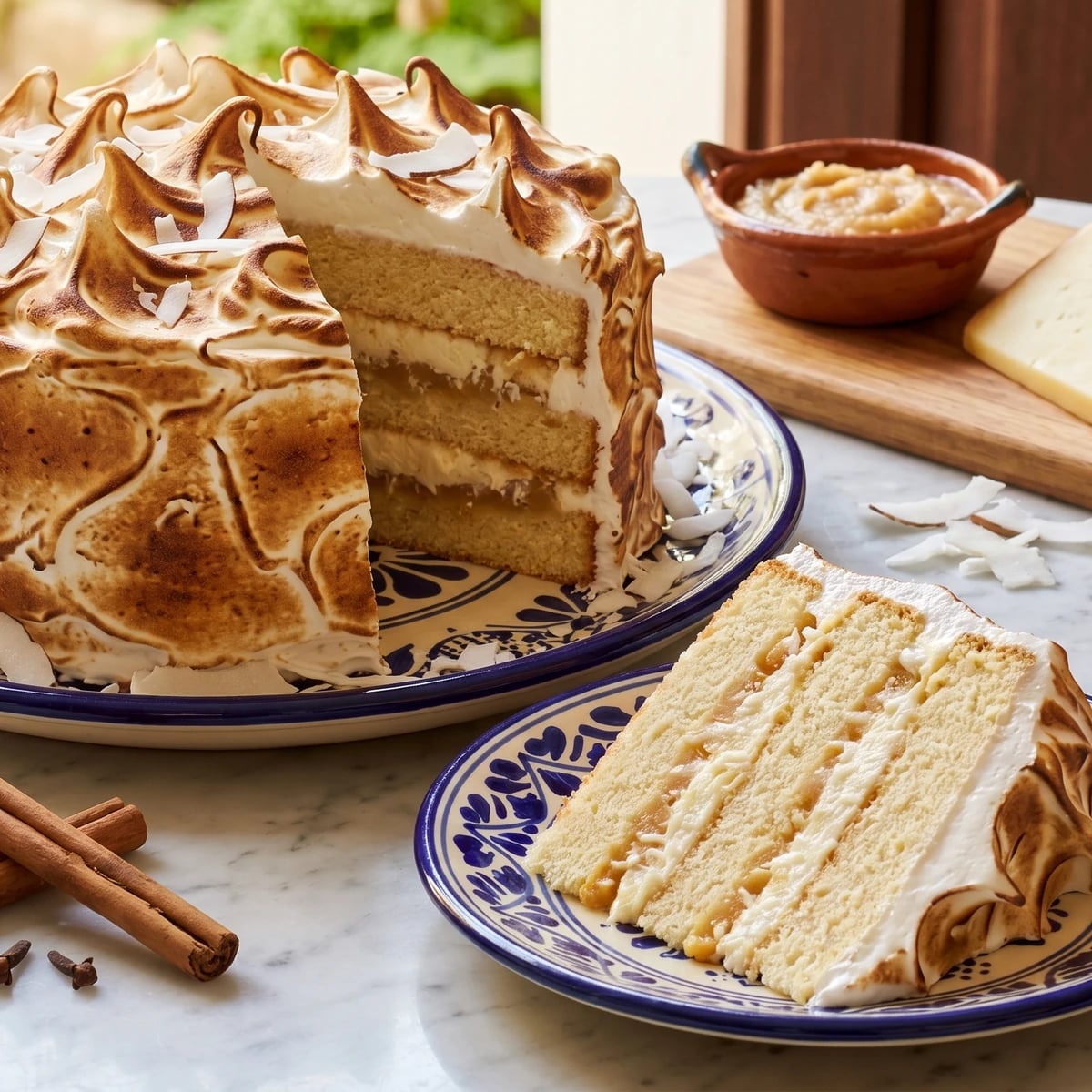
Yucatán's convent-era celebration cake: white camote and fresh coconut crushed atropellado with canela and clove, layered between sponge soaked in Jerez and crowned with a dramatic Italian meringue browned at the peaks.

Desserts
Mexican
Celebration
Special Occasion
Birthday
1 hr 30 min
Active Time
1 hr 15 min cook2 hr 45 min total
Yield12 servings

This is from Yucatán. Specifically from Mérida, from the family dulcerías and the church-bazaar tables where postres like this one have been served at quinceañeras, weddings, and saint's day celebrations for generations. It is not a cake from a Mexico City pastelería. It is not a Oaxacan postre. It belongs to the peninsula, to the cooks who built a sugar tradition on white camote, fresh coconut, and the Spanish-inherited art of the merengue italiano.

The filling is what makes it. White camote, not the orange sweet potato most people know, boiled whole, peeled, then mashed directly into a hot syrup with finely grated fresh coconut, canela, and clove. The word atropellado means run over, crushed together, and that is exactly what you do: you crush the camote and the coconut into one body until they cannot be separated. The result is dense, perfumed, almost candy-like. Bagged coconut will not do this. Orange-fleshed sweet potato will not do this. Cada estado, su propia cocina, and Yucatán has its own ingredients.

The sponge gets soaked in Jerez seco, dry Spanish sherry, the same Jerez that arrived with the Spanish ships and stayed in the Yucatecan pantry alongside the alcaparrado and the queso de bola. The Italian meringue on top is not decoration. It is structural. Pulled into dramatic peaks and browned with a torch, it holds the cake together for two days and gives it the silhouette that Yucatecan dulceras have been pulling out of their kitchens for over a century.

My mother never made this cake. She was from Jalisco and her dessert tradition was rice pudding and capirotada. I learned this one in Mérida from a señora named doña Esther who ran a postre stall at the Mercado Lucas de Gálvez. She let me write down the recipe on the back of a napkin and told me, in Spanish that was half Maya, that if I served it without enough Jerez I should not bother making it at all. Saber cocinar es saber vivir.

Pastel atropellado belongs to the convent dessert tradition that flourished in colonial Yucatán, where Spanish nuns and criolla cooks adapted Iberian techniques like merengue and almíbar to the peninsula's native ingredients: camote, coconut, and the abundant sugar from the henequen-era haciendas. The white-fleshed camote (Ipomoea batatas), domesticated in Mesoamerica thousands of years before contact, was the preferred dulce-making variety in Yucatán long before the orange-fleshed cultivars gained commercial dominance elsewhere. The use of Jerez to soak sponges, rather than rum or local aguardiente, is a marker of the Spanish maritime trade route that connected Andalucía to Veracruz and then overland to Mérida, and it distinguishes Yucatecan postres from those of central and southern Mexico.

The technique, the tradition, and the story behind every dish.

Discover Culinary Explorer

Ingredients

white camote (white-fleshed sweet potato)

Quantity

2 pounds

scrubbed

mature fresh coconut

Quantity

1

cracked, meat pried out and brown skin pared off

granulated sugar (for the filling)

Quantity

2 cups

water (for the filling)

Quantity

1 cup

Mexican canela (Ceylon cinnamon)

Quantity

2 sticks

whole cloves

Quantity

3

lime zest

Quantity

1 strip

pared with a knife

fine sea salt

Quantity

1/4 teaspoon

large eggs

Quantity

6

at room temperature, separated

granulated sugar (for the sponge)

Quantity

1 cup

all-purpose flour

Quantity

1 cup

sifted twice

vanilla extract

Quantity

1 teaspoon

salt for the sponge

Quantity

pinch

dry sherry or Jerez seco

Quantity

1/2 cup

for soaking the sponge

simple syrup

Quantity

1/4 cup

equal parts sugar and water, cooled

large egg whites (for the Italian meringue)

Quantity

5

at room temperature

granulated sugar (for the Italian meringue)

Quantity

1 1/2 cups

water (for the Italian meringue)

Quantity

1/2 cup

cream of tartar

Quantity

1/4 teaspoon

vanilla extract (for the meringue)

Quantity

1/2 teaspoon

fresh coconut shavings (optional)

Quantity

for finishing

Mexican canela sticks (optional)

Quantity

for the platter

Equipment Needed

  • 9-inch round springform pan
  • Stand mixer with whisk attachment
  • Candy thermometer
  • Heavy small saucepan for the sugar syrup
  • Wide heavy cazuela or saucepan for the atropellado
  • Box grater for the coconut
  • Long serrated knife for slicing the sponge
  • Offset spatula
  • Kitchen torch (or broiler) for browning the meringue

Instructions

  1. 1

    Boil the camote

    Place the whole white camotes in a large pot and cover with cold water by two inches. Bring to a simmer and cook, partially covered, for 35 to 45 minutes, until a knife slides through the thickest one with no resistance. Drain and let them sit until cool enough to handle. Peel off the skin with your fingers. The flesh should be pale, almost ivory. If you used orange-fleshed sweet potato, this is not the same dish. The white camote of Yucatán gives the postre its color and its mild, almost floral sweetness.

    Boil the camote whole, with the skin on. Cut it into chunks first and you will leach the flavor and the color into the water.
  2. 2

    Prepare the coconut

    Crack the coconut by tapping firmly around its equator with the back of a heavy knife or hammer. Catch the water in a bowl and save it. Pry the meat out of the shell with a sturdy paring knife. Pare off the brown inner skin so only the white flesh remains. Grate the coconut on the small holes of a box grater. You should have about 2 1/2 cups of finely grated coconut. Bagged dried coconut is not a substitute. The fresh coconut gives the filling its moisture and its perfume. No me vengas con atajos.

  3. 3

    Build the atropellado

    In a heavy cazuela or wide saucepan, combine the 2 cups of sugar, 1 cup of water, the canela sticks, cloves, lime zest, and salt. Bring to a gentle boil over medium heat. Cook for 5 minutes until the syrup thickens slightly. Add the peeled camote and mash it directly into the syrup with a wooden spoon or potato masher. Add the grated coconut. Lower the heat and cook, stirring constantly with a wooden spoon, for 20 to 25 minutes. The mixture will thicken, pull away from the sides of the pan, and turn glossy. This is the atropellado: the camote and coco crushed together, cooked into one body. When the spoon leaves a clean track across the bottom of the pan, it is ready. Fish out the canela, cloves, and lime zest. Let it cool completely.

    Stir without stopping in the last ten minutes. Sugar at this concentration will scorch the moment you turn your back, and a burned atropellado is a ruined cake.
  4. 4

    Bake the sponge

    Heat the oven to 350F. Line the bottom of a 9-inch round springform pan with parchment. Do not grease the sides. Whip the 6 egg yolks with 1/2 cup of the sugar and the vanilla on high speed for 4 to 5 minutes, until pale and thick enough to ribbon off the whisk. In a separate clean bowl, whip the 6 egg whites with the pinch of salt to soft peaks, then rain in the remaining 1/2 cup of sugar and whip to firm, glossy peaks. Fold one third of the whites into the yolks to lighten, then fold in the rest in two additions. Sift the flour over the top in three additions, folding gently with a spatula until no streaks remain. Pour into the pan and bake for 25 to 30 minutes, until the top springs back when pressed and the cake has pulled away from the sides. Cool completely in the pan.

  5. 5

    Slice and soak the sponge

    Run a knife around the edge of the cooled sponge and release it from the pan. Slice the sponge horizontally into three even layers with a long serrated knife. Combine the dry sherry and the simple syrup in a small bowl. Brush each layer generously on both sides with the sherry syrup. The sponge should be moist but not soaked through. In Mérida this is called el almíbar, and a dry sponge here means a dry cake forever. Be generous.

  6. 6

    Assemble the layers

    Place the bottom sponge layer on a flat serving platter. Spread half of the cooled camote and coco atropellado over it in an even layer about 3/4 inch thick. Top with the middle sponge layer, press down gently, and spread the remaining atropellado over it. Set the top sponge layer over the filling and press the whole stack down with your palms so the layers settle and bond. Refrigerate for at least 30 minutes while you make the meringue. A cold cake holds its shape under the meringue.

  7. 7

    Make the Italian meringue

    Combine the 1 1/2 cups of sugar and 1/2 cup of water in a small heavy saucepan. Stir once to wet the sugar, then leave it alone. Bring to a boil over medium-high heat and cook, without stirring, until the syrup reaches 240F on a candy thermometer (soft-ball stage). While the syrup heats, begin whipping the 5 egg whites with the cream of tartar on medium speed until soft peaks form. The timing has to match: the syrup should hit 240F just as the whites reach soft peaks. With the mixer running on medium, pour the hot syrup down the side of the bowl in a thin, steady stream. Avoid the whisk itself or the syrup will spin into threads against the sides. Once all the syrup is in, raise the speed to high and whip for 6 to 8 minutes, until the bowl is no longer warm to the touch and the meringue is thick, glossy, and holds stiff peaks. Beat in the vanilla.

    Italian meringue is the right meringue for this cake. Swiss meringue weeps. American buttercream is wrong for the tradition. Yucatecan postres of this family always use merengue italiano because it holds for two days without breaking.
  8. 8

    Cover the cake

    Pile the meringue generously on top of the chilled cake. Using an offset spatula, spread it across the top and down the sides in a thick, even coat. Then go back and pull the spatula up off the surface in quick motions to create peaks and swoops across the entire cake. This is how the dulcerias of Mérida finish their postres: dramatic peaks, not a smooth fondant finish. The texture is part of the dish.

  9. 9

    Brown the meringue and rest

    Pass a kitchen torch lightly over the peaks until they take on a deep golden color, almost mahogany at the tips. Alternatively, place the cake under a hot broiler for 60 to 90 seconds, watching every second. Scatter fresh coconut shavings over the top. Refrigerate for at least 2 hours before slicing, ideally overnight. The cake needs time for the almíbar, the atropellado, and the meringue to settle into each other. Cut with a long serrated knife dipped in hot water and wiped clean between slices. Recetas probadas y garantizadas.

Chef Tips

  • White camote is non-negotiable. Look for it at Latin markets labeled camote blanco or boniato. The orange sweet potato in American supermarkets is a different species in flavor and color, and it will give you an orange cake that tastes like Thanksgiving, not like Mérida.
  • Fresh coconut is the second non-negotiable. Crack a whole coconut. Pare the brown skin. Grate the white meat. Bagged sweetened coconut will throw off the sugar balance and the texture will be stringy and wrong. The atropellado depends on the moisture and the fat of the fresh meat.
  • Use Jerez seco, dry sherry, not sweet sherry, not rum, not brandy. The Yucatecan pantry has a long relationship with Andalusian sherry and the dish was built around it. If you cannot find Jerez, a dry oloroso will do. Sweet cream sherry is wrong.
  • The Italian meringue takes practice. The candy thermometer is not optional. Syrup poured too cold will deflate the whites. Syrup poured too hot will cook them into curds. Buy a thermometer if you do not own one. La cocina no es decoración, es trabajo.

Advance Preparation

  • The camote and coco atropellado can be made up to 3 days ahead and refrigerated in a sealed container. Bring it to room temperature before spreading on the sponge.
  • The sponge can be baked one day ahead, wrapped well in plastic, and held at room temperature. Slice and soak on assembly day.
  • The fully assembled cake, once finished with meringue, holds in the refrigerator for up to 2 days. The Italian meringue does not weep, which is the whole reason Yucatecan dulceras chose it for this cake.
  • Do not freeze. The atropellado weeps when thawed and the meringue collapses.

Frequently Asked Questions

Nutrition Information

1 serving (about 240g)

Calories
585 calories
Total Fat
14 g
Saturated Fat
12 g
Trans Fat
0 g
Unsaturated Fat
2 g
Cholesterol
95 mg
Sodium
115 mg
Total Carbohydrates
106 g
Dietary Fiber
6 g
Sugars
83 g
Protein
8 g

Note: Chef personas and recipes are created with AI assistance. Cook with care: follow safe food-handling practices, check doneness with a thermometer when needed, and adapt for allergies and your kitchen.

Where cooking meets culture.

Culinary guides, cultural storytelling, and the editorial depth that makes cooking meaningful.

Discover Culinary Explorer

More from Yucatecan Desserts

Browse the full collection