Culinary Explorer

A cooking platform built around craft, culture, and the stories behind what we eat.
Discover Culinary Explorer
Papas al Chiltomate

Papas al Chiltomate

Created by

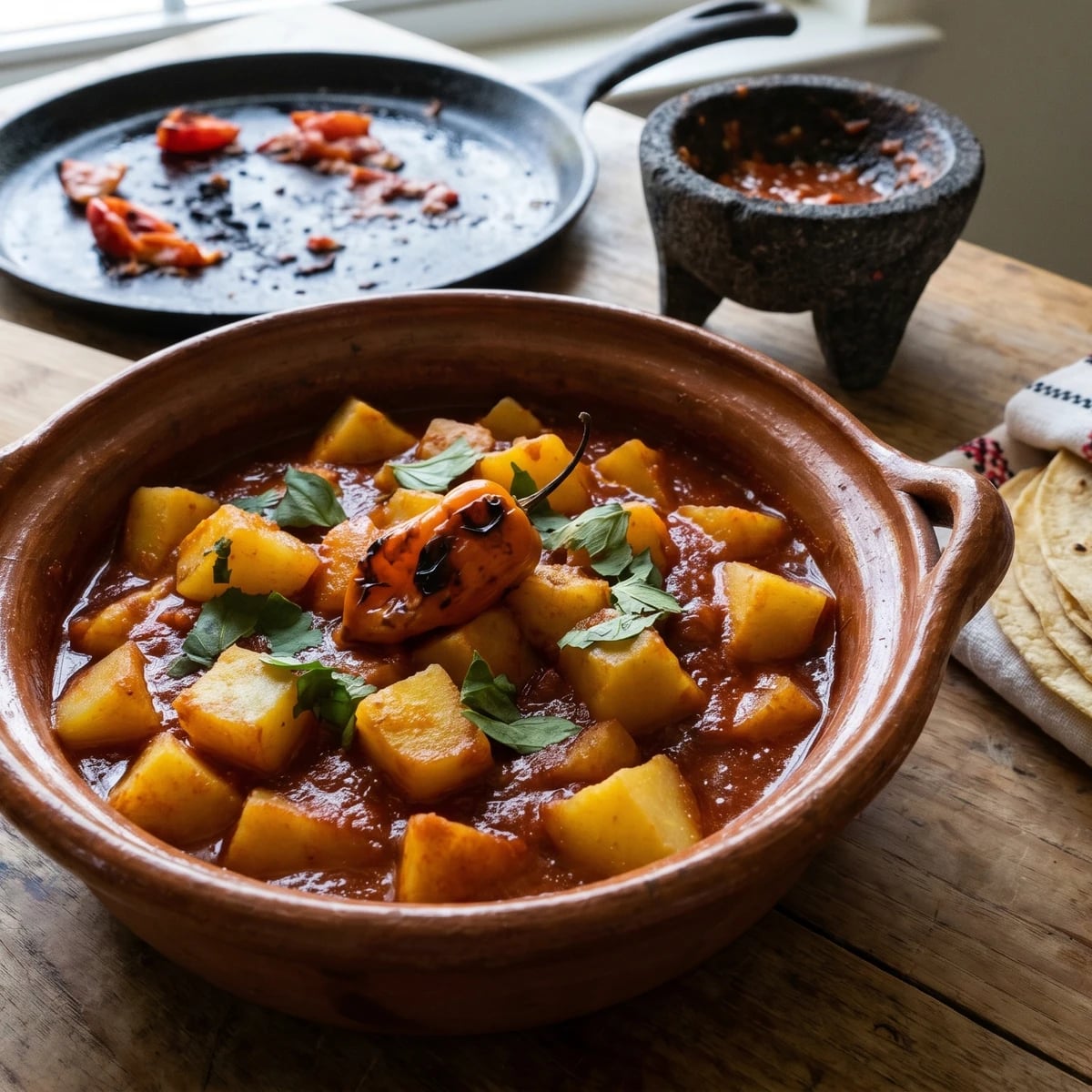
Yucatan's everyday side of soft potatoes simmered in chiltomate, the charred tomato-habanero salsa that anchors the Maya kitchen, perfumed with epazote and finished in a clay cazuela.

Side Dishes
Mexican
Weeknight
Comfort Food
15 min
Active Time
35 min cook50 min total
Yield6 servings

This is a Yucatan dish. Not a Mexican dish in the broad sense, a Yucatan dish in the specific sense, born in the Maya kitchens of the peninsula where chiltomate is the base sauce the way sofrito is in the Caribbean. Chiltomate is tomato charred on the comal until the skin blackens, ground with charred habanero and garlic, then fried in lard until it darkens. That sauce is the foundation. Potatoes are just one of many things that fall into it.

The habanero is non-negotiable. Not jalapeno, not serrano. Habanero, the chile that grows on the peninsula and carries that floral, almost fruity perfume that nothing else in the Mexican chile family can give you. You cook it whole and unpunctured so its presence is felt without overpowering the dish. The Yucatecos understand habanero better than anyone. They use it with restraint, the way Italians use truffle, not the way internet recipes use it.

Epazote is the other anchor. It is not parsley, it is not cilantro, it is epazote, and the Yucatan kitchen will not let you substitute it. If you cannot find fresh, find dried at a Mexican grocery and use half the amount. If you cannot find dried, cook a different dish. La cocina no es decoracion, es trabajo.

I watched a senora in the mercado of Valladolid make a pot of papas al chiltomate over a comal that had not been cleaned in twenty years. She charred her tomatoes black on one side, ground them in a stone molcajete with a habanero from her own backyard, fried the salsa in lard until it smelled like the whole peninsula, and dropped the potatoes in. No timer, no measuring cup. She knew. Cada estado, su propia cocina, and this one belongs to the Yucatan.

Chiltomate, from the Maya 'chil' (chile) and the Nahuatl-derived 'tomate,' is one of the oldest continuously prepared sauces in Mexican cuisine, with charred-tomato-and-chile preparations documented in pre-Columbian Maya cooking long before Spanish contact. The potato in this dish is a post-conquest addition; while the potato is native to the Andes, it traveled north through colonial trade routes and was absorbed into Yucatecan home cooking by the 18th century as an everyday starch alongside indigenous tubers like jicama and yuca. The habanero (Capsicum chinense) is so identified with the peninsula that Mexico granted it Denominacion de Origen status in 2010, protecting the 'Chile Habanero de la Peninsula de Yucatan' as a regional product, the way France protects Champagne.

The technique, the tradition, and the story behind every dish.

Discover Culinary Explorer

Ingredients

waxy yellow potatoes

Quantity

2 pounds

peeled and cut into 1-inch cubes

ripe Roma tomatoes

Quantity

1.5 pounds

chile habanero

Quantity

1

whole and unpunctured

white onion

Quantity

1 medium

half left whole, half finely diced

garlic cloves

Quantity

3

unpeeled

manteca de cerdo (pork lard)

Quantity

3 tablespoons

fresh epazote

Quantity

2 large sprigs

kosher salt

Quantity

1.5 teaspoons, plus more to taste

dried Mexican oregano (preferably oregano yucateco)

Quantity

1/2 teaspoon

water or unsalted chicken broth

Quantity

1 cup

lime halves (optional)

Quantity

for serving

warm hand-pressed corn tortillas (optional)

Quantity

for serving

Equipment Needed

  • Cast iron comal or heavy skillet for charring
  • Volcanic stone molcajete or blender
  • Wide 10 to 12-inch clay cazuela or heavy skillet with lid
  • Wooden spoon

Instructions

  1. 1

    Char the tomatoes and aromatics

    Heat a dry comal or heavy cast iron skillet over medium-high until it smokes lightly. Lay the whole tomatoes, the habanero, the unpeeled garlic, and the half white onion directly on the surface. Do not add oil. Turn each piece as the skin blisters and blackens in patches. The tomatoes take about 10 minutes, the garlic about 6, the habanero about 4. You are not roasting them gently. You are charring them. The black spots are flavor. This is the whole foundation of chiltomate.

    Do not puncture the habanero before or during charring. The skin needs to stay intact so you control how much heat enters the salsa. A single habanero, whole, gives perfume and a serious back-of-the-throat heat without burning the dish.
  2. 2

    Build the chiltomate

    Pull the charred ingredients off the comal as they finish. Peel the garlic. Leave the blackened tomato skin on. That is where the flavor lives. Transfer the tomatoes, garlic, and charred onion half to a molcajete or blender. The habanero goes in whole, still uncut. Pulse the blender or grind in the molcajete until you have a coarse, rustic salsa, not a smooth puree. Chiltomate has texture. Strained chiltomate is a different sauce.

  3. 3

    Bloom the lard and onion

    Melt the lard in a wide clay cazuela or heavy skillet over medium heat. La manteca es el sabor, especially in the Yucatan, where lard carries the dish from the comal to the table. Add the diced raw white onion and cook for 4 to 5 minutes until soft and translucent but not browned. You want the onion sweet, not caramelized.

  4. 4

    Fry the chiltomate

    Pour the chiltomate into the cazuela with the onion. It will sputter. Raise the heat to medium-high and cook for 6 to 8 minutes, stirring often, until the salsa darkens to a deep brick red and the fat starts to separate at the edges. This step is not optional. Raw chiltomate tastes thin. Fried chiltomate tastes like the Yucatan.

  5. 5

    Simmer the potatoes

    Add the cubed potatoes to the cazuela and turn them to coat in the chiltomate. Pour in the water or broth. Add the oregano, the salt, and tuck the epazote sprigs down into the sauce. The whole habanero from the salsa should be sitting somewhere in the pot, still intact. Bring to a gentle simmer, cover partially, and cook for 20 to 25 minutes, stirring carefully every few minutes so the potatoes do not break apart. The potatoes are ready when a knife slides through with no resistance and the sauce has thickened around them.

  6. 6

    Finish and serve

    Taste for salt. The sauce should be tomato-forward with the habanero perfume sitting at the back. If you want more heat, press the whole habanero against the side of the cazuela with a wooden spoon to release a little of its juice. Press lightly. A habanero respects nothing. Pull out the spent epazote stems but leave the leaves that have fallen apart. Serve directly from the cazuela with warm corn tortillas and lime halves. Así se hace y punto.

Chef Tips

  • Buy your habaneros from a Mexican grocer if you can. Peninsula habaneros are floral and bright. Imported habaneros sold in chain supermarkets are often picked underripe and taste flat and harsh. The chile matters.
  • Yellow waxy potatoes hold their shape in the simmer. Russets fall apart and turn the dish into a puree. If you can find papa cambray, the small Mexican waxy potato, use that and leave them whole. Cut larger papas into even cubes so they cook at the same rate.
  • If fresh epazote is not in your market, dried epazote works at half the volume. Do not substitute cilantro or oregano alone. Epazote has a resinous, slightly medicinal quality that nothing else in the herb world replicates, and chiltomate without it is a different dish.

Advance Preparation

  • The chiltomate base can be made one day ahead through the frying step and refrigerated. Reheat with the broth before adding the potatoes.
  • Leftover papas al chiltomate keep refrigerated for three days and reheat well in a covered skillet with a splash of water. The flavor deepens overnight as the potatoes absorb more of the chiltomate.

Frequently Asked Questions

Nutrition Information

1 serving (about 300g)

Calories
210 calories
Total Fat
7 g
Saturated Fat
3 g
Trans Fat
0 g
Unsaturated Fat
4 g
Cholesterol
6 mg
Sodium
385 mg
Total Carbohydrates
33 g
Dietary Fiber
5 g
Sugars
5 g
Protein
4 g

Note: Chef personas and recipes are created with AI assistance. Cook with care: follow safe food-handling practices, check doneness with a thermometer when needed, and adapt for allergies and your kitchen.

Where cooking meets culture.

Culinary guides, cultural storytelling, and the editorial depth that makes cooking meaningful.

Discover Culinary Explorer

More from Yucatecan Side Dishes

Browse the full collection