Chef Jeong-sun
Baechu-jeon (배추전, Napa Cabbage Pancake)
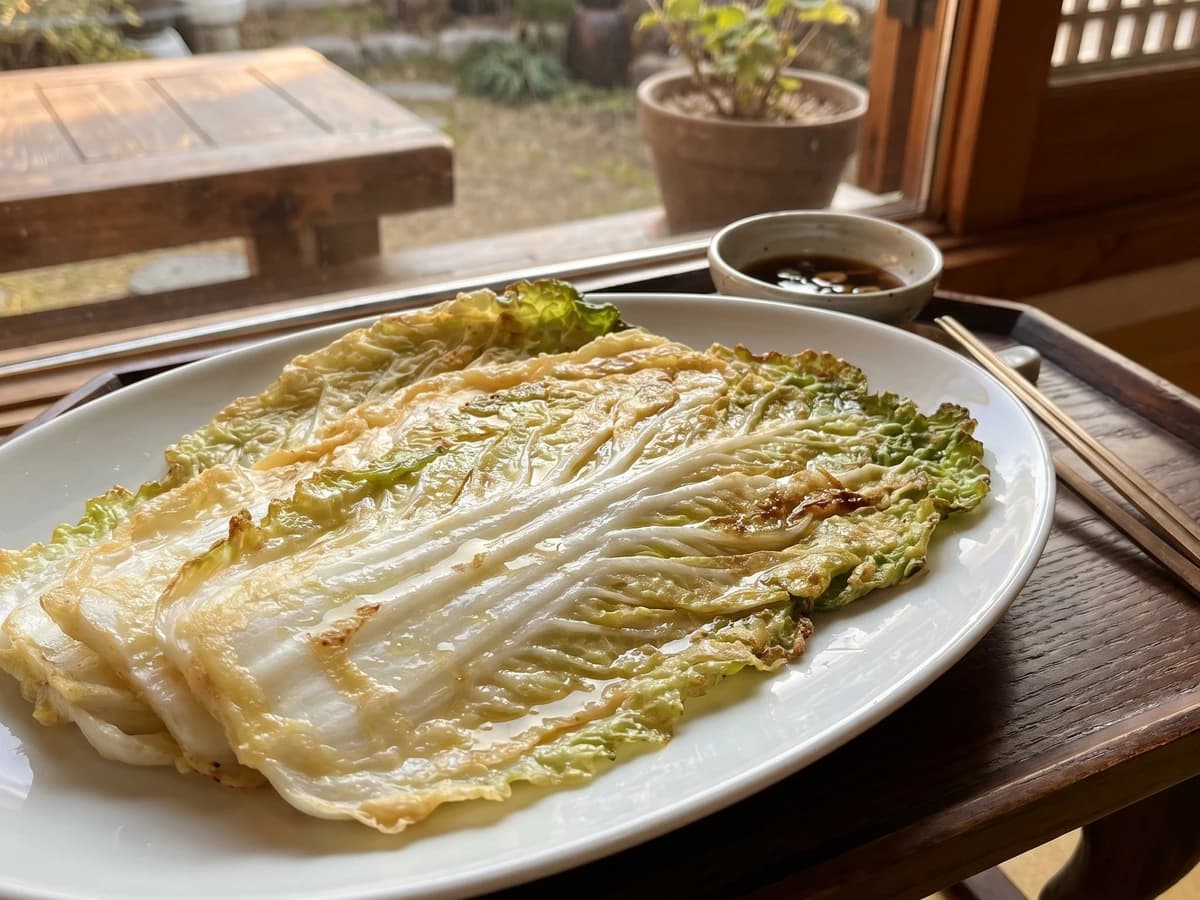
A Gyeongsang home pancake made from one whole napa cabbage leaf at a time, flattened at the rib, brushed in thin salted batter, and fried until sweet, tender, and quietly crisp at the edges.
A cooking platform built around craft, culture, and the stories behind what we eat.

Created by
Whole scallions laid in a hot pan, barely tied with cold batter and fried until the edges crisp; a plain Korean pancake that tastes of scallion, not flour.
Pajeon is not a flour pancake with scallions hiding inside it. It is scallions held together by just enough batter to make them one piece. That is the correction to write at the top of the page, because once the batter becomes the main thing, the dish has already wandered off.
My teacher made us lay the scallions in one direction, white ends alternating with green tops, so every bite had both sweetness and green sharpness. She used less batter than the students wanted. We complained with our faces, not our mouths. Then the edges turned crisp and the scallions softened without disappearing, and the lesson became plain: the pan is cooking the vegetable, not decorating the flour.
Tonight this dish asks for a hot pan, cold batter, and patience before you flip. Split the fat white ends so they cook at the same pace as the leaves. Pour the batter thinly, press once, then leave it alone until the underside is strong enough to turn. 손맛 is real; I measure it anyway. Here, that means 200 grams of scallions to less than one cup of flour, so the scallion still reads as itself.
Jeon, Korea's broad family of pan-fried battered foods, appears across home tables, markets, taverns, and holiday meals, with pajeon especially tied to spring scallions and rainy-day drinking tables. Dongnae pajeon from Busan is the best-known regional version, a thicker pancake associated with the old Dongnae area and often made with seafood, beef, and a loose batter poured over arranged scallions. The plainer home version keeps the same principle but strips it down: scallions first, batter second.
Quantity
200g
trimmed, thick white ends split lengthwise
Quantity
3/4 cup
Quantity
2 tablespoons
Quantity
1/2 teaspoon
Quantity
1/4 teaspoon
Quantity
3/4 cup
Quantity
1
lightly beaten
Quantity
4 to 5 tablespoons
divided
Quantity
1 tablespoon
for dipping sauce
Quantity
1 tablespoon
for dipping sauce
Quantity
1 teaspoon
for dipping sauce
Quantity
1/2 teaspoon
Quantity
1/2 teaspoon
Quantity
1
finely sliced, for dipping sauce
| Ingredient | Quantity |
|---|---|
| Korean scallions or thin green onionstrimmed, thick white ends split lengthwise | 200g |
| all-purpose flour | 3/4 cup |
| rice flour or potato starch | 2 tablespoons |
| fine sea salt | 1/2 teaspoon |
| sugar | 1/4 teaspoon |
| ice-cold water | 3/4 cup |
| large egglightly beaten | 1 |
| neutral oildivided | 4 to 5 tablespoons |
| soy saucefor dipping sauce | 1 tablespoon |
| rice vinegarfor dipping sauce | 1 tablespoon |
| waterfor dipping sauce | 1 teaspoon |
| gochugaru (Korean chili flakes) (optional) | 1/2 teaspoon |
| toasted sesame seeds | 1/2 teaspoon |
| small scallionfinely sliced, for dipping sauce | 1 |
Trim the roots and any tired green tips. If the white ends are thicker than a pencil, split them lengthwise so they soften before the green tops scorch. Cut very long scallions in half crosswise only if your skillet is small; whole lengths give pajeon its proper shape.
Whisk the flour, rice flour or potato starch, salt, and sugar in a bowl. Stir in the ice-cold water, then the beaten egg, just until no dry flour remains. Do not beat it smooth for sport. A few small lumps are better than a tough pancake, because overworked flour gives chew where you want crispness.
Set a 10-inch nonstick or well-seasoned skillet over medium-high heat and add 2 tablespoons oil. The oil should shimmer and move easily across the pan before the scallions go in. If the pan is timid, the pancake drinks oil and turns heavy.
Lay half the scallions in the pan in a tight single layer, alternating white ends and green tops so the pancake cooks evenly. Pour about 1/2 cup batter over them, using a spoon to nudge it into gaps. Leave some scallion exposed. This is not a blanket; it is mortar.
Cook 4 to 5 minutes, pressing lightly once with a spatula after the first minute. Do not keep fussing with it. The bottom should be deep golden in patches, the edges crisp and lacy, and the top mostly set with a few wet streaks before you turn it.
Slide a wide spatula under the pancake and flip it in one confident motion. Drizzle 1 tablespoon oil around the edge, then cook 3 to 4 minutes more, pressing once or twice so the scallions meet the pan. The second side should brown, and the pancake should feel firm enough to lift without sagging.
Move the first pancake to a rack or paper-lined plate and repeat with the remaining scallions, batter, and oil. Stir together the soy sauce, vinegar, water, gochugaru if using, sesame seeds, and sliced scallion. Cut the pajeon into rough squares and serve it right away, while the edges still answer your teeth.
1 serving (about 145g)
Culinary guides, cultural storytelling, and the editorial depth that makes cooking meaningful.
Discover Culinary ExplorerChef Jeong-sun
A Gyeongsang home pancake made from one whole napa cabbage leaf at a time, flattened at the rib, brushed in thin salted batter, and fried until sweet, tender, and quietly crisp at the edges.

Chef Jeong-sun
A holiday jeon of fresh shiitake or oyster mushrooms, salted lightly, dusted thinly, and carried through egg in a quiet pan until the mushroom stays earthy and the coating stays tender.

Chef Jeong-sun
Soaked mung beans ground coarse, folded with pork, bracken, sprouts, and kimchi, then fried thick until the edges crisp and the center stays tender enough for a shared table.

Chef Jeong-sun
A summer garlic chive pancake fried thin, crisp at the edges and chewy in the center, with just enough batter to hold the green pile together and a sharp soy-vinegar dip.