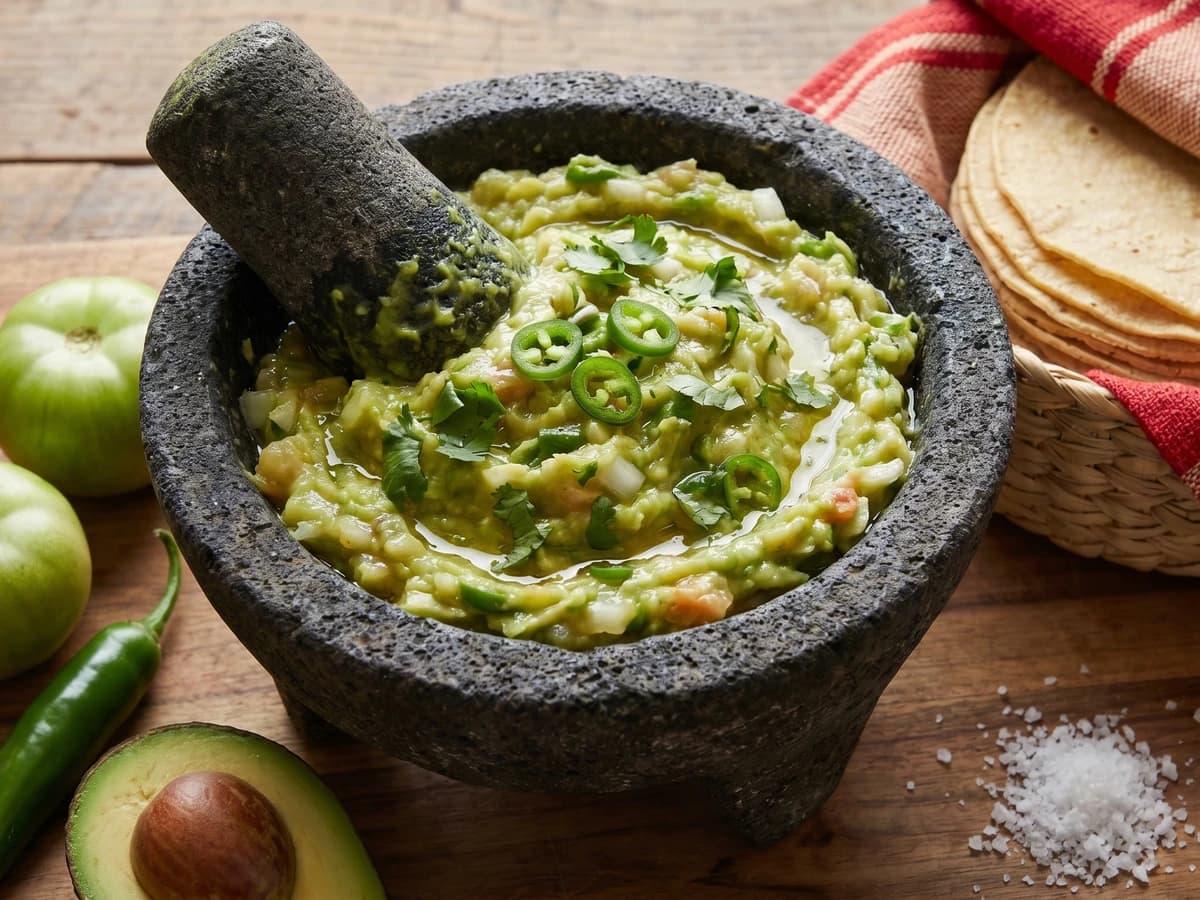
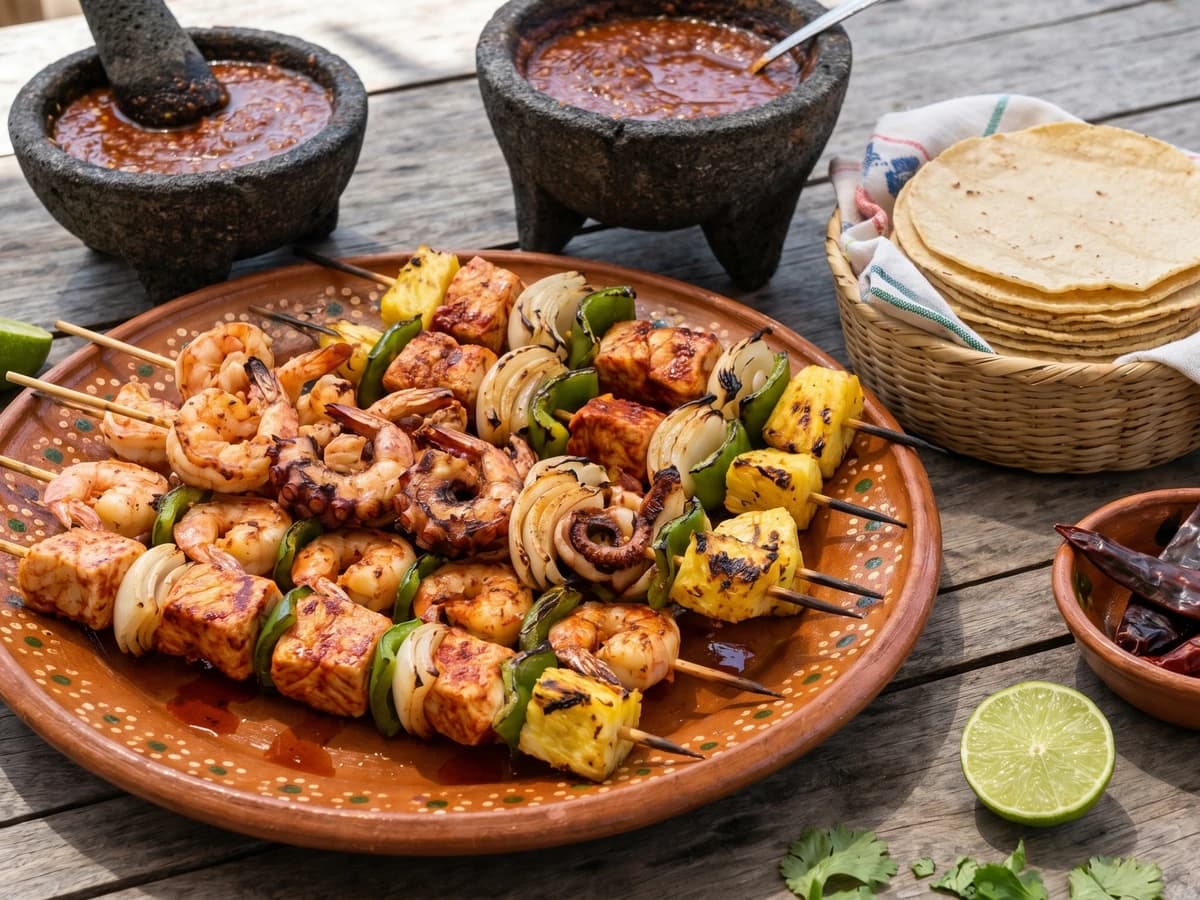
Baja California's grilled oysters from the Ensenada coast, draped in a fierce adobo of guajillo, chile de arbol, and chipotle morita, topped with melted Chihuahua cheese and pulled hot off the grate.
Appetizers & Snacks
Mexican
Dinner Party
Special Occasion
Date Night
30 min
Active Time
15 min cook•45 min total
Yield4 servings (24 oysters)
This is from Baja California. Specifically from Ensenada, the port town two hours south of Tijuana where the Pacific oysters come out of Bahia de San Quintin and the mercado negro sells them by the dozen, shucked while you wait. Ostiones a la diabla is what the marisquerias serve when an oyster on the half shell with lime is not enough. The diabla is the chile, hot, smoky, and direct, and it lives on top of the oyster, not next to it.
The adobo is built on three chiles: guajillo for the body and the deep red color, chile de arbol for the heat, and chipotle morita for the smoke. Charred tomato and onion ground in. Vinegar to keep it bright. Lard to fry the puree until the fat separates and the salsa darkens. That last step is what makes it adobo and not raw chile sauce. La manteca es el sabor. No me vengas con atajos.
The Pacific oyster matters here. Ensenada's bays are some of the best oyster waters on the continent and the local cooks know it. Use the freshest you can find, kept cold, shucked at the last minute. Cheese on a seafood dish is unusual in most of Mexico, but Baja is the north and queso Chihuahua belongs there the way Oaxacan string cheese belongs in tlayudas. Cada estado, su propia cocina. The melted cheese, the bubbling diabla, the briny oyster underneath, eaten with a saltine and a lime and a cold beer at a plastic table. That is Ensenada on a plate.
Pacific oyster cultivation in Baja California traces to the early 20th century, but the species most farmed today, Crassostrea gigas, was introduced commercially to the protected estuaries of Bahia de San Quintin and Bahia Falsa in the 1970s, transforming the region into Mexico's principal oyster producer. The marisqueria culture of Ensenada and the Mercado Negro de Mariscos developed as a working-class extension of the fishing fleet, with cooks adapting interior Mexican adobo techniques to the seafood at hand and folding in the northern dairy tradition that brought queso Chihuahua and queso menonita south from the Mennonite communities of Cuauhtemoc. The 'a la diabla' designation, common across Mexican coastal cooking, traditionally indicates a chile-forward preparation built on dried guajillo and arbol, distinguishing it from the milder garlic-and-butter mojo de ajo style.
The technique, the tradition, and the story behind every dish.
•Cast iron comal or heavy skillet for charring and toasting
•Sturdy oyster knife and a folded kitchen towel
•High-powered blender
•Heavy 10-inch skillet for frying the adobo
•Long tongs and a heavy oven mitt
•Sheet pan for dressing the oysters
Instructions
1
Prepare the grill
Build a hot charcoal fire or heat a gas grill to high. The shells need to sit directly on the grate, so the heat must be aggressive. Mesquite charcoal is what they use in Baja and the smoke is part of the flavor. If you only have gas, that is fine, but get the grill as hot as it will go before the oysters touch it.
2
Char the salsa base
Heat a dry comal or heavy skillet over medium-high. Lay the tomatoes, the onion half, and the unpeeled garlic directly on the comal. Turn them as the skin blackens in patches. The tomatoes take about 8 minutes, the onion about 6, the garlic about 4. You want char, not ash. The blackened skin is the smoky depth of the salsa. Pull each one as it is ready and let them cool enough to handle. Slip the garlic out of its skin.
Do not peel the tomatoes after charring. The blackened bits of skin are flavor. They go into the blender with everything else.
3
Toast the chiles
On the same comal, toast the guajillo, arbol, and chipotle morita separately. The guajillo takes about 30 seconds per side. The arbol and morita are smaller and thinner, watch them, 15 seconds per side is enough. They should puff and turn fragrant, never blacken. Burned chile is bitter chile and there is no fixing it later. Place the toasted chiles in a heatproof bowl, cover with hot tap water, and let them soften for 15 minutes.
4
Blend the adobo
Drain the chiles and transfer them to a blender with the charred tomatoes, onion, and garlic. Add the apple cider vinegar, oregano, cumin, and salt. Blend until completely smooth, about two minutes. The adobo should be thick enough to coat a spoon and the color of a Pacific sunset, deep red leaning toward brick. Taste it. It should be hot, smoky, and bright from the vinegar. Adjust salt now.
5
Fry the adobo in lard
Melt the manteca in a heavy skillet over medium heat. Pour in the blended adobo. It will sputter, that is correct. Cook for 8 to 10 minutes, stirring often, until the salsa darkens and you see the fat starting to separate at the edges. La manteca es el sabor. This step is what turns a raw chile puree into an adobo. Skip it and the salsa tastes raw on the oyster. Pull off the heat and let it cool slightly.
6
Shuck the oysters
Working over a bowl to catch the liquor, shuck each oyster. Slide the knife along the top shell to release the muscle, lift the top shell off, then run the knife under the oyster to free it from the bottom shell. Leave the oyster sitting in its own liquor in the deep half of the shell. Discard the flat top. Do this just before grilling. Shucked oysters do not wait.
If you have never shucked an oyster, ask the fishmonger to do it and pack them on ice. Tell them to keep the oysters in the deep half-shell with the liquor.
7
Dress the oysters
Arrange the shucked oysters on a sheet pan, balancing each shell so the liquor stays inside. Spoon a generous tablespoon of the warm adobo over each oyster, covering it completely. Top each one with a pinch of shredded queso Chihuahua and a small pat of butter. The cheese melts into the adobo and the butter keeps the edges of the oyster from drying on the grill.
8
Grill the oysters
Set the dressed oysters directly on the hot grate, shell side down. Close the lid. Grill for 4 to 6 minutes. They are ready when the adobo is bubbling at the edges, the cheese has melted into the sauce, and the oyster has plumped and firmed at the edges. Do not overcook. An oyster that has tightened into a rubber button is an oyster you have ruined.
Use long tongs and a heavy oven mitt. The shells will be very hot and the liquor inside is essentially boiling adobo. This is not the moment for bare hands.
9
Serve immediately
Transfer the oysters to a platter lined with rock salt or a folded servilleta to keep the shells level. Scatter chopped cilantro and diced raw white onion over the top. Set lime wedges, saltines, and cold cerveza on the table. Eat them with your hands, sliding the oyster off the shell with the edge of a cracker. Asi se hace y punto.
Chef Tips
•The oysters must be alive when you shuck them. The shells should be tightly closed or close when you tap them. An oyster that gapes open and does not respond is dead and you do not eat it.
•Chipotle morita is smaller, darker, and smokier than chipotle meco. Both are smoked jalapenos but the morita is what you want here. If your market only carries canned chipotles in adobo, use 2 of those instead and skip the soaking, but the smoke will be flatter.
•Queso Chihuahua is the right cheese. It melts cleanly, browns at the edges, and does not turn to oil. Monterey Jack is a compromise if you cannot find Chihuahua. Cheddar is not. This is not a Tex-Mex dish.
•The adobo makes more than you need for 24 oysters. Refrigerate the leftover for up to a week. It is excellent on grilled shrimp, on a fried egg, or stirred into the next pot of beans.
Advance Preparation
•The adobo can be made up to 4 days ahead and refrigerated. The flavor deepens overnight. Warm it gently before spooning over the oysters.
•Charred tomatoes, onion, and garlic can be done the morning of and held at room temperature.
•Do not shuck the oysters in advance. They go from shell to grill within minutes or the texture suffers.
Frequently Asked Questions
Nutrition Information
1 serving (about 220g)
Calories
310 calories
Total Fat
20 g
Saturated Fat
9 g
Trans Fat
0 g
Unsaturated Fat
10 g
Cholesterol
60 mg
Sodium
580 mg
Total Carbohydrates
18 g
Dietary Fiber
5 g
Sugars
3 g
Protein
14 g
Where cooking meets culture.
Culinary guides, cultural storytelling, and the editorial depth that makes cooking meaningful.