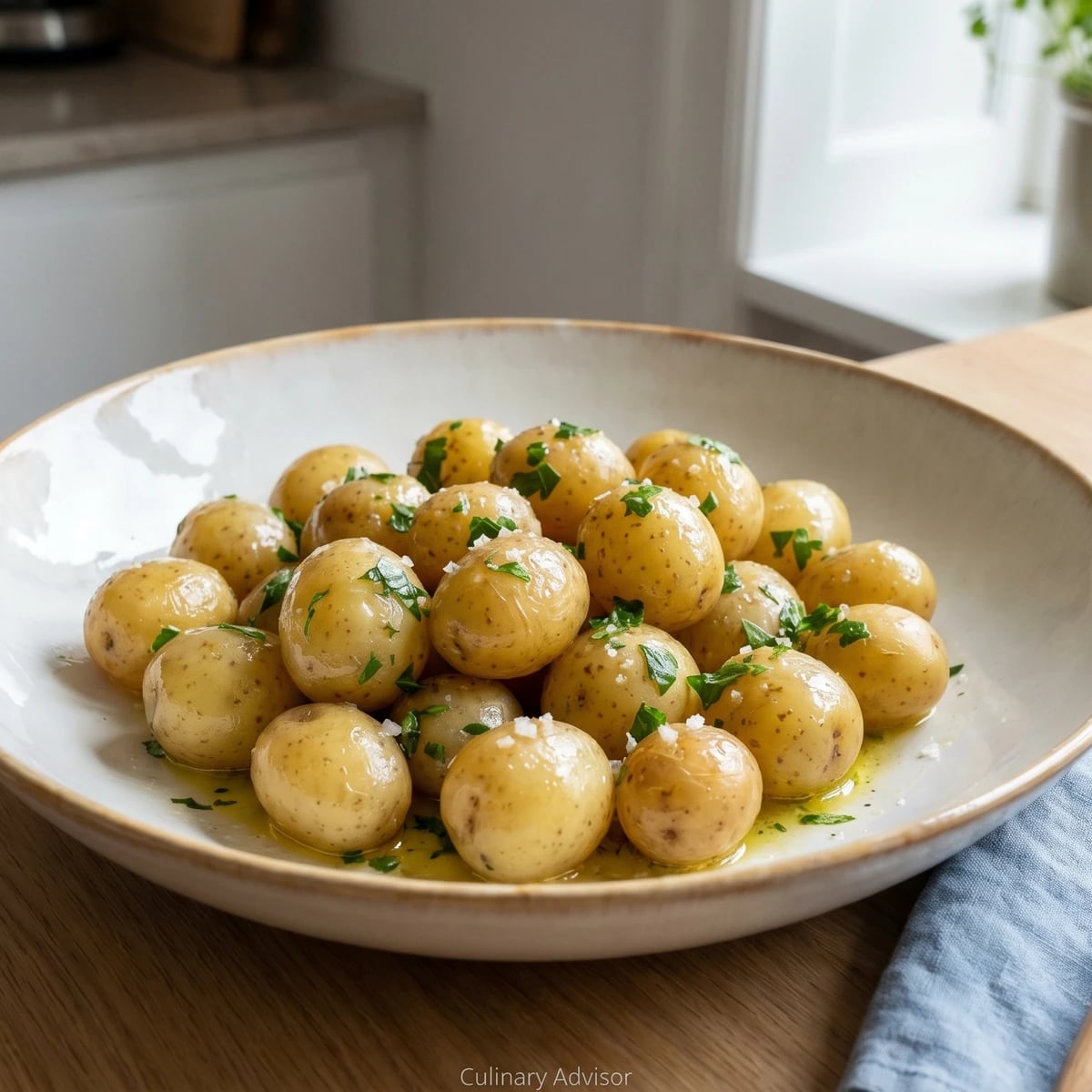
The first new potatoes of the Danish summer, boiled gently with their thin skins on and turned in warm parsley butter. June on a plate, and the only side that stegt flaesk will ever truly need.
Side Dishes
Danish
Weeknight
Comfort Food
Special Occasion
10 min
Active Time
18 min cook•28 min total
Yield4 servings
June in Denmark is when the waiting ends. The light stays until nearly eleven. The gardens are loud with green. And the nye kartofler arrive.
You can buy potatoes year-round, of course. But that's not the same thing. Nye kartofler are the first small potatoes of the season, pulled from the sandy soils of Samsoe or Lammefjorden while their skins are still so thin you can brush them away with your thumb. They taste like the earth they came from, sweet and mineral and clean, and for a few weeks every summer the entire country reorganises its cooking around them. The season decides.
The preparation could not be simpler. You boil them in very salty water until a knife slides through without resistance, then you toss them in warm butter with a generous handful of chopped parsley. That's it. There is no technique to master, no trick to learn. What matters is the potato itself, and the only instruction that really counts is this: wait for the right ones. Buy them small, buy them local, buy them when the calendar says June. Danish strawberries have July. Nye kartofler have now.
Serve them alongside stegt flaesk, the crisp pork belly that is Denmark's national dish, and you have a plate that every Dane alive recognises as summer. You'll know when it's right. The butter pools at the bottom, the parsley stays green, and the potatoes are so tender they barely hold together. Cooked with love, eaten immediately.
New potatoes became a seasonal ritual in Denmark after the tuber established itself as a staple crop in the late 1700s, but the specific celebration of nye kartofler as a June event intensified in the 20th century with the development of early-harvest potato varieties on the islands of Samsoe and in the Lammefjorden area of Sjaelland. Lammefjorden potatoes, grown in reclaimed seabed soil rich in minerals, earned a protected geographical status and remain the benchmark by which all Danish new potatoes are judged. The tradition of serving them simply with parsley butter alongside stegt flaesk was formalised when stegt flaesk med persillesovs was voted Denmark's national dish in 2014, but it had been the default summer supper in Danish homes for generations before anyone thought to make it official.
The technique, the tradition, and the story behind every dish.
Rinse the potatoes gently under cold water to remove any loose soil. Don't scrub them. The skins on new potatoes are thin as paper, barely there, and that's the point. If you scrub, you lose them. If any are larger than a walnut, halve them so everything cooks at the same pace. Leave the small ones whole.
True nye kartofler should feel smooth and waxy in your hand, with skins so thin you can rub them off with your thumb. If the skins feel thick and papery, the potatoes are older than they should be. They'll still taste good, but they won't be the same.
2
Boil in salted water
Put the potatoes into a pot and cover with cold water. Add a generous amount of fine sea salt, more than you think. The water should taste like the sea. This is important: potatoes absorb salt as they cook, and if the water is timid, the potatoes will be flat no matter what you do afterwards. Bring to a boil, then lower the heat to a steady simmer. Cook for twelve to fifteen minutes, depending on size.
Start in cold water, not boiling. Cold water lets the heat reach the centre of each potato at the same speed it cooks the outside. Drop new potatoes into boiling water and the outsides go soft while the centres stay hard.
3
Test for doneness
Slide the tip of a small knife into the largest potato. It should meet no resistance at all, then the potato should slide off the knife under its own weight. That's the moment. Even one minute too long and they start to crumble. Nye kartofler are waxy, not floury, and they should hold their shape completely. Drain them immediately and let them sit in the colander for a minute so the surface moisture evaporates. Dry potatoes take butter. Wet potatoes repel it.
4
Make the parsley butter
While the potatoes cook, melt the butter in a small saucepan over a low heat. You don't want it to brown here. Not this time. Browned butter has its place, but persillesmor is about the clean, sweet taste of good butter meeting the green bite of parsley. When the butter is melted and warm, take the pan off the heat and stir in the chopped parsley. It should sizzle gently, just once, then go quiet. That brief heat is enough to wake the parsley's oils without killing its colour.
Chop the parsley finely, but not into a paste. You want small distinct flecks, not a green smear. The texture matters. You should see the parsley and taste it in separate little bursts.
5
Toss and serve
Tip the drained potatoes into a warm serving bowl. Pour the parsley butter over them and turn the potatoes gently with a spoon until every one is coated and glistening. Be careful. They're tender now and will break if you're rough. Finish with a scattering of flaky sea salt. Serve immediately, while the butter is still pooling at the bottom and the parsley is still bright green. This is a dish that waits for no one.
Chef Tips
•The potato variety matters more than the recipe. Look for early-season Danish varieties if you can get them: Solist, Hamlet, or anything marked from Samsoe or Lammefjorden. Their flavour is sweeter and more concentrated than storage potatoes, and no amount of good butter will compensate for a bland potato.
•Use real butter, not margarine, not a spread. Unsalted, so you control the salt yourself. Danish butter from grass-fed cows has a yellow tint and a richness that cheaper butter doesn't match. You'll taste the difference.
•Some cooks add a sprig of fresh mint or dill to the boiling water. It's a small thing, but it perfumes the potatoes from the inside. Mint is the traditional choice on Bornholm. Dill is more common on Sjaelland. Both work. Both are honest.
•If you have leftovers, slice them and fry them in butter the next morning. Cold boiled nye kartofler, sliced and crisped in a hot pan, are one of the great quiet pleasures of a Danish summer kitchen.
Advance Preparation
•Nye kartofler are best the moment they are made. The parsley darkens and the butter congeals as they cool, and reheating doesn't bring them back. Boil them just before you sit down.
•You can chop the parsley an hour ahead and keep it wrapped in a damp cloth in the fridge. It stays greener that way than if you chop it and leave it exposed to the air.
Frequently Asked Questions
Nutrition Information
1 serving (about 285g)
Calories
355 calories
Total Fat
16 g
Saturated Fat
10 g
Trans Fat
1 g
Unsaturated Fat
5 g
Cholesterol
40 mg
Sodium
450 mg
Total Carbohydrates
51 g
Dietary Fiber
5 g
Sugars
2 g
Protein
5 g
Where cooking meets culture.
Culinary guides, cultural storytelling, and the editorial depth that makes cooking meaningful.