Chef Fai
Crispy Rice with Coconut Dip (Khao Tang Na Tang)
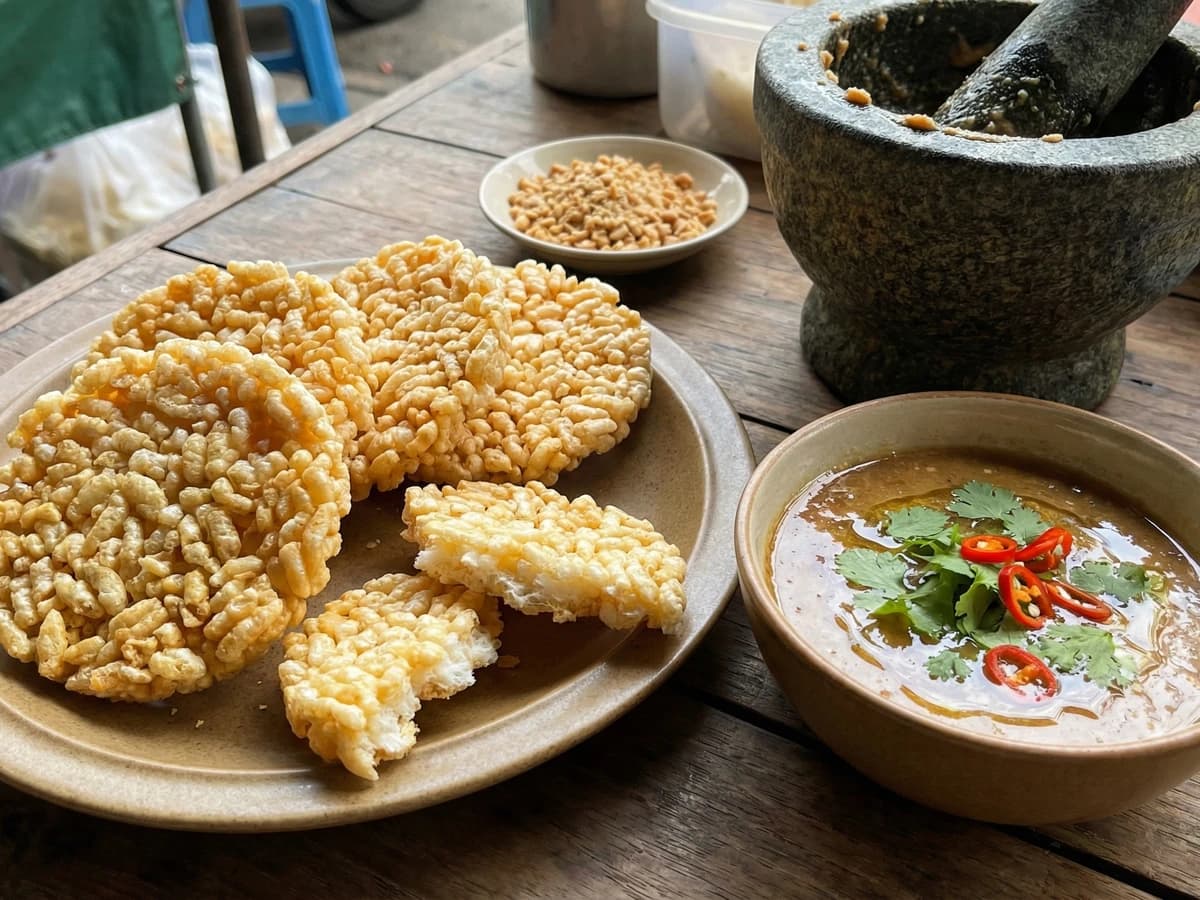
The kreung tam doesn't rest, not even for a snack. Pounded paste cracked into coconut cream, spooned over golden rice that shatters on contact. Four pillars in every bite.
A cooking platform built around craft, culture, and the stories behind what we eat.
Created by
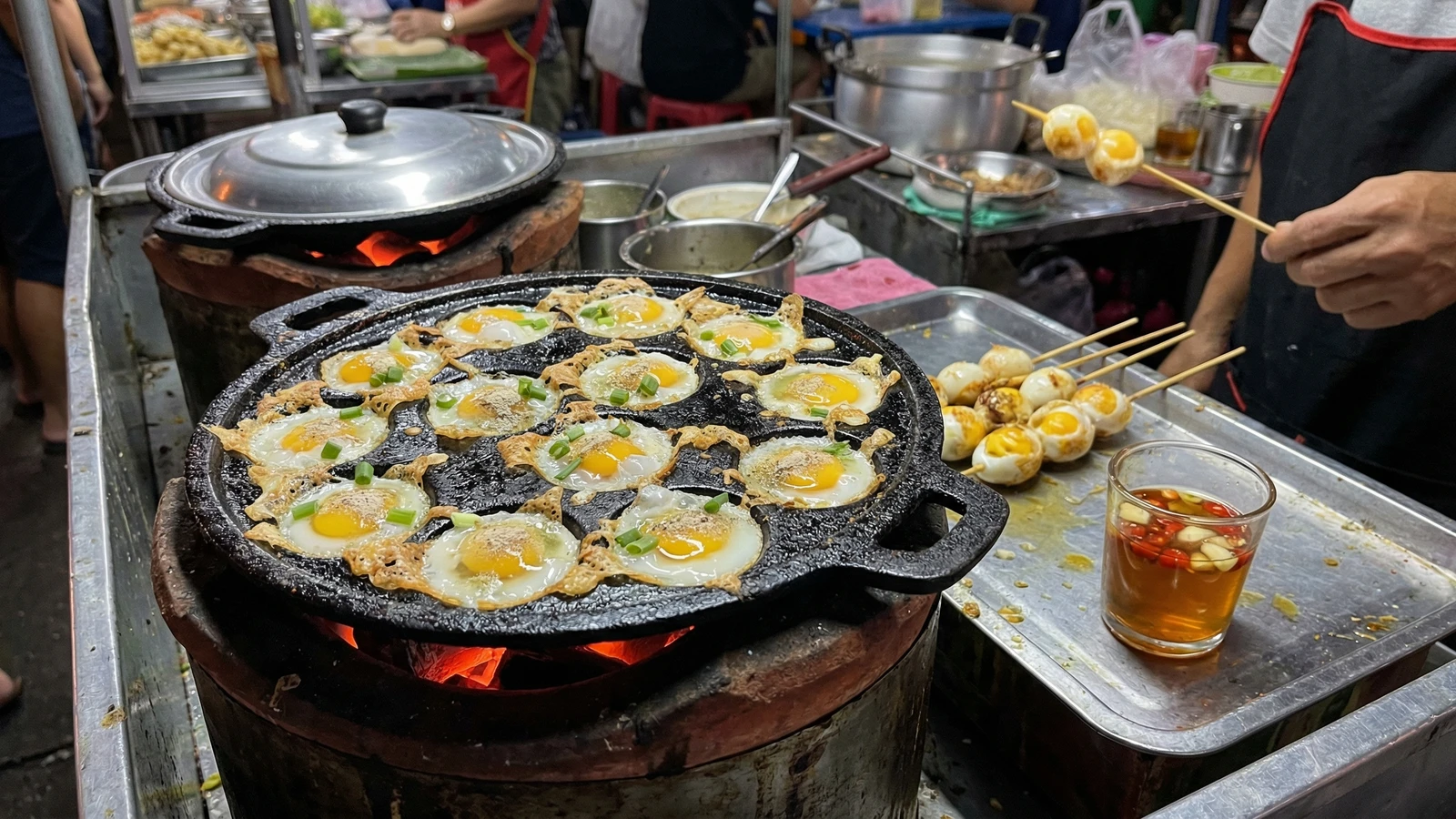
A thin rice-flour shell, a trembling yolk, and a nam jim wan that carries every pillar of Thai flavor in a single dip. Night bazaar cooking stripped to its honest bones.
Not every dish needs a kreung tam to prove it belongs in the Thai system. Some dishes prove it with nothing more than a dipping sauce. Kai nok krata is three baht worth of quail egg fried in a cast-iron mold at the Chiang Mai night bazaar, and the nam jim wan (sweet chili sauce) you dip it into carries every single pillar: palm sugar for sweet, fish sauce for salt, rice vinegar for sour, prik khi nu (bird's eye chili) for heat. The system doesn't require complexity. It requires understanding.
The technique is pure Lanna street economy. A cast-iron mold with a dozen round cups sits over charcoal. Oil goes in each cup. A thin pour of rice flour batter coats the bottom, and within seconds a quail egg is cracked on top. The batter sets into a lacy, golden shell while the yolk stays liquid at the center. Thirty seconds per egg. The vendor works the mold like a typewriter, left to right, cracking and pouring, never looking up. When the edges turn golden and crisp and the white is just set, she skewers them onto bamboo sticks and hands them over. You walk and eat. That's the format.
I've watched the kai nok krata vendors on Chang Klan Road work through hundreds of eggs in an hour. No thermometer. No timer. They know the mold is ready by how the oil behaves. They know the egg is done by how the edge looks. Thirty years of muscle memory, encoded in a three-baht snack. Ajarn always said you can find the principles everywhere if you know what to look for. The night bazaar vendor isn't thinking about the four pillars. She doesn't have to. She makes her nam jim wan the way it's always been made: palm sugar, vinegar, fish sauce, chili. The system is in the culture, not the textbook.
Learn the nam jim wan first. It's one sauce that works across half of Northern Thai street food: sai oua, moo ping, kai yang, anything grilled or fried off a charcoal brazier. The eggs are the vehicle. The sauce is the lesson.
Kai nok krata became a fixture of Chiang Mai's night bazaar in the 1980s as the Chang Klan Road market expanded into Northern Thailand's main evening gathering point for locals and travelers alike. The cast-iron molds share their design with the pans used for khanom krok (coconut puddings), suggesting the technique migrated from dessert to savory snack within the broader Lanna street food tradition. Quail farming expanded across Thailand's northern provinces in the 1970s, making the eggs cheap and abundant enough to become street food currency: a few baht each, eaten off bamboo skewers between stalls.
Quantity
24
Quantity
40g
Quantity
60ml
Quantity
pinch
Quantity
3 tablespoons
for the molds
Quantity
to taste
Quantity
2
thinly sliced
Quantity
80g
chopped
Quantity
80ml
Quantity
1 tablespoon
Quantity
2 tablespoons
Quantity
3
finely sliced
Quantity
2 cloves
minced
| Ingredient | Quantity |
|---|---|
| quail eggs (kai nok krata) | 24 |
| rice flour (paeng khao jao) | 40g |
| water (for batter) | 60ml |
| salt | pinch |
| vegetable oilfor the molds | 3 tablespoons |
| white pepper | to taste |
| green onions (ton hom)thinly sliced | 2 |
| palm sugar (nam tan pip)chopped | 80g |
| rice vinegar | 80ml |
| fish sauce (nam pla) | 1 tablespoon |
| water (for sauce) | 2 tablespoons |
| bird's eye chilies (prik khi nu)finely sliced | 3 |
| garlicminced | 2 cloves |
Combine the chopped palm sugar, rice vinegar, water, and fish sauce in a small saucepan over medium heat. Stir until the sugar dissolves completely, about 2 minutes. The liquid should turn amber and go slightly syrupy. Remove from heat and stir in the sliced chilies and minced garlic. Let it cool to room temperature. The sauce thickens as it cools. Taste it: sweet hits first, then sour, then the slow burn of chili, with fish sauce holding the salt underneath everything. If it's too sweet, splash in more vinegar. Too sharp, a pinch more palm sugar. That's the four pillars in a cup.
Whisk the rice flour, water, and a pinch of salt together until smooth. The consistency should be thin, like crepe batter, not pancake batter. It coats the back of a spoon and runs off immediately. Too thick and the shell comes out doughy. Too thin and it won't hold together. This batter is what gives kai nok krata its signature crispy edge, the lacy golden shell that crunches when you bite through to the soft yolk inside.
Set your cast-iron egg mold over medium heat. Let it heat for 3 to 4 minutes until a drop of water sizzles and evaporates on contact. Add about half a teaspoon of vegetable oil to each cup and swirl the mold to coat. The oil should shimmer but not smoke. If it's smoking, pull it off the heat for thirty seconds. You want hot enough to set the batter instantly, not so hot that it burns before the egg is in.
Pour about a teaspoon of rice flour batter into each cup. It should sizzle on contact and start setting at the edges immediately. Working quickly, crack one quail egg into each cup on top of the batter. The white will spread and merge with the batter at the edges. Sprinkle a tiny pinch of white pepper over each egg and scatter the sliced green onions across the tops. Cook undisturbed for 60 to 90 seconds. Watch the edges: they should turn golden and lacy, pulling away from the mold slightly, while the yolk stays liquid and trembling at the center. Don't flip them. The bottom is crispy, the top is soft. That contrast is the whole point.
Use a bamboo skewer or small spoon to pop each egg out of the mold. The underside should be golden brown and crisp, releasing cleanly. Thread 3 to 4 eggs onto bamboo skewers, or pile them onto a plate. Serve immediately with the nam jim wan in a small cup for dipping. The yolk should break when you bite in, running into the crispy batter shell and mixing with the sweet, sour, salty, spicy dip. That's three baht of night market perfection. No sticky rice needed. This is walking-and-eating food. Fai Thai, baby.
1 serving (about 140g)
Culinary guides, cultural storytelling, and the editorial depth that makes cooking meaningful.
Discover Culinary ExplorerChef Fai
The kreung tam doesn't rest, not even for a snack. Pounded paste cracked into coconut cream, spooned over golden rice that shatters on contact. Four pillars in every bite.
Chef Fai
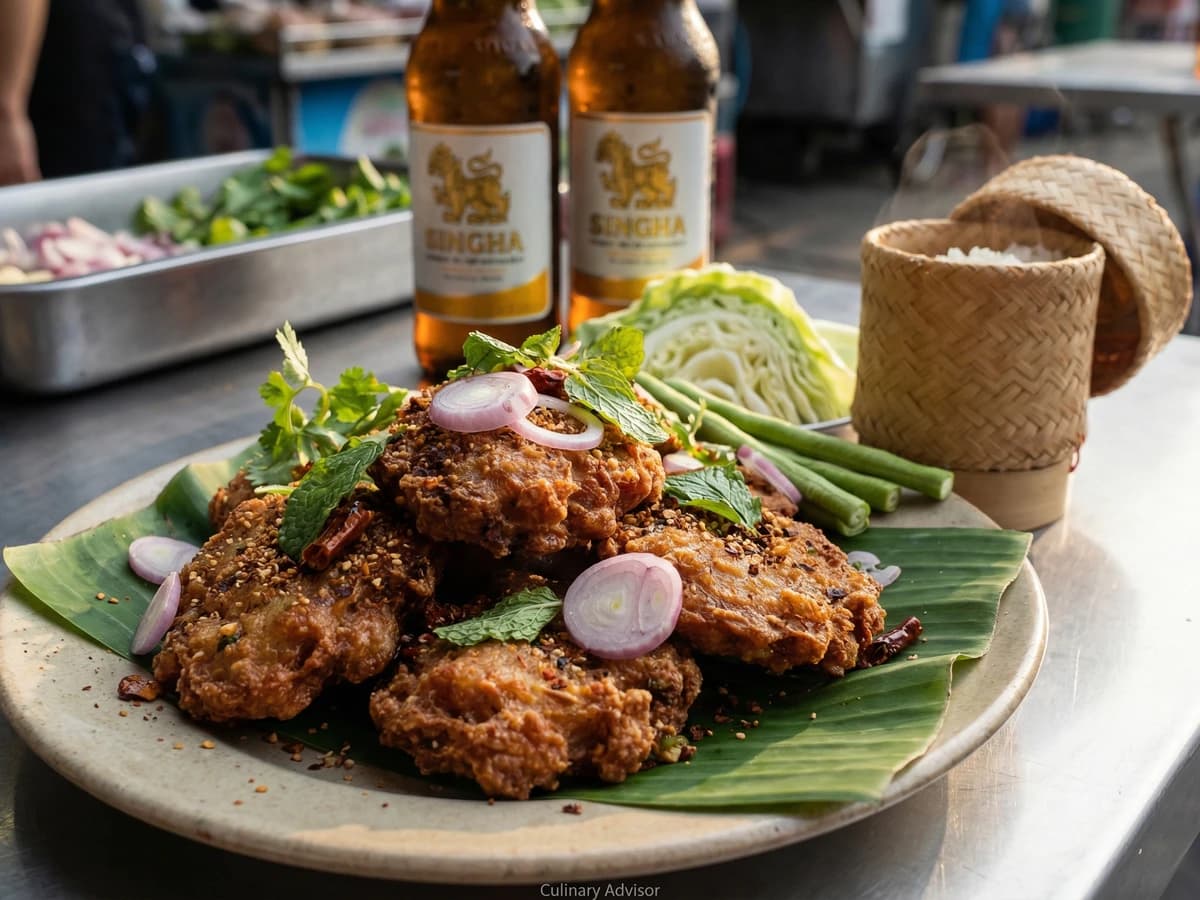
Isan's larb principles pressed into patties and fried golden: fish sauce for salt, lime for sour, khao khua for structure and crunch, prik pon for heat. No sugar. That's the rule that separates Isan from everything else.
Chef Fai
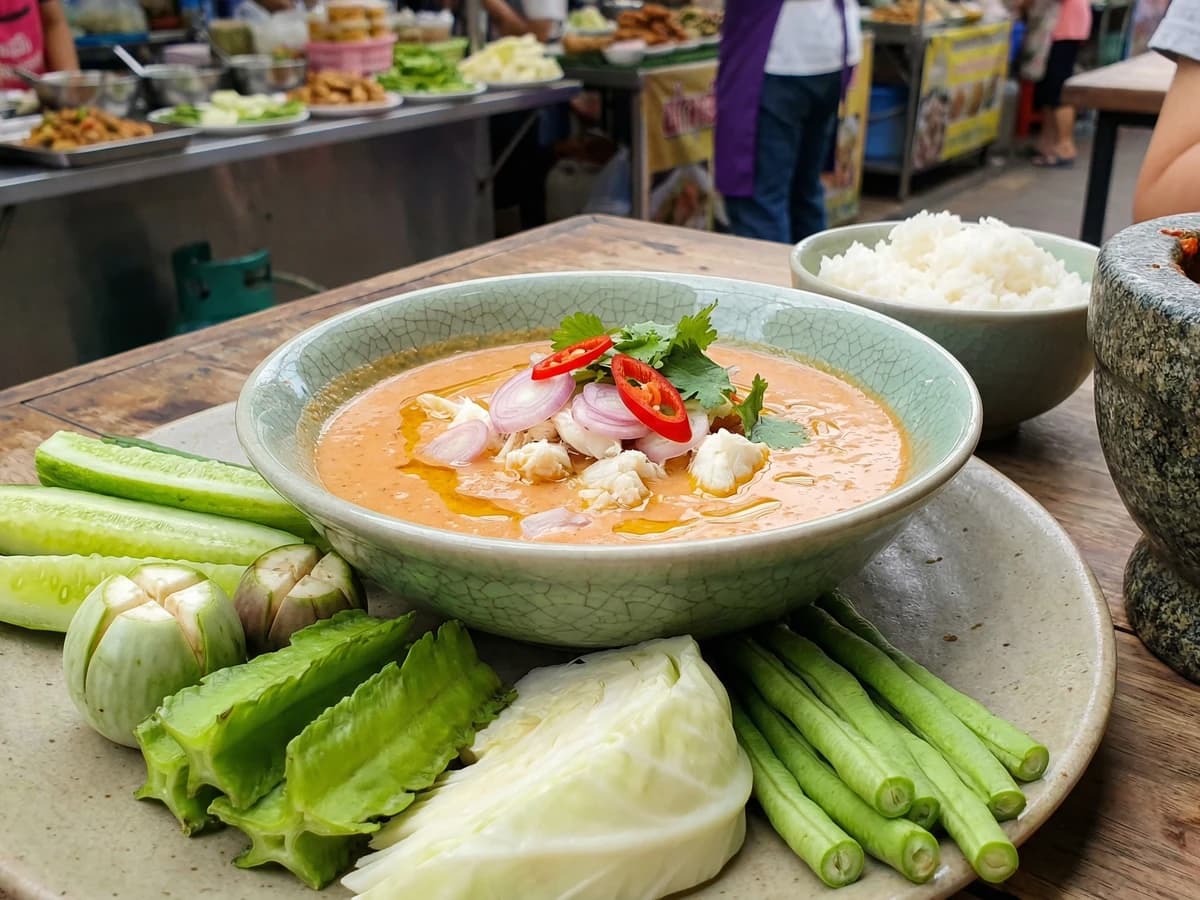
A kreung tam pounded in the krok, dissolved into cracked coconut cream, sweet crab folded through at the end. All four pillars balanced in a dip so silky you'll forget it started in a granite mortar. Central Thai home cooking at its most principled.

Chef Fai
Twenty-four meatballs, eight bamboo skewers, a charcoal grill the size of a shoebox, and one pot of nam jim built on the four pillars. The simplest vendor setup in Thailand proves the system works everywhere.