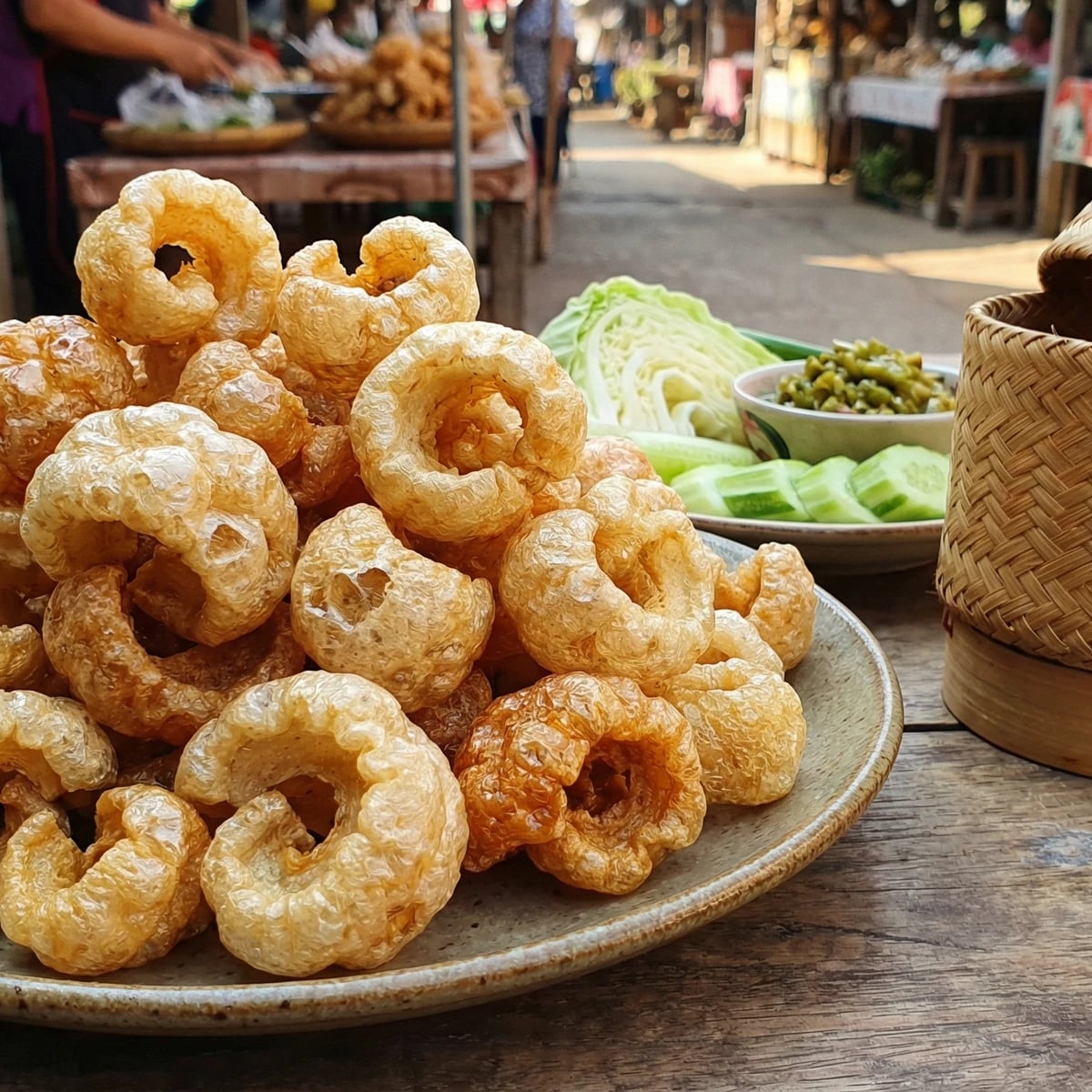
Sun-dried pork skin fried until it shatters into golden shards. In the Lanna meal, kab moo isn't the star. It's the vehicle that carries nam prik and sticky rice to your mouth. Texture with purpose.
Side Dishes
Thai
Weeknight
Comfort Food
30 min
Active Time
1 hr 15 min cook•1 hr 45 min total
Yield6 servings
Kab moo is three ingredients and two days of patience. Pork skin, salt, oil. That's it. The technique is the recipe.
Ajarn always said Thai food is a system, not a menu. Every dish at the table has a job. The nam prik brings the flavor. The sticky rice brings the starch. And the kab moo? It brings the crunch. It's a textural vehicle designed to scoop nam prik, shatter between your teeth, and melt into the sticky rice you've pinched around it. You don't eat kab moo alone any more than you'd eat a spoon alone. It exists to serve the meal.
The science is simple and brutal. Boil the skin until tender. Scrape the fat until only a paper-thin layer remains. Dry it until there's almost no moisture left. Then hit it with screaming-hot oil. The tiny amount of remaining water inside the collagen matrix turns to steam instantly, puffing the skin outward like a balloon. That's how you get the shatter. That's how you get those airy, cloud-like rinds that crumble when you bite down. Skip the drying step and you get chewy, greasy leather. The drying is everything.
In Chiang Mai, you see kab moo piled in plastic bags at every morning market, stacked next to kratip baskets of sticky rice and small bags of nam prik num. It's a Lanna breakfast staple. At the night bazaar, vendors fry it fresh and it's gone in minutes. At home, it sits on the khan tok tray alongside laab khua, gaeng hang lay, and bowls of nam prik ong. It belongs to the whole table. Pork is king in the North, and kab moo is the crunch that holds the kingdom together.
Kab moo (แคบหมู) is a foundational element of Lanna cuisine, the culinary tradition of Thailand's northern provinces centered around Chiang Mai, Chiang Rai, and Lamphun. Pork dominates the Northern Thai table in a way it doesn't in other regions, largely because the mountainous terrain historically favored pig husbandry over cattle or poultry farming. Sun-drying pork skin before frying was originally a preservation technique: dried skins could be stored for weeks and fried on demand, making kab moo a practical food born from the same resourcefulness that gave the North its fermented pork (jin som) and cured sausages (sai oua). The word 'kab' (แคบ) in the Lanna dialect refers specifically to this puffed, fried skin, distinct from the Central Thai 'khaep moo' (แคปหมู), though both describe a similar product.
The technique, the tradition, and the story behind every dish.
from the belly or back, thin layer of fat attached
coarse sea salt
Quantity
2 tablespoons
white peppercorns (prik thai khao) (optional)
Quantity
1 teaspoon
vegetable oil
Quantity
about 1 litre
for deep-frying
Ingredient
Quantity
pork skin (nang moo)from the belly or back, thin layer of fat attached
1 kg
coarse sea salt
2 tablespoons
white peppercorns (prik thai khao) (optional)
1 teaspoon
vegetable oilfor deep-frying
about 1 litre
Equipment Needed
•Large pot for boiling
•Wok or deep heavy-bottomed pot for frying
•Spider or slotted spoon
•Wire rack for drying and draining
•Baking sheet
•Kitchen thermometer
Instructions
1
Clean and boil the skin
Rinse the pork skin under cold water. Place it in a large pot, cover with water, add 1 tablespoon of the salt and the white peppercorns if using. Bring to a boil, then reduce to a steady simmer. Cook for 45 minutes to 1 hour, until the skin is completely tender when you poke it with a knife. It should yield easily, no resistance. If there's any chewiness, keep going. Undercooked skin won't puff.
Ask your butcher for pork skin from the belly or back. These sections have more uniform thickness, which means even puffing when you fry. Skin from the legs is too thick and uneven.
2
Scrape the fat
Pull the skin out of the pot and let it cool just enough to handle. Now flip it fat-side up and scrape. Use the back of a knife or a spoon and drag it firmly across the fat layer. You want to remove almost all the fat, leaving only a paper-thin layer on the skin. This is where most people go wrong. Too much fat left means the rinds fry greasy and dense instead of airy. Too little and they're brittle without flavor. You want to see the skin's surface through a translucent veil of fat. That's the target.
Don't throw the scraped fat away. Render it down in a pan over low heat. You'll get clean pork lard, which is the traditional Northern Thai cooking fat. Nothing goes to waste in Lanna cooking.
3
Cut and season
Cut the scraped skin into strips about 2 inches wide and 3 inches long. Rub the remaining tablespoon of salt evenly across all pieces, both sides. The salt draws out residual moisture during drying and seasons the rinds from within. Smaller, more uniform pieces dry faster and fry more evenly. Don't skip the sizing. Uneven pieces mean some shatter perfectly while others stay chewy in the same batch.
4
Dry the skin completely
This is the step that separates kab moo from fried pork fat. Lay the strips skin-side up on a wire rack set over a baking sheet. Dry them in a low oven at 80-90°C (175-195°F) for 4 to 6 hours, or until the strips are hard, translucent, and shrunken to about half their original size. They should snap when you try to bend them. If they flex, they're not dry enough. In Chiang Mai, vendors dry them in the sun for a full day or two. If you have consistent sun and dry air, spread them on a rack outside and let the sky do the work. The oven method is your insurance policy.
The Lanna vendors at Warorot market dry their skins in the mountain sun for two days. If you live somewhere humid, don't even attempt sun-drying. The oven at the lowest setting with the door cracked open works. A food dehydrator at 70°C for 6-8 hours works even better. What doesn't work is skipping this step.
5
Fry until puffed
Fill a wok or deep heavy pot with oil to at least 3 inches depth. Heat to 200°C (390°F). Test with one piece first. Drop it in. Within 5 to 10 seconds, it should puff dramatically, ballooning outward and turning golden. If it sinks and sizzles weakly, your oil isn't hot enough. If it browns instantly, it's too hot. Fry in small batches, 4 or 5 pieces at a time. They expand to three times their size, so give them room. Flip once with a spider or slotted spoon. Total fry time per batch: 15 to 20 seconds. That's it. They should be golden, airy, and featherlight when you lift them out.
The puffing is physics. The dried collagen matrix still holds a tiny amount of bound water. When that water hits 200°C oil, it flashes to steam and inflates the skin from the inside. No moisture left means no puff. Too much moisture means sputtering, popping oil, and dense rinds. The drying step controls everything.
6
Drain and serve
Lift the puffed rinds onto a wire rack or paper-lined tray. They'll crisp further as they cool for 1 to 2 minutes. Season with a light pinch of salt while they're still hot if you want. Break one open. The inside should be airy, almost hollow, with a thin shattering crust. Pile them on a plate alongside your nam prik, a kratip of sticky rice, and raw vegetables. Tear off a piece of sticky rice, pinch some nam prik on top, grab a shard of kab moo. That's a bite. That's the Lanna table working as a system.
Chef Tips
•Kab moo is not a snack. In Lanna, it's a component of the meal. You eat it with nam prik num (roasted green chili relish), nam prik ong (pork and tomato chili relish), or nam prik ta daeng (dried red chili relish). The crunch is designed to carry the relish and sticky rice together. Eating kab moo by itself is like eating a spoon by itself. It's a tool.
•The thickness of the skin determines everything. Ask your butcher for belly skin or back skin, which runs about 3-4 mm thick after fat is scraped. Leg skin is too thick and doesn't puff evenly. If you can only get thick skin, boil it longer and scrape it down more aggressively.
•Properly dried kab moo stores beautifully before frying. Keep the dried strips in an airtight container at room temperature for up to two weeks, or freeze them for a month. Fry from the dried state directly, no need to thaw. This is how Lanna households have always done it: dry a big batch, store it, fry a handful each morning.
•If your rinds come out chewy and flat instead of puffed and shattered, the problem is always one of two things. Either the skin wasn't dry enough, or your oil wasn't hot enough. Test with one piece. If it doesn't puff within 10 seconds, stop and fix the variable before you waste the rest of the batch.
Advance Preparation
•The dried pork skin strips can be prepared days or even weeks in advance. Once fully dried (hard, translucent, snapping when bent), store them in an airtight container at room temperature for up to 2 weeks or freeze for up to a month. Fry directly from the dried state.
•The boiling and scraping can be done a day ahead. Refrigerate the scraped, cut strips overnight, then proceed with drying the next morning.
•Fried kab moo is best within a few hours. It stays crisp for a day in dry conditions but gradually loses its shatter as it absorbs ambient humidity. In Chiang Mai's mountain air, they last longer. In Bangkok's humidity, eat them fast.
Frequently Asked Questions
Nutrition Information
1 serving (about 65g)
Calories
385 calories
Total Fat
24 g
Saturated Fat
9 g
Trans Fat
0 g
Unsaturated Fat
15 g
Cholesterol
70 mg
Sodium
920 mg
Total Carbohydrates
0 g
Dietary Fiber
0 g
Sugars
0 g
Protein
42 g
Where cooking meets culture.
Culinary guides, cultural storytelling, and the editorial depth that makes cooking meaningful.