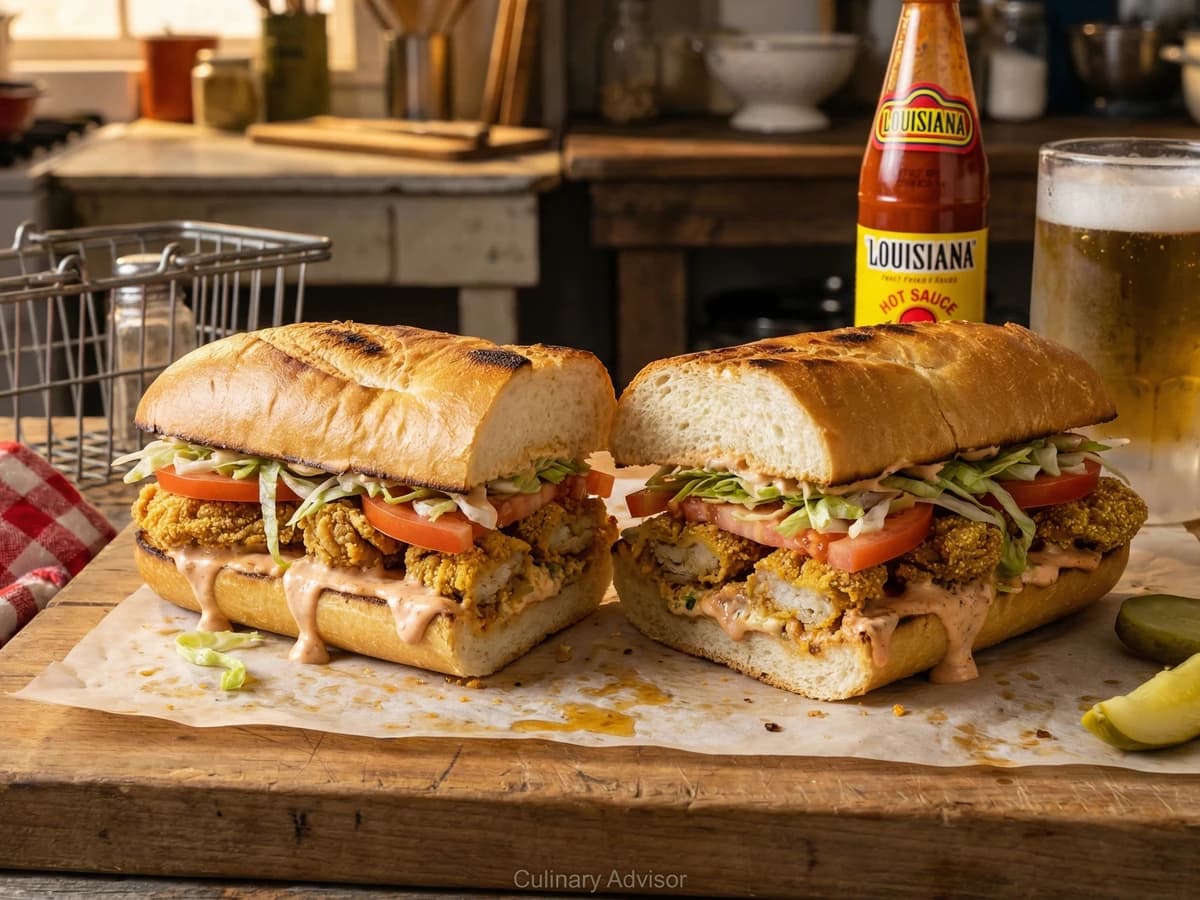
Crispy cornmeal-crusted Gulf oysters piled high on crusty French bread, dressed with creamy remoulade, shredded lettuce, and ripe tomatoes, the kind of sandwich that made New Orleans famous and keeps locals coming back generation after generation.
Sandwiches & Wraps
Creole
Comfort Food
Special Occasion
30 min
Active Time
20 min cook•50 min total
Yield4 sandwiches
The po' boy is New Orleans in sandwich form. Born during the 1929 streetcar strike when the Martin brothers fed striking workers for free, it became the great equalizer of Louisiana cuisine. Rich or poor, dressed or undressed, everybody in this city has a favorite po' boy shop and strong opinions about who does it best.
At Lagniappe, we serve our oyster po' boys the way my grandmother Evangeline taught me: oysters so fresh they still smell like the Gulf, a cornmeal crust that shatters when you bite through it, and bread that crackles like kindling under your fingers. The bread matters more than most folks realize. Real po' boy bread has a crust thin as paper that gives way to a soft, pillowy interior. It compresses just enough to hold everything together without getting soggy. Accept no substitutes.
The secret to perfect fried oysters is restraint. You season the breading, you season the oysters, but you don't overwork anything. Three minutes in hot oil and they're done. Any longer and you've turned Gulf treasures into rubber erasers. I've seen it happen a thousand times to cooks who walk away from the fryer. Stay present. Watch the color. Listen to the sizzle change pitch. That's the bayou way.
The technique, the tradition, and the story behind every dish.
Whisk together the mayonnaise, Creole mustard, horseradish, lemon juice, hot sauce, minced garlic, paprika, and green onion in a small bowl until smooth and coral-pink. Taste it. The flavors should be bold and tangy with a gentle heat building at the finish. Adjust the hot sauce if you want more kick. Cover and refrigerate while you prepare everything else. The flavors will marry and deepen as it sits.
This remoulade keeps for a week refrigerated. Make extra. You'll want it on everything.
2
Season the oysters
Pat the drained oysters dry with paper towels. They should feel tacky, not wet. Sprinkle them with one teaspoon of the Creole seasoning and toss gently to coat. This first layer of seasoning goes directly on the protein, building flavor from the inside out. Let them sit while you prepare the breading station.
3
Build your breading station
Set up three shallow dishes in a row. In the first, whisk together the buttermilk and egg until smooth. In the second, combine the cornmeal, flour, remaining teaspoon of Creole seasoning, garlic powder, cayenne, black pepper, and salt. Stir with a fork to distribute the spices evenly. The third dish stays empty for now; that's where your breaded oysters will rest.
Use one hand for wet ingredients, the other for dry. This keeps your fingers from turning into breaded clubs.
4
Bread the oysters
Working with one oyster at a time, dip it into the buttermilk mixture, let the excess drip off for a second, then drop it into the cornmeal mixture. Use your dry hand to scoop cornmeal over the top and press gently so the coating adheres. Lift the oyster, shake off loose breading, and place it on the empty dish. Repeat with remaining oysters. The coating should look sandy and even, not clumpy.
5
Heat the oil
Pour oil into a large cast iron skillet or Dutch oven to a depth of about one inch. Set it over medium-high heat and bring to 375 degrees Fahrenheit. Use a thermometer. If you don't have one, drop a pinch of breading into the oil. It should sizzle immediately and float to the surface, bubbling vigorously. If it sinks and sits there quietly, your oil isn't ready.
Temperature control is everything. Too cool and the oysters absorb grease. Too hot and the coating burns before the inside cooks.
6
Fry until golden
Carefully lower oysters into the hot oil in batches of six to eight, giving them room to swim. Don't crowd the pan or the temperature drops and everything gets soggy. Fry for two to three minutes, turning once halfway through, until the coating is deep golden brown and the edges look lacy and crisp. The sizzle should be steady and enthusiastic. When the bubbling slows and the pitch rises, they're done.
Gulf oysters are best at medium or medium-rare inside. Three minutes total is plenty. Trust the color.
7
Drain and season immediately
Transfer fried oysters to a wire rack set over a sheet pan. Season them with a light sprinkle of salt while they're still glistening. This is your last chance to build flavor, and the salt will stick to the hot crust. Let the oil return to 375 degrees between batches. Keep finished oysters warm in a 200-degree oven if needed.
8
Prepare the bread
Split each piece of French bread lengthwise, leaving one edge attached like a hinge. Spread softened butter on the cut surfaces. Toast the bread cut-side down in a dry skillet over medium heat, or under the broiler for 60 to 90 seconds, until golden and fragrant. The crust should crackle when you press it. Soft bread makes a sad po' boy.
9
Assemble the po' boys
Spread a generous layer of remoulade on both cut surfaces of each toasted bread. Don't be shy. Layer the bottom with shredded lettuce, then tomato slices, then a row of hot fried oysters (six per sandwich is proper). Tuck pickle slices along the sides. Close the sandwich gently, pressing just enough for the hinge to hold. Cut in half on a sharp diagonal if you want to see that beautiful cross-section.
10
Serve immediately
These sandwiches wait for no one. The moment you assemble them, the clock starts ticking on that perfect crispy crust. Serve with extra napkins (you'll need them), more remoulade for dipping, and cold beer or sweet tea. When the last bite is as good as the first, you've done it right.
Chef Tips
•Fresh oysters are non-negotiable. They should smell like clean seawater, nothing fishy or ammonia-like. If your fishmonger can't tell you when they were shucked, find a new fishmonger.
•Real New Orleans French bread from Leidenheimer or Gendusa bakeries ships overnight if you can't find proper po' boy bread locally. It's worth the trouble. Regular baguette works in a pinch, but the texture isn't quite right.
•At Lagniappe, we always fry our oysters in peanut oil for the cleanest flavor and highest smoke point. Vegetable oil works fine if allergies are a concern.
•The remoulade is forgiving. Like it spicier? Add more hot sauce and cayenne. Want more tang? Another squeeze of lemon. Taste, taste, taste. That's the bayou way.
•If you're cooking for a crowd, bread all the oysters first, keep them on a sheet pan in the fridge, and fry in quick succession. Assembly line style, just like we do on busy Friday nights.
Advance Preparation
•Remoulade can be made up to one week ahead and refrigerated. The flavors improve after a day.
•Oysters can be breaded up to two hours ahead and kept refrigerated on a parchment-lined sheet pan. Bring to room temperature for 10 minutes before frying.
•French bread is best the day you buy it. If using day-old bread, refresh it in a 350-degree oven for 5 minutes before splitting and toasting.
Frequently Asked Questions
Nutrition Information
1 serving (about 370g)
Calories
910 calories
Total Fat
45 g
Saturated Fat
9 g
Trans Fat
0 g
Unsaturated Fat
34 g
Cholesterol
105 mg
Sodium
1900 mg
Total Carbohydrates
95 g
Dietary Fiber
6 g
Sugars
3 g
Protein
28 g
Where cooking meets culture.
Culinary guides, cultural storytelling, and the editorial depth that makes cooking meaningful.