Culinary Explorer

A cooking platform built around craft, culture, and the stories behind what we eat.
Discover Culinary Explorer
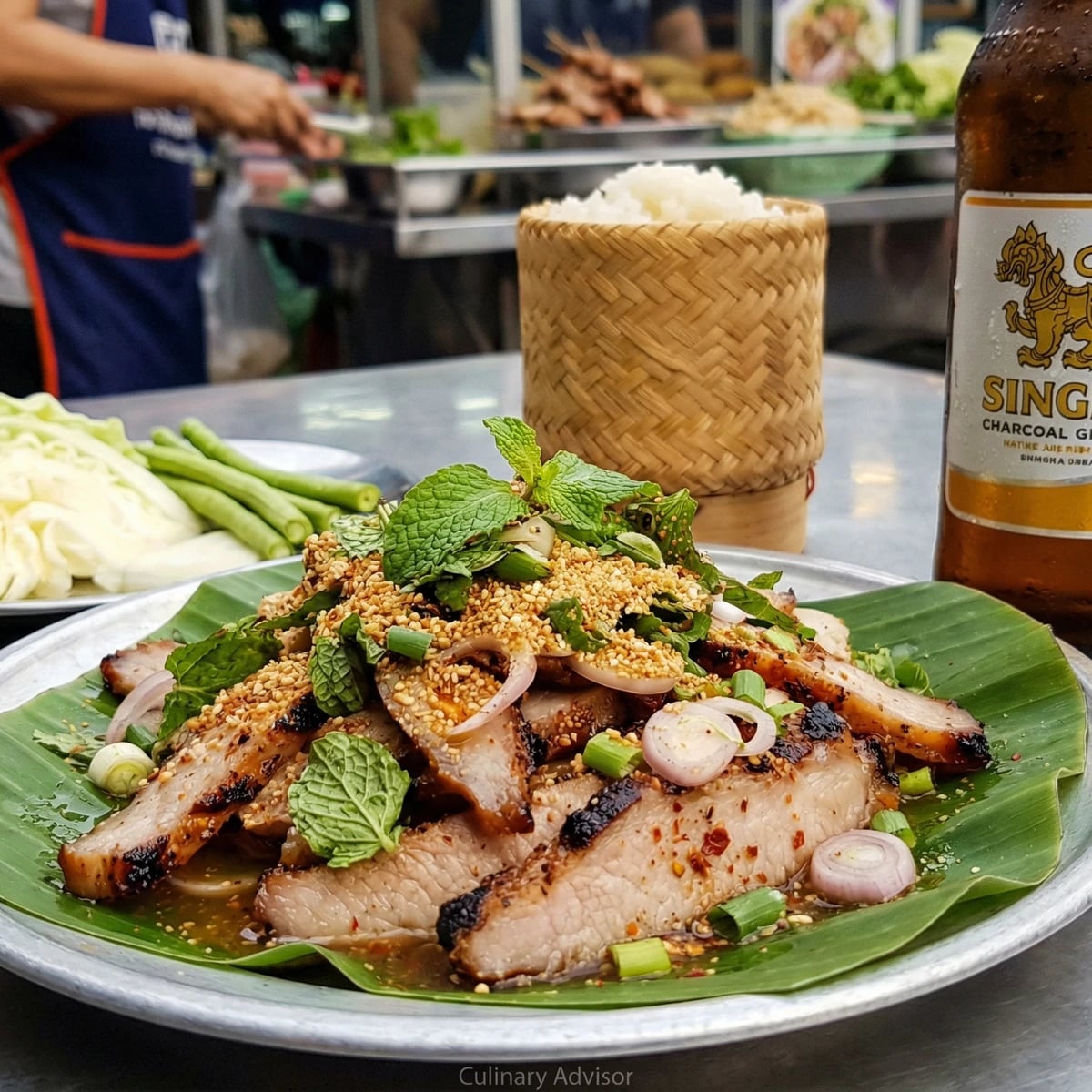
Grilled Pork Waterfall Salad (Nam Tok Moo, น้ำตกหมู)

Grilled Pork Waterfall Salad (Nam Tok Moo, น้ำตกหมู)

Created by

Isan's governing rule in action: no sugar. Fish sauce for salt, lime for sour, khao khua for crunch, prik pon for heat, and the juices of charcoal-grilled pork neck running like a waterfall through every bite.

Salads
Thai
Weeknight
Comfort Food
20 min
Active Time
15 min cook35 min total
Yield2-3 servings

No sugar. That's the rule. If you put sugar in nam tok, you've crossed out of Isan and into Central Thai territory. The absence of sweet is the principle that defines this entire regional tradition. Ajarn always said: understanding what a cuisine leaves out tells you as much as what it puts in. Isan leaves out sugar. Remember that.

Nam tok is larb's first cousin. Same dressing architecture: nam pla (fish sauce) for salt, manao (lime) for sour, prik pon (roasted dried chili) for heat, khao khua (toasted sticky rice powder) for that smoky, nutty crunch that ties the whole thing together. Same raw shallots, same torn mint, same room-temperature service with sticky rice. The difference is the protein preparation. Larb chops. Nam tok grills, then slices. And that grilling changes everything.

The name means "waterfall." Grill a thick piece of pork neck over charcoal, slice it against the grain while it's still warm, and watch the juices run down the cutting board. That's the waterfall. Those juices carry fat, smoke, and meat flavor directly into the dressing. This is why you dress the meat warm. Cold pork seals shut. Warm pork is open, porous, ready to absorb lime and fish sauce into every fiber. The temperature of the meat at the moment of dressing is the technique that separates a good nam tok from a great one.

Pork neck (kor moo, คอหมู) is the cut. Not tenderloin, not loin, not shoulder. Neck. It has the right ratio of fat to meat, the marbling that keeps it juicy over high heat. Every grilled pork vendor in Isan knows this. The cut is part of the principle. You don't substitute it any more than you'd substitute the fish sauce.

Nam tok belongs to the larb family of Isan (northeastern Thai) and Lao dressed-meat salads, with roots that predate written culinary records in the region. The word "nam tok" (น้ำตก, literally "falling water") refers to the juices that flow from freshly grilled meat when sliced, a visual metaphor that became the dish's name. While larb moo uses raw or barely cooked minced pork in traditional Isan preparations, nam tok emerged as the grilled variant, likely connected to the charcoal-grilling culture along the Mekong River where protein was often smoked or grilled before dressing. The dish migrated to Bangkok with Isan workers in the 1970s and 80s, where it was frequently sweetened with sugar to suit Central Thai palates, a modification that Isan cooks consider a fundamental violation of the regional flavor system.

The technique, the tradition, and the story behind every dish.

Discover Culinary Explorer

Ingredients

pork neck (kor moo, คอหมู)

Quantity

400g

one thick piece, about 1.5 inches thick

fish sauce (nam pla)

Quantity

3 tablespoons

fresh lime juice (nam manao)

Quantity

4 tablespoons (about 3-4 limes)

freshly squeezed

toasted sticky rice powder (khao khua, ข้าวคั่ว)

Quantity

2 tablespoons

freshly toasted and pounded

roasted dried chili flakes (prik pon, พริกป่น)

Quantity

1 tablespoon

shallots (hom daeng)

Quantity

3

sliced thin

fresh mint leaves (saranae, สะระแหน่)

Quantity

1 large handful

torn

fresh cilantro (pak chi)

Quantity

1 small handful

roughly torn

green onion (ton hom)

Quantity

3-4 stalks

sliced into 1-inch pieces

sawtooth coriander (pak chi farang, ผักชีฝรั่ง) (optional)

Quantity

a few leaves

sliced thin

sticky rice (khao niew)

Quantity

for serving

raw vegetables

Quantity

for serving

cabbage wedges, long beans, Thai eggplant, fresh mint sprigs

Equipment Needed

  • Charcoal grill or grill pan
  • Heavy granite mortar and pestle (krok hin) for pounding khao khua
  • Large mixing bowl
  • Sharp knife for slicing pork against the grain
  • Sticky rice steaming pot and basket (huad and mo neung)

Instructions

  1. 1

    Toast the khao khua

    Put a dry wok or skillet over medium heat. Add a small handful of raw sticky rice grains (about 3 tablespoons uncooked to yield 2 tablespoons ground). No oil. Shake the pan constantly. The rice will go from white to pale gold to deep tan. You want it the color of a paper bag, with some grains just starting to darken past that. The kitchen should smell like roasted grain and smoke. This takes 5-7 minutes. Don't rush it. Underdone khao khua tastes like nothing. Properly toasted khao khua is smoky, nutty, and fragrant. Let it cool completely, then pound in a mortar to a coarse powder. Not flour. Coarse. You want crunch.

    Store-bought khao khua powder is dead. The oils go stale within days. Toast and pound it fresh every time. This step takes ten minutes and it's the difference between nam tok that tastes like Isan and nam tok that tastes like nothing.
  2. 2

    Grill the pork neck

    Get your charcoal grill screaming hot. If you're using a gas grill or grill pan, crank it to maximum. The pork neck should go on as one thick piece, about 1.5 inches. Don't butterfly it, don't thin it out. You need the interior to stay juicy while the outside chars. Grill 5-6 minutes per side. You want a deep char on the surface, almost black at the edges, with the meat cooked through but still pink and juicy at the center. There is no sauce, no marinade. Just meat and fire. The pork neck's fat content handles the rest. When you press the center, it should give slightly. Pull it off and let it rest for 3-4 minutes on the cutting board.

    Charcoal is the whole point. The smoke flavor is part of the dish's identity. If you can only use a grill pan, you'll still get good nam tok, but you won't get Isan nam tok. The charcoal aroma in the meat is what the khao khua echoes in the dressing. Smoke meets smoke.
  3. 3

    Slice against the grain

    Find the direction of the muscle fibers in the pork neck. Slice against them, cutting thin pieces about 1/4 inch thick. Watch the juices run out onto the cutting board. That's the waterfall. That's the name of the dish. Scrape every drop of those juices into your mixing bowl along with the sliced pork. The meat must still be warm. This is not optional. Warm pork absorbs the dressing. Cold pork rejects it. The temperature at this moment determines the dish.

  4. 4

    Dress the pork

    To the warm pork and its juices in the bowl, add the fish sauce first. Toss. Then the lime juice. Toss again. The acid hits the warm meat and you'll see the surface tighten slightly and turn a shade lighter. That's the lime denaturing the outer protein, locking in the dressing. Now add the prik pon (roasted chili flakes). Toss. Then the khao khua. Toss once more. Taste. The balance should be: sour first, salty second, heat building, and that khao khua crunch pulling everything together. No sugar. I'll say it again: no sugar. If it's too sour, add a touch more fish sauce. If it's too salty, add more lime. The adjustment is always within the system. You do not reach for sugar.

    Ajarn always said: add sour last, add sour slowly. But with nam tok, the lime goes in early because the warm pork needs that acid immediately to open up and absorb. The rule adapts to the technique. Principles, not recipes.
  5. 5

    Add the herbs and shallots

    Add the sliced shallots, torn mint, cilantro, green onion, and sawtooth coriander if you have it. Toss gently. These are structural ingredients, not garnish. The shallots give sharp raw bite. The mint gives cool contrast to the chili heat. The sawtooth coriander adds a grassy, almost citrus depth that regular cilantro can't match. Every component has a job. Toss it once or twice. Don't overwork it. The herbs should stay whole enough to identify.

  6. 6

    Serve immediately

    Transfer to a plate. Serve at room temperature or warm, never cold. This is critical. Isan salads are not refrigerator food. The flavors are designed to be eaten at the temperature they're dressed. Serve with sticky rice (khao niew) from a kratip basket and a plate of raw vegetables: cabbage wedges, long beans, sliced Thai eggplant, extra mint sprigs. Tear off a piece of sticky rice, pinch some nam tok on top, grab a leaf of mint. That's a bite. That's how it's designed to be eaten.

Chef Tips

  • No sugar. I'm going to keep saying it because every Central Thai-influenced recipe you'll find online adds palm sugar or white sugar to nam tok. In Isan, the larb family of dishes, nam tok included, does not use sugar. The sweetness in Central Thai versions is a Bangkok adaptation. The absence of sugar is what gives Isan nam tok its sharp, clean, aggressive flavor profile. Sour and salty duke it out, heat builds from the prik pon, and the khao khua provides the only round, nutty warmth. That architecture collapses the moment you add sugar. Respect the regional system.
  • Pork neck (kor moo) is the only correct cut. It has visible marbling, a fat cap that renders and chars on the grill, and enough intramuscular fat to stay juicy when sliced thin. Pork loin dries out. Pork shoulder is too tough for this application. Pork belly is too fatty and the texture is wrong. Every Isan grilled pork vendor uses neck. The cut is the principle.
  • Khao khua (toasted sticky rice powder) must be freshly made. Toast raw sticky rice in a dry pan until it's the color of a paper bag, smoky and fragrant. Pound it coarse in a mortar. The commercial powder in bags has been sitting on a shelf for months and tastes like dust. Fresh khao khua is smoky, nutty, and aromatic. It's the ingredient that defines the Isan table, the same way fish sauce defines the Thai table. Don't disrespect it with a shortcut.
  • Dress the meat while it's warm. Not hot off the grill (you'll cook the herbs), not room temperature (the pork won't absorb), but warm. Rest it 3-4 minutes after grilling, slice it, and dress it immediately. The window matters. The warm protein fibers are relaxed and open, pulling the lime and fish sauce into the meat. Cold pork is sealed shut. You end up with dressed pork versus pork sitting in dressing. There's a huge difference.
  • Sticky rice (khao niew) is the only accompaniment. Not jasmine rice. Sticky rice is steamed (not boiled), served in a kratip (woven basket), and eaten by hand. You tear off a small ball, press it between your fingers, and use it to grab a piece of nam tok. The stickiness of the rice, the acidity of the dressing, the crunch of khao khua: that's the textural design of the dish. Jasmine rice turns it into something else entirely.

Advance Preparation

  • Khao khua can be toasted and pounded up to a few hours ahead. After that, the aromatics start fading. If you must prepare it the morning of, store it in a sealed jar at room temperature. Never refrigerate it.
  • Shallots can be sliced and herbs washed and dried in advance. Keep herbs wrapped in damp paper towel in the fridge. Do not tear the mint until the moment you toss the salad.
  • The pork cannot be grilled ahead. Nam tok is a warm preparation. Grilling, slicing, and dressing happen in sequence, and the timing between them is the technique. Reheated pork dressed with lime and fish sauce is leftovers, not nam tok.

Frequently Asked Questions

Nutrition Information

1 serving (about 210g)

Calories
355 calories
Total Fat
19 g
Saturated Fat
7 g
Trans Fat
0 g
Unsaturated Fat
12 g
Cholesterol
120 mg
Sodium
1770 mg
Total Carbohydrates
14 g
Dietary Fiber
2 g
Sugars
3 g
Protein
31 g

Note: Chef personas and recipes are created with AI assistance. Cook with care: follow safe food-handling practices, check doneness with a thermometer when needed, and adapt for allergies and your kitchen.

Where cooking meets culture.

Culinary guides, cultural storytelling, and the editorial depth that makes cooking meaningful.

Discover Culinary Explorer

More from Isan Larb, Nam Tok & Meat Salads

Browse the full collection