Culinary Explorer

A cooking platform built around craft, culture, and the stories behind what we eat.
Discover Culinary Explorer
Muhalabia (المهلبية)

Muhalabia (المهلبية)

Created by

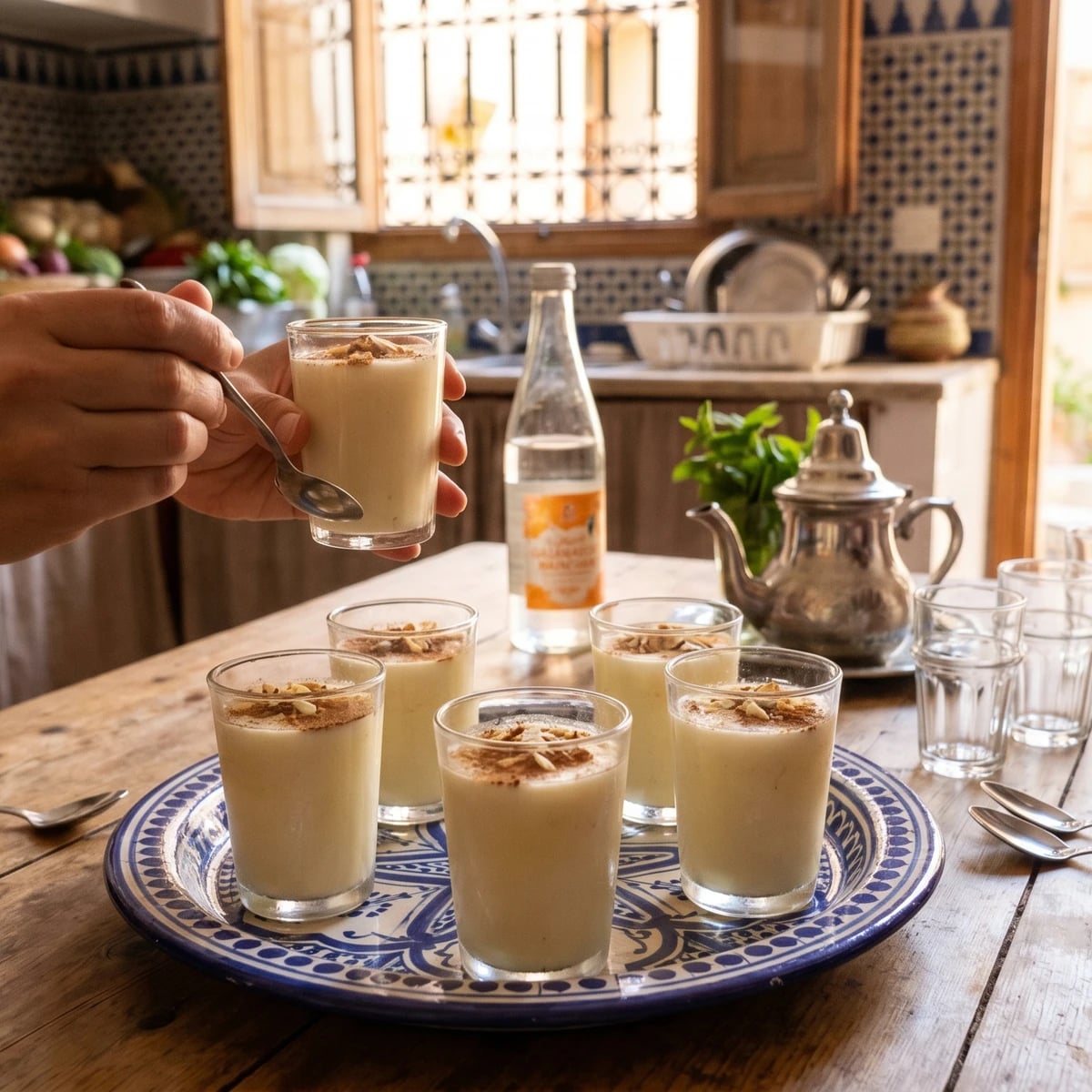
A cool Moroccan milk pudding, set gently with cornstarch, threaded with bloomed saffron and orange-blossom water, then chilled in small glasses for the guest who arrives after dinner.

Desserts
Moroccan
Comfort Food
Make Ahead
Special Occasion
15 min
Active Time
15 min cook4 hr 30 min total
Yield6 small glasses

The spoon tells you when muhalabia is ready. At first the milk moves like milk, loose and bright, then the saffron begins to stain it gold and the cornstarch wakes under the whisk. When it coats the back of the spoon and a finger drawn through leaves a clean path, stop. This pudding sets again in the cold, so if you cook it until it stands in the pot, you'll serve something stiff instead of tender.

Orange-blossom water goes in after the fire, not before it. Heat is greedy with perfume; it takes the fragrance and leaves only sweetness behind. Use real saffron threads bloomed in warm milk, not powder, because here there is nowhere for a false color to hide.

In Moroccan homes this is a cool sweet for a full evening, Ramadan nights, a guest after a long tagine, or one of those days when comfort wants a small glass and a spoon. It isn't one monument called Moroccan cuisine; il n'y a pas une cuisine marocaine, mais des cuisines marocaines (not one Moroccan cuisine, but many), and this milk pudding sits especially well in the urban Andalusi register, perfumed, restrained, made ahead so the host can stay at the table.

Make six even if you need four. Cold muhalabia waits kindly, and a table is a door you leave open.

Muhalabia's name is often linked to al-Muhallab ibn Abi Sufra, a 7th-century Umayyad-era commander in Basra, but that origin is a story rather than a proven recipe date. By the 10th-century Abbasid cookbook tradition in Baghdad, milk puddings thickened with rice or starch were written down, and similar dishes moved west through Andalusi and Maghrebi routes. In Morocco the pudding settled into city tables, especially Fassi, Tetouani, and Jewish-Moroccan households, where orange-blossom water, cinnamon, almonds, and sometimes saffron mark the local hand.

The technique, the tradition, and the story behind every dish.

Discover Culinary Explorer

Ingredients

whole milk

Quantity

1 liter

divided

sugar

Quantity

80g

cornstarch

Quantity

40g

sifted

saffron threads

Quantity

1 generous pinch

fine sea salt

Quantity

1 pinch

orange-blossom water (ma zhar)

Quantity

1 to 1 1/2 tbsp

added off heat

blanched almonds (optional)

Quantity

35g

toasted and chopped

ground cinnamon (optional)

Quantity

1/2 tsp

for dusting

Equipment Needed

  • Medium heavy saucepan, 2 to 3 liter
  • Whisk
  • Fine-mesh sieve
  • Six 120ml small glasses or beldi bowls

Instructions

  1. 1

    Bloom the saffron

    Take 2 tablespoons from the measured milk and warm it until just hot to the touch. Rub the saffron threads lightly between your fingers into the milk and leave them for 10 minutes, until the milk turns yellow-gold and smells floral. Powdered yellow dye has no place in this pudding.

    The saffron needs warmth and a little time to open. Drop dry threads straight into the pot and you lose half of what you paid for.
  2. 2

    Make the slurry

    Pour 200ml of the measured cold milk into a bowl and whisk in the cornstarch until completely smooth. Cold milk matters: cornstarch clumps when it meets heat dry, and those little lumps stay with you.

  3. 3

    Warm the milk

    Pour the remaining milk into a medium heavy saucepan with the sugar and salt. Warm it over medium-low heat, stirring until the sugar dissolves and tiny bubbles gather around the edge. Whisk in the bloomed saffron milk.

  4. 4

    Thicken gently

    Whisk the cornstarch slurry once more, then pour it slowly into the warm milk while whisking. Cook over medium-low heat for 6 to 8 minutes, scraping the bottom and corners of the pan, until the pudding coats the spoon and a line drawn through it stays clean. Let it make small lazy bubbles for one full minute so the starch tastes cooked, not chalky.

    Do not chase a hard boil. The milk catches fast at the bottom, and the pudding will thicken more as it chills.
  5. 5

    Perfume off heat

    Take the pan off the heat and stir in 1 tablespoon orange-blossom water. Smell it. If your bottle is quiet, add another teaspoon or two. La balance est dans les yeux, and here it is in the nose too. Pass the pudding through a fine sieve into a jug if you want it especially smooth.

  6. 6

    Pour and chill

    Pour the pudding into 6 small glasses or beldi bowls. Tap each one gently on the counter to settle the surface, then let them cool until no longer hot. Cover and refrigerate for at least 4 hours, until softly set and cold all the way through. It should tremble when moved, not stand like a block.

  7. 7

    Finish at serving

    Just before serving, scatter the toasted almonds over the cold puddings and dust with a little cinnamon. Serve with small spoons, mint tea if you like, and one extra glass ready for whoever arrives late.

Chef Tips

  • Use whole milk. Lighter milk will set, but it tastes thin and the perfume has nothing soft to rest on.
  • Bloom saffron threads in warm milk before they meet the pot. With saffron, as with ras el hanout, you don't cheat.
  • Orange-blossom water varies from bottle to bottle. Start with 1 tablespoon, then smell and taste. Too much turns soapy, too little disappears.
  • Cornstarch needs that last quiet minute of bubbling or the pudding tastes chalky. Stop once it coats the spoon; the cold will finish the setting.
  • Garnish at the end. Almonds soften in the refrigerator, and cinnamon stains the surface if it sits too long.

Advance Preparation

  • Make muhalabia up to 2 days ahead and keep it covered in the refrigerator.
  • Add almonds and cinnamon only just before serving.
  • Do not freeze it. The milk and starch separate after thawing, and the texture breaks.

Frequently Asked Questions

Nutrition Information

1 serving (about 190g)

Calories
215 calories
Total Fat
9 g
Saturated Fat
3 g
Trans Fat
0 g
Unsaturated Fat
5 g
Cholesterol
17 mg
Sodium
95 mg
Total Carbohydrates
29 g
Dietary Fiber
1 g
Sugars
22 g
Protein
7 g

Note: Chef personas and recipes are created with AI assistance. Cook with care: follow safe food-handling practices, check doneness with a thermometer when needed, and adapt for allergies and your kitchen.

Where cooking meets culture.

Culinary guides, cultural storytelling, and the editorial depth that makes cooking meaningful.

Discover Culinary Explorer

More from Moroccan Sweet Interludes & Puddings

Browse the full collection