
Chef Klaus
Berlin Currywurst
The Berlin Imbiss counter on a plate: fried sausage cut thick, a tomato curry sauce cooked until glossy, and enough fries or bread to chase every bit.
A cooking platform built around craft, culture, and the stories behind what we eat.
Created by
Munich's white sausage works because the meat stays cold before stuffing and the water stays gentle after it. Boil it once, and you've made a split sausage and a cloudy pot.
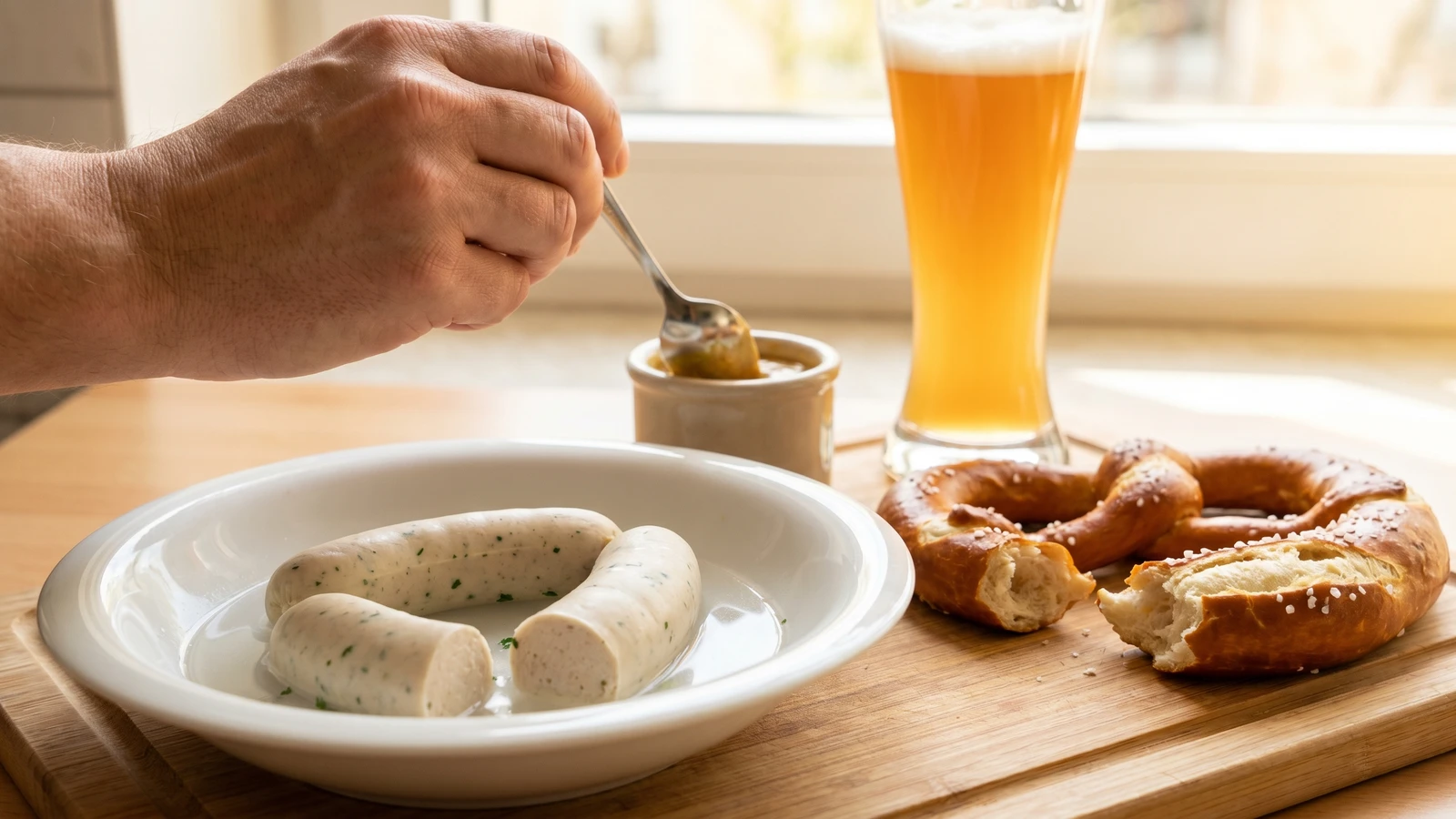
Weisswurst belongs to Munich and to the late morning table, the second breakfast before the day turns serious. In Bavaria it comes with sweet mustard, a Brezn, and usually a Weissbier if the day allows it; further north, people look at the clock rule and shake their heads. Im Norden anders, im Sueden anders. This one is Munich's argument, and it has held its ground.
The sausage is pale because there is no curing salt, only veal, pork back fat, parsley, lemon, onion, and warm spice. That means it is perishable and mild by design. It is not smoked, not browned, not thrown on a grill. Das ist kein Bierzelt. You make it, poach it gently, and eat it fresh.
Two temperatures decide the whole thing. The meat and fat must stay very cold while you grind and mix, because warm fat smears instead of binding, and a smeared sausage turns grainy. Then the stuffed sausages sit in water around 70C, never boiling, because a hard boil tightens the casing and breaks the fine filling. Runter mit der Temperatur. That's the dish.
Serve it in its hot water, lift it out as you eat, and bring the mustard from the jar if you bought the right mustard, but not the sausage. Nicht aus dem Glas, and not from a packet either.
Weisswurst is closely tied to Munich and is commonly dated to 1857, when the innkeeper Sepp Moser at the Gasthaus Zum Ewigen Licht is said to have made pale sausages from veal when the usual sheep casings or bratwurst materials ran short. The before-noon rule came from the time before reliable refrigeration, since an uncured, unsmoked sausage made early in the day did not keep well. Its Munich identity is so strong that Bavaria and the rest of Germany still argue over the proper way to eat it, with sweet mustard and Brezn in the south, and plenty of raised eyebrows elsewhere.
Quantity
700g
very cold, cut into 2cm cubes
Quantity
300g
very cold, cut into 2cm cubes
Quantity
18g
Quantity
3g
Quantity
1g
Quantity
1g
Quantity
1 teaspoon
finely grated
Quantity
1
finely grated and squeezed dry
Quantity
25g
finely chopped
Quantity
150g
Quantity
2 metres
soaked and rinsed
Quantity
to serve
Quantity
to serve
| Ingredient | Quantity |
|---|---|
| veal shouldervery cold, cut into 2cm cubes | 700g |
| pork back fatvery cold, cut into 2cm cubes | 300g |
| fine sea salt | 18g |
| ground white pepper | 3g |
| ground mace | 1g |
| ground cardamom | 1g |
| lemon zestfinely grated | 1 teaspoon |
| small onionfinely grated and squeezed dry | 1 |
| flat-leaf parsley leavesfinely chopped | 25g |
| crushed ice | 150g |
| hog casingssoaked and rinsed | 2 metres |
| sweet Bavarian mustard | to serve |
| Brezn or soft pretzels | to serve |
Put the veal, pork back fat, grinder parts, and mixing bowl in the freezer for 25 to 30 minutes, until the meat is firm at the edges but not frozen solid. Cold fat cuts cleanly and binds into the sausage; warm fat smears, and then the filling eats grainy instead of fine.
Rinse the hog casings inside and out under cool water, then leave them in fresh water while you grind. Clean casings slide onto the stuffer without tearing, and the rinse clears the packed salt that would make the first bite harsh.
Grind the cold veal and back fat through a fine plate into the chilled bowl. Work quickly and put the bowl back over ice if the fat starts looking shiny, because shine means it is warming, and warming is where a Weisswurst begins to fail.
Add the salt, white pepper, mace, cardamom, lemon zest, squeezed onion, parsley, and crushed ice. Mix firmly with a paddle or cold hands until the farce turns sticky and holds to the side of the bowl, 2 to 3 minutes; the salt pulls protein from the meat, and that protein is the glue that keeps the sausage juicy instead of crumbly.
Load the casing onto the stuffer and fill it with the farce, guiding it loosely rather than tight. A little slack matters because the filling swells during poaching; overstuff it now and the casing splits later, then everyone looks at the pot as if the pot did it.
Twist into 10 to 12cm sausages, alternating direction with each link so they hold their shape. Prick only obvious air pockets with a clean needle; holes everywhere leak juice, and juice belongs in the sausage, not in the water.
Heat a wide pot of water to 75C, slide in the sausages, then hold the water around 70C for 25 to 30 minutes. Do not boil. A boil hammers the casing and tightens the protein too fast, so the sausage splits outside and turns rubbery inside. Runter mit der Temperatur.
Serve the Weisswurst sitting in some of its hot poaching water, with sweet mustard and Brezn at the table. Lift out only what you are eating, because the water keeps the sausage gentle and warm without browning it. Eat it fresh, before noon if you are keeping Munich time. Schoen ist, was schmeckt.
1 sausage with accompaniments (about 190g)
Culinary guides, cultural storytelling, and the editorial depth that makes cooking meaningful.
Discover Culinary ExplorerChef Klaus
The Berlin Imbiss counter on a plate: fried sausage cut thick, a tomato curry sauce cooked until glossy, and enough fries or bread to chase every bit.

Chef Klaus
A northern fish-stall roll built on sharp Bismarck herring, raw onion, and pickle, with one rule deciding the whole thing: the vinegar cure goes on cold and gets its time.

Chef Klaus
Franconia's sour-poached bratwurst skips the grill: raw sausages, onion, vinegar, wine, and one quiet rule, keep the sud below the boil.

Chef Klaus
A Berlin Brühwurst belongs in hot water, not boiling water: warm it gently, keep the skin tight, then eat it in a roll with sharp mustard.