
Chef Lupita
Arroz a la Tumbada Veracruzano
Veracruz's Gulf coast rice from Alvarado, built with seafood stock, tomato, chile chipotle, epazote, shrimp, fish, jaiba, and pulpo, served loose and brothy in a clay cazuela.
A cooking platform built around craft, culture, and the stories behind what we eat.
Created by
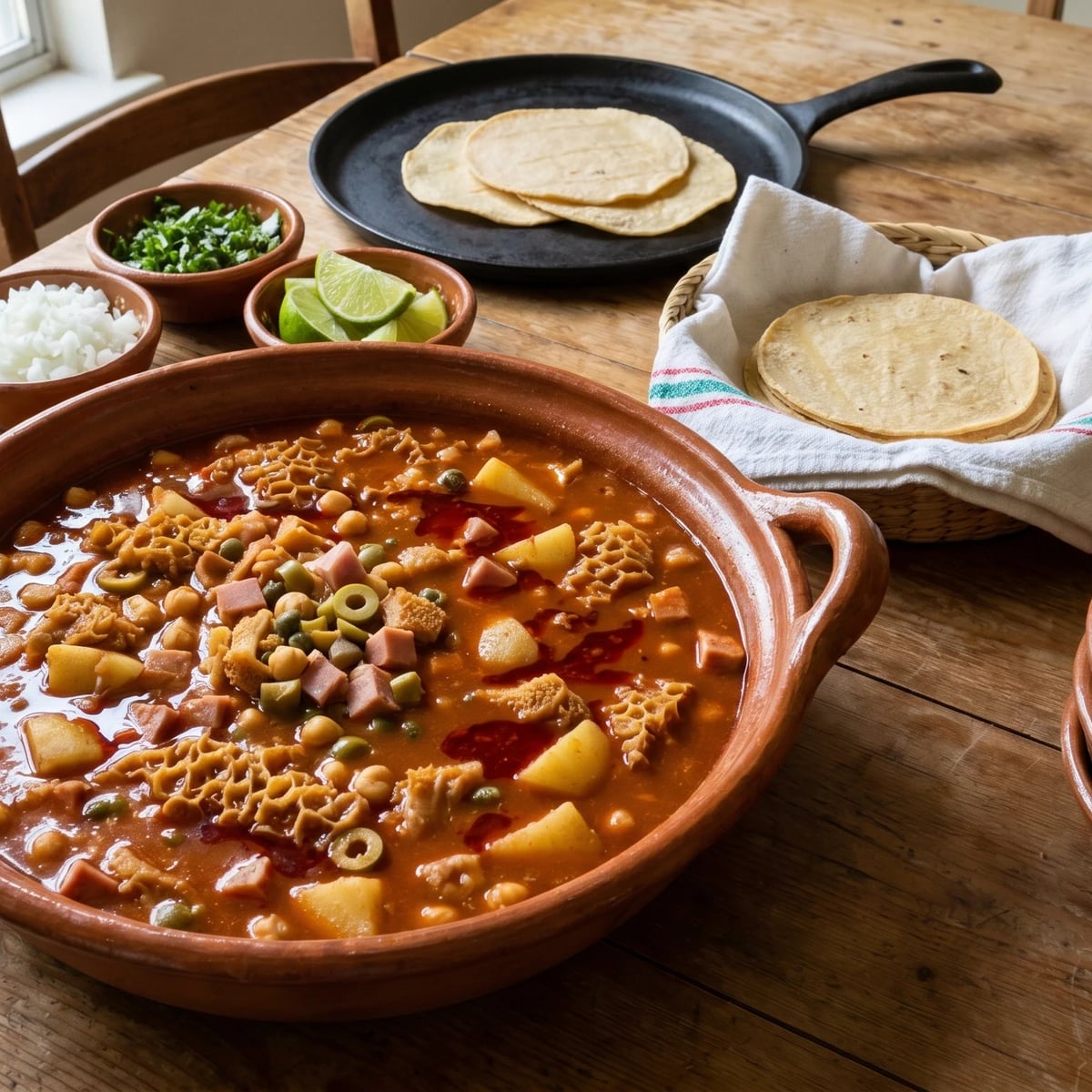
Veracruz's Gulf-coast mondongo is a long-simmered tripe stew with guajillo, tomato, chorizo, ham, garbanzos, and herbs, heavier than northern menudo and sweeter at the edge.
Veracruz, especially the port and the Sotavento, cooks mondongo like a state that has always lived with ships arriving, spices moving, and women making something serious from the parts other people ignore. This is not northern menudo. This is a Veracruz stew: tomato, chile guajillo, chorizo, ham, garbanzos, and tripe simmered until it stops fighting the spoon.
The chile here is guajillo, with a little ancho for body. Not chile powder. Not a packet. You toast the chiles on a comal, soak them, blend them with tomato, and fry that sauce in manteca de cerdo until it darkens and smells deep. The chorizo gives red fat, the ham gives salt and sweetness, and the garbanzos make the pot feel Spanish and Gulf at the same time. Cada estado, su propia cocina.
I learned a version like this from a señora near Mercado Hidalgo in Veracruz, who cleaned the tripe twice because, as she said, laziness has a smell. She was right. Mondongo asks for patience before it asks for skill. Clean it well, cook it low, season it at the end, and serve it in a clay cazuela with lime, onion, and warm corn tortillas. Saber cocinar es saber vivir.
Mondongo arrived in Mexico through Spanish offal cookery and took different regional forms as local chiles, herbs, and market habits shaped the pot. Veracruz's version reflects the port's colonial trade routes, where Spanish cured meats, chickpeas, olives, capers, and Caribbean seasoning habits entered local kitchens alongside native chiles and tomato. Unlike northern menudo, which is usually built around a cleaner chile broth and hominy, mondongo veracruzano is commonly thicker, tomato-rich, and reinforced with chorizo, ham, garbanzos, and potatoes.
Quantity
3 pounds
rinsed and cut into 1 1/2-inch pieces
Quantity
2 pounds
rinsed
Quantity
1/2 cup
for cleaning the tripe
Quantity
2 tablespoons
for cleaning the tripe
Quantity
1
halved crosswise
Quantity
1 large
halved, divided
Quantity
2
Quantity
1 teaspoon
Quantity
1 tablespoon, plus more to taste
Quantity
10
stemmed and seeded
Quantity
2
stemmed and seeded
Quantity
4
roasted
Quantity
4
roasted
Quantity
2 tablespoons
Quantity
8 ounces
casing removed
Quantity
6 ounces
diced
Quantity
1 medium
finely chopped
Quantity
2 medium
peeled and cut into 3/4-inch cubes
Quantity
1 1/2 cups
drained
Quantity
1 teaspoon
Quantity
1 sprig
Quantity
1/4 cup
sliced
Quantity
1 tablespoon
rinsed
Quantity
2 tablespoons
Quantity
for serving
Quantity
for serving
Quantity
for serving
Quantity
for serving
| Ingredient | Quantity |
|---|---|
| beef honeycomb triperinsed and cut into 1 1/2-inch pieces | 3 pounds |
| beef foot or beef shank bonesrinsed | 2 pounds |
| white vinegarfor cleaning the tripe | 1/2 cup |
| kosher saltfor cleaning the tripe | 2 tablespoons |
| head of garlichalved crosswise | 1 |
| white onionhalved, divided | 1 large |
| bay leaves | 2 |
| black peppercorns | 1 teaspoon |
| kosher salt | 1 tablespoon, plus more to taste |
| dried chile guajillostemmed and seeded | 10 |
| dried chile anchostemmed and seeded | 2 |
| Roma tomatoesroasted | 4 |
| garlic clovesroasted | 4 |
| manteca de cerdo | 2 tablespoons |
| Mexican chorizocasing removed | 8 ounces |
| smoked hamdiced | 6 ounces |
| white onionfinely chopped | 1 medium |
| waxy potatoespeeled and cut into 3/4-inch cubes | 2 medium |
| cooked garbanzosdrained | 1 1/2 cups |
| dried Mexican oregano | 1 teaspoon |
| fresh epazote | 1 sprig |
| pimiento-stuffed green olivessliced | 1/4 cup |
| capersrinsed | 1 tablespoon |
| pickled jalapeno brine (optional) | 2 tablespoons |
| fresh lime wedges (optional) | for serving |
| finely diced white onion (optional) | for serving |
| chopped cilantro (optional) | for serving |
| warm corn tortillas (optional) | for serving |
Put the tripe in a large bowl with the vinegar and 2 tablespoons kosher salt. Rub it hard with your hands for 2 minutes, then rinse under cold running water until the water runs clear. Smell it. It should smell clean and faintly mineral, not sour or barnyard. Laziness has a smell. Do this properly.
Place the cleaned tripe, beef foot or shank bones, halved garlic head, half of the large onion, bay leaves, peppercorns, and 1 tablespoon kosher salt in a heavy stockpot. Cover with cold water by 3 inches. Bring to a gentle simmer over medium heat and skim the foam during the first 20 minutes. Do not boil hard. Tripe gets tender through time, not violence.
Lower the heat until the pot gives slow, steady bubbles. Cover partially and cook for 2 1/2 to 3 hours, until the tripe is tender but still has a pleasant chew. Remove the onion, garlic, bay leaves, and bones. Keep the tripe and broth together. If using beef foot, pull off any tender meat and return it to the pot.
Heat a dry comal over medium. Toast the chile guajillo and chile ancho separately, about 20 to 30 seconds per side, just until the skins puff and the color deepens. Do not blacken them. Burned guajillo turns sharp and bitter, and no amount of ham will save the pot.
Place the toasted chiles in a bowl and cover with hot water, not boiling water. Let them soften for 20 minutes. Drain, then blend with the roasted tomatoes, roasted garlic cloves, the remaining half onion, and 1 cup of the tripe broth until completely smooth. Strain through a fine-mesh sieve. A Veracruz stew should be rich, not gritty.
In a wide cazuela or Dutch oven, melt the manteca de cerdo over medium heat. Add the chorizo and cook until it releases its red fat, 5 to 6 minutes. Add the ham and chopped onion and cook until the onion softens. Pour in the strained chile-tomato sauce. It will sputter. Stir and fry it for 8 to 10 minutes, until the sauce darkens, thickens, and the fat begins to separate at the edges. La manteca es el sabor.
Add the tripe and enough of its broth to make a generous stew, about 7 to 8 cups. Stir in the potatoes, garbanzos, dried Mexican oregano, and epazote. Simmer uncovered for 35 to 45 minutes, until the potatoes are tender and the broth has body. The surface should show small red pools of chorizo fat and chile, not a thin watery soup.
Stir in the olives, capers, and pickled jalapeno brine if using. Simmer 10 minutes more. Taste for salt only after the ham, olives, and capers have had time to speak. The final flavor should be savory, red with guajillo, lightly sweet from the tomato and ham, and a little briny at the end.
Ladle the mondongo into deep clay bowls or bring the cazuela to the table. Set out lime wedges, diced white onion, chopped cilantro, and warm corn tortillas. Flour tortillas belong to the north. Here you eat this with corn tortillas and the broth staining the rim of the bowl red. Así se hace y punto.
1 serving (about 600g)
Culinary guides, cultural storytelling, and the editorial depth that makes cooking meaningful.
Discover Culinary Explorer
Chef Lupita
Veracruz's Gulf coast rice from Alvarado, built with seafood stock, tomato, chile chipotle, epazote, shrimp, fish, jaiba, and pulpo, served loose and brothy in a clay cazuela.

Chef Lupita
Veracruz's Christmas cod stew, built from salt cod soaked back to life, tomato, olive oil, capers, almonds, potatoes, and pickled chile guero from the Gulf port kitchen.

Chef Lupita
Veracruz's Gulf coast caldo, built from fish bones, shrimp shells, jaiba, tomato, chile guajillo, chile ancho, and epazote, the kind of pot that belongs to Lent, family tables, and port kitchens.

Chef Lupita
Veracruz's Sotavento broth from Alvarado, clear and direct, whole fish simmered with tomato, chile jalapeño, epazote, cilantro, and lime until the sea and river taste like themselves.