
Chef Lupita
Aguascalientes Beef Tongue Pozole (Pozole de Lengua)
Aguascalientes' Bajio pozole de lengua, built with cacahuazintle hominy, tender beef tongue, chile ancho and guajillo, with xoconostle brightness and table garnishes.
A cooking platform built around craft, culture, and the stories behind what we eat.
Created by
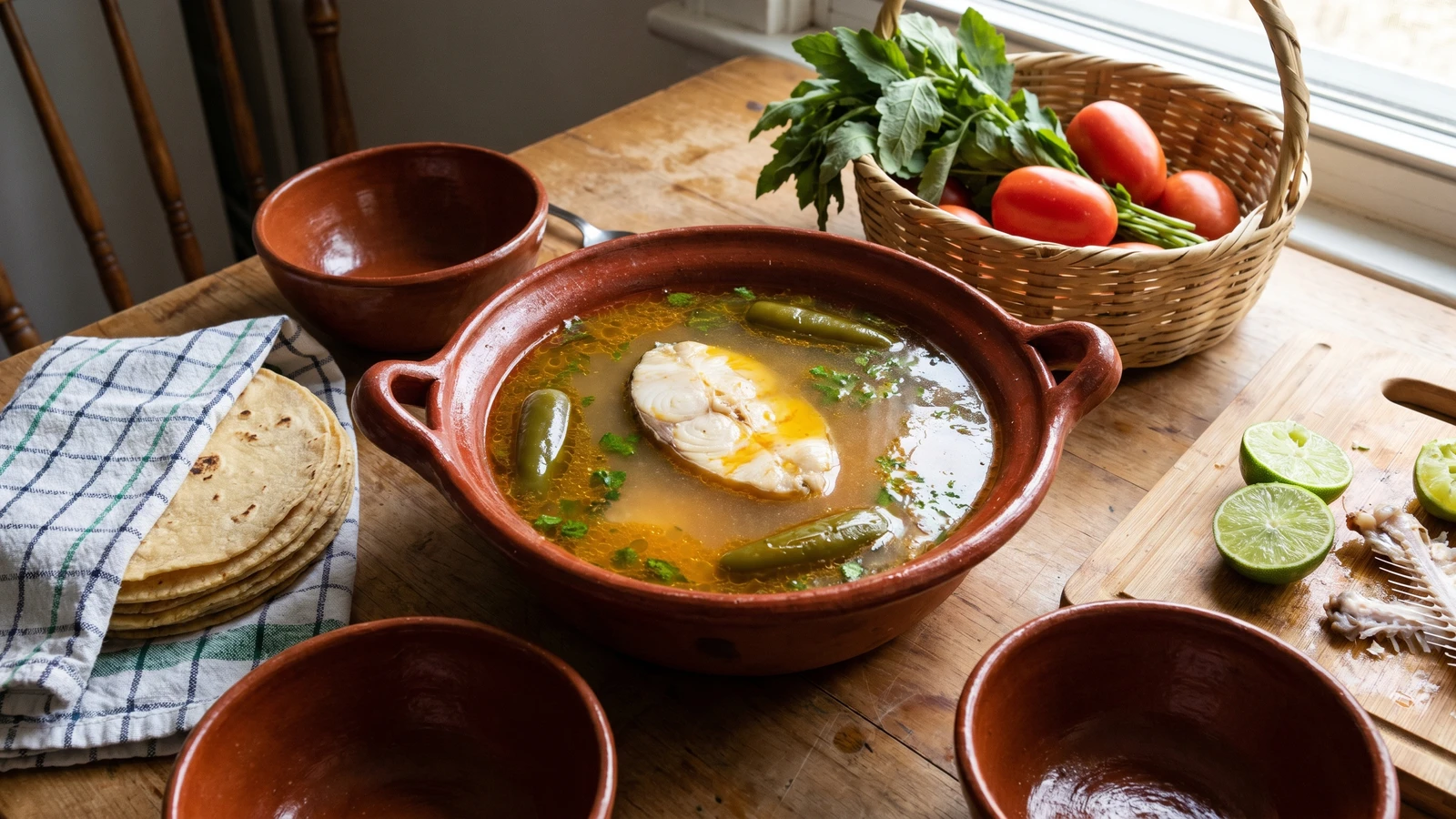
Veracruz's Sotavento broth from Alvarado, clear and direct, whole fish simmered with tomato, chile jalapeño, epazote, cilantro, and lime until the sea and river taste like themselves.
Veracruz, the Sotavento, Alvarado. Put it on the map first: south of the port of Veracruz, near the mouth of the Papaloapan, where river, lagoon, and Gulf water have fed cooks for generations. Caldo largo lives there because fish lives there. Robalo, mojarra, huachinango, pargo, whatever the boats and the mercado give you that morning.
This is not chowder. It is not pozole. It is not a tomato soup wearing a fish costume. Caldo largo is clear fish broth with jitomate, chile jalapeño, epazote, cilantro, and lime at the table. No masa. No cream. No roux. The skill is restraint: simmer the bones gently, stain the broth with tomato, and cook the fish only until it flakes. That is the difference between a Veracruz broth and a pot of punished seafood.
I learned this one from a señora in Alvarado who watched my hands more than my notebook. She used the head for the broth, kept the jalapeño whole so it scented the pot without taking over, and slapped my spoon when I tried to stir after the fish went in. She was right. The fish should sit in the broth like it belongs there, not dissolve into it.
My mother was from Jalisco, so this was not in her notebook. But she wrote one sentence that belongs here anyway: 'El caldo se respeta.' Respect the broth. Saber cocinar es saber vivir.
Alvarado sits in Veracruz's Papaloapan basin, a fishing and river-trade region shaped by Indigenous, Spanish, and Afro-Caribbean foodways after the Gulf coast entered the colonial maritime network in the 16th century. The name Alvarado appears in early Spanish accounts tied to Pedro de Alvarado and the 1518 Juan de Grijalva expedition, but the cooking of the region remained rooted in local fish, lagoon shrimp, herbs, and maize long after the maps changed. Caldo largo belongs to the Veracruz tradition of clear seafood broths: stretched enough to feed a table, but never thickened into something that hides the fish.
Quantity
1 fish, 2 1/2 to 3 pounds
scaled, gutted, gills removed, head and bones kept, flesh cut into thick steaks
Quantity
10 cups
Quantity
1 medium
half left whole and half thinly sliced
Quantity
5
3 crushed and 2 finely chopped
Quantity
6
chopped
Quantity
2
slit lengthwise
Quantity
1 tablespoon
Quantity
1
Quantity
8
Quantity
2 teaspoons, plus more to taste
Quantity
3 large sprigs
Quantity
1 small bunch
stems and leaves separated
Quantity
2
cut into wedges
Quantity
for serving
| Ingredient | Quantity |
|---|---|
| whole firm white fish, such as robalo, huachinango, mojarra, or pargoscaled, gutted, gills removed, head and bones kept, flesh cut into thick steaks | 1 fish, 2 1/2 to 3 pounds |
| cold water | 10 cups |
| white onionhalf left whole and half thinly sliced | 1 medium |
| garlic cloves3 crushed and 2 finely chopped | 5 |
| ripe Roma tomatoeschopped | 6 |
| fresh chile jalapeñoslit lengthwise | 2 |
| aceite de oliva or neutral oil | 1 tablespoon |
| bay leaf | 1 |
| black peppercorns | 8 |
| kosher salt | 2 teaspoons, plus more to taste |
| fresh epazote | 3 large sprigs |
| cilantrostems and leaves separated | 1 small bunch |
| limescut into wedges | 2 |
| warm corn tortillas (optional) | for serving |
Ask the fishmonger to scale and gut the fish, remove the gills, cut the flesh into thick steaks, and give you the head and backbone. The head is not decoration. It is flavor. Rinse the pieces quickly under cold water and pat them dry. Salt the fish steaks lightly and keep them cold while you build the broth.
Put the fish head, backbone, half onion, 3 crushed garlic cloves, bay leaf, peppercorns, cilantro stems, 1 teaspoon salt, and cold water in a wide pot. Bring it slowly to a gentle simmer. Skim the foam that rises. Do not boil it hard. Fish gives its flavor quickly, and violence in the pot gives you cloudy broth and broken flesh.
After 20 minutes of gentle simmering, strain the broth through a fine-mesh strainer into a bowl or clean pot. Press lightly on the bones, then stop. If you mash everything, you drag bitterness and grit into a broth that should be clean. Discard the spent bones and aromatics, unless someone at the table wants the fish head. In Alvarado, somebody usually does.
Wipe out the pot and set it over medium heat. Add the aceite de oliva, the sliced onion, and the 2 finely chopped garlic cloves. Cook until the onion softens but does not brown, about 3 minutes. Add the chopped Roma tomatoes and the slit chile jalapeños. Cook 6 to 8 minutes, until the tomato collapses and stains the oil orange-red. This is not a thick sauce. It is a clean tomato base for the broth.
Pour the strained fish broth back into the pot. Add the epazote and the remaining teaspoon of salt. Bring it back to a quiet simmer and cook 10 minutes so the tomato, chile, and herbs settle into the liquid. Taste now. It should taste like fish first, tomato second, chile in the background. Not all Mexican food is trying to burn your mouth. That lazy idea has ruined enough good cooking.
Lower the fish steaks into the broth in one layer. Do not stir them around like laundry. Spoon a little broth over the top, cover partially, and simmer 8 to 10 minutes, depending on thickness. The fish is done when it flakes at the thickest part and still holds its shape. If it breaks apart into threads, you cooked it too hard. No me vengas con atajos. Gentle heat is the technique.
Remove the epazote stems if they are tough. Stir in a handful of cilantro leaves just before serving. Ladle broth into deep bowls with one piece of fish in each. Put lime wedges and warm corn tortillas on the table. The lime is squeezed in by the person eating, not boiled into the pot. Recetas probadas y garantizadas.
1 serving (about 575g)
Culinary guides, cultural storytelling, and the editorial depth that makes cooking meaningful.
Discover Culinary ExplorerChef Lupita
Aguascalientes' Bajio pozole de lengua, built with cacahuazintle hominy, tender beef tongue, chile ancho and guajillo, with xoconostle brightness and table garnishes.

Chef Lupita
Veracruz's Gulf coast rice from Alvarado, built with seafood stock, tomato, chile chipotle, epazote, shrimp, fish, jaiba, and pulpo, served loose and brothy in a clay cazuela.

Chef Lupita
Costa Chica's wet salt-beef stew, built from chile costeño, guajillo, tomato, manteca, yuca, plantain, and masa dumplings, the ranching pot of Cuajinicuilapa and Pinotepa.

Chef Lupita
Michoacán's P'urhépecha atápakua is a masa-thickened sauce and stew at once, built with pork, chile guajillo, and hierbabuena added only at the end.