
Chef Thomas
A Proper Ploughman's Board
A board of good cheddar, thick ham, proper pickle, hard-boiled eggs, and crusty bread. Not cooking so much as assembling with conviction, and one of the finest lunches the English kitchen has ever produced.
A cooking platform built around craft, culture, and the stories behind what we eat.
Created by Chef Thomas
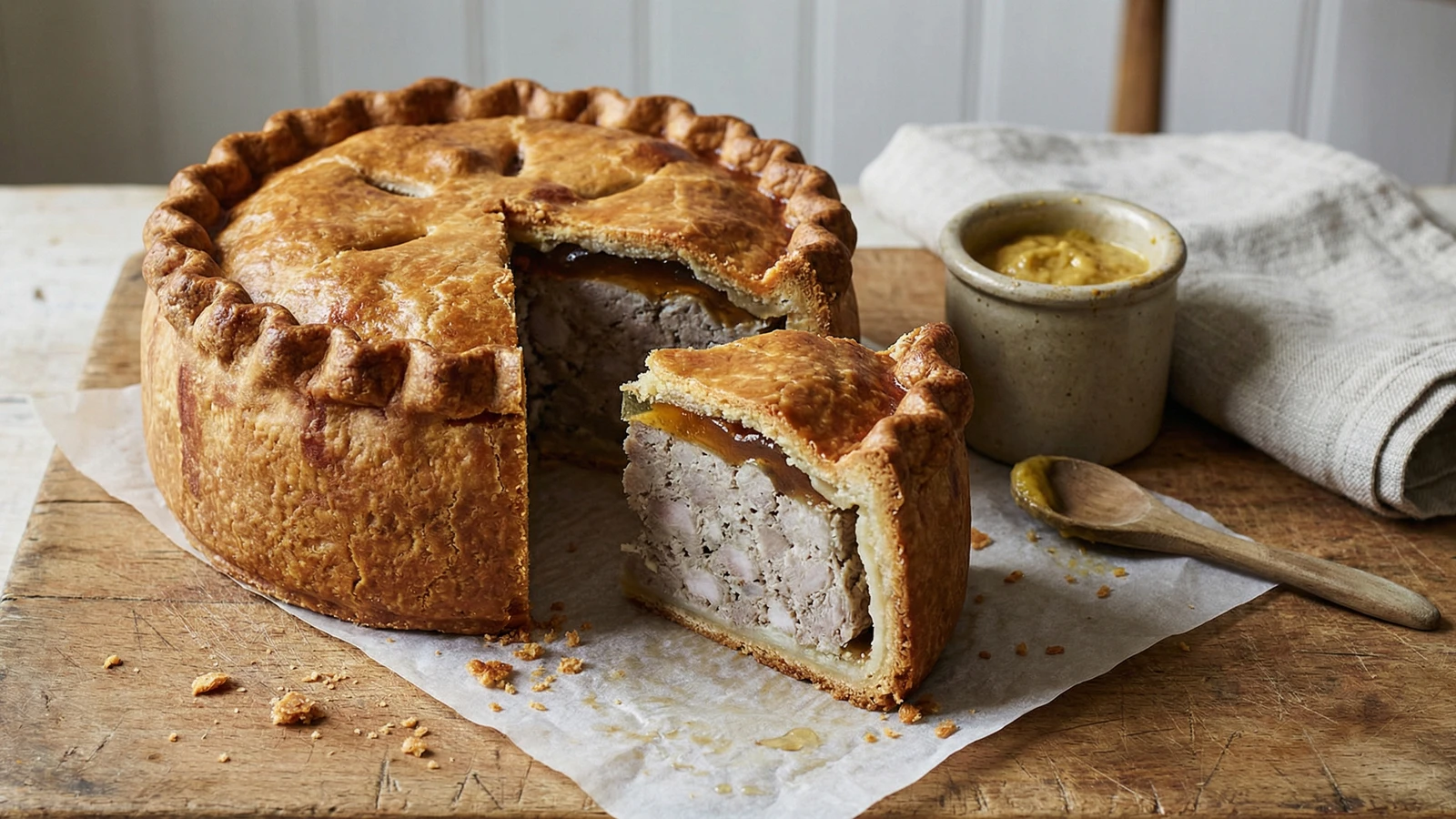
A proper hand-raised pork pie with hot water crust and rough-chopped uncured pork, set with savoury bone stock jelly, the kind of cold pie that makes Boxing Day worth the early morning.
There is a moment on Boxing Day, somewhere around mid-morning, when the kitchen is cold and the house is quiet, and someone opens the fridge and finds the pie. It has been sitting there since yesterday, the jelly set firm, the crust golden and solid. Someone cuts a wedge. Then another. A cold pork pie at eleven in the morning, standing at the counter with a dab of mustard and nobody watching, is one of the more civilised pleasures this country has produced.
This is not a weeknight recipe. I won't pretend otherwise. A Melton Mowbray pork pie asks for an afternoon of your attention, a willingness to get your hands into warm dough, and the patience to let the whole thing set overnight before you cut into it. But the reward is something no shop-bought pie will give you: a hand-raised crust, golden and slightly bow-sided because you shaped it yourself, filled with rough-chopped pork that tastes of the animal and not the curing salt, held together with a trembling layer of savoury jelly made from bones and time.
The meat stays grey when it cooks. This is correct. This is what uncured pork does, and it is the mark of a proper Melton Mowbray. The pink, uniform filling of a factory pie comes from nitrates and machines. Yours will look different. It will taste of pork.
I make one every December. The notebook has a page for it: 'Pork pie. Boxing Day. The crust held.' That was a good year. The year it didn't is also in there, because honesty matters in a notebook. The pie still tasted right. It just looked like it had been in an argument.
Quantity
400g
Quantity
1 teaspoon
for the pastry
Quantity
100g
plus extra for greasing
Quantity
150ml
Quantity
1
beaten with a splash of milk for glaze
Quantity
750g
bone out, hand-chopped into rough small pieces
Quantity
1 teaspoon
for the filling
Quantity
½ teaspoon
Quantity
¼ teaspoon
Quantity
1 teaspoon
Quantity
300ml
well-flavoured, ideally made from bones
Quantity
3 leaves
| Ingredient | Quantity |
|---|---|
| plain flour | 400g |
| fine sea saltfor the pastry | 1 teaspoon |
| lardplus extra for greasing | 100g |
| water | 150ml |
| egg yolkbeaten with a splash of milk for glaze | 1 |
| pork shoulderbone out, hand-chopped into rough small pieces | 750g |
| fine sea saltfor the filling | 1 teaspoon |
| ground white pepper | ½ teaspoon |
| ground mace | ¼ teaspoon |
| anchovy essence (optional) | 1 teaspoon |
| pork stockwell-flavoured, ideally made from bones | 300ml |
| leaf gelatine | 3 leaves |
This is the part that matters most. Take the pork shoulder and chop it by hand with a sharp, heavy knife. Not mince. Not a food processor. You want rough, irregular pieces, some the size of a pea, some a little larger. The unevenness is the point: it gives the pie texture and bite, something to press your teeth against. Season the chopped pork with the salt, white pepper, mace, and the anchovy essence if you're using it. Mix it well with your hands until the seasoning is evenly worked through. Cover and put it in the fridge while you deal with the pastry.
Put the flour and salt in a large bowl and make a well in the centre. In a small saucepan, heat the water and lard together until the lard has melted completely and the liquid is just boiling. Pour it into the flour all at once and stir quickly with a wooden spoon until it comes together into a rough, shaggy dough. Turn it out onto a lightly floured surface and knead briefly until smooth. The dough should feel warm and pliable, like clay. Work quickly. Hot water crust is your friend while it's warm and your enemy once it cools and stiffens.
Grease an 18cm loose-bottomed cake tin or springform tin with a little lard. Cut off roughly a third of the warm pastry and keep it under a tea towel for the lid. Roll the larger piece into a thick circle, about 30cm across, and drape it into the tin, pressing it firmly into the base and up the sides with your knuckles. Let it come a centimetre or so above the rim. There should be no gaps, no thin patches, no light showing through. If you want to do it the traditional way, raise it by hand around a floured jam jar and ease the jar out once the pastry holds its shape. The tin is more forgiving and the pie will taste the same.
Pack the seasoned pork into the pastry case, pressing it down firmly with your fist so there are no air pockets. Mound it slightly higher in the centre. The meat will shrink as it cooks, and the gap that opens between filling and crust is where the jelly will go. Roll the reserved pastry into a circle just larger than the top of the pie. Brush the pastry rim with a little of the beaten egg, press the lid on firmly, and crimp the edges together with your fingers or the back of a fork. Cut a clean hole in the centre of the lid, about the width of your little finger. This is not decoration. You will pour the jelly through it tomorrow.
Heat the oven to 200C (180C fan). Brush the top and sides of the pie generously with the beaten egg yolk. Set the pie on a baking tray in case it leaks and bake at the higher temperature for thirty minutes, until the pastry starts to colour and feels firm to the touch. Reduce the oven to 160C (140C fan) and bake for a further hour and a quarter to an hour and a half. The pie is ready when the crust is a deep, confident gold all over. If the top colours too quickly, lay a sheet of foil loosely over it. If you're using a loose-bottomed tin, remove the sides for the last twenty minutes and brush the exposed pastry with more egg wash. A pale-sided pie is a half-finished pie.
While the pie bakes, gently warm the pork stock. Soak the gelatine leaves in cold water for five minutes until soft and floppy, squeeze out the excess water, and stir them into the warm stock until completely dissolved. Let this cool to room temperature. It should be liquid but not hot. When the pie comes out of the oven, let it cool for thirty minutes or so, then slowly pour the jellied stock through the steam hole using a small funnel or a jug with a steady lip. Go slowly. Let it seep down through the gaps between meat and crust. You will need to come back to it two or three times as the liquid finds its level and the air pockets give way. Use as much as the pie will take.
Let the pie cool completely at room temperature, then cover it loosely and refrigerate overnight. The jelly will set firm. The flavours will deepen and settle. The pastry will absorb just enough moisture from the filling to become something remarkable: sturdy enough to hold in your hand, yielding enough to crumble when you bite through it. Serve cold, cut into generous wedges, with English mustard and perhaps some piccalilli if the mood takes you. This is picnic food. Boxing Day food. The sort of thing you wrap in greaseproof paper and carry in a bag to somewhere worth sitting. It doesn't need warming. It doesn't need improving. It needs a sharp knife, a steady hand, and someone to share it with.
1 serving (about 200g)
Culinary guides, cultural storytelling, and the editorial depth that makes cooking meaningful.
Discover Culinary ExplorerChef Thomas
A board of good cheddar, thick ham, proper pickle, hard-boiled eggs, and crusty bread. Not cooking so much as assembling with conviction, and one of the finest lunches the English kitchen has ever produced.

Chef Thomas
Puff pastry twisted with anchovy and Parmesan, baked until golden and shattering and salty, the kind of thing you put out with drinks that disappears before anyone sits down.

Chef Thomas
Fresh oysters wrapped in crisp streaky bacon and grilled until the salt of the sea meets the smoke of the cure, served on hot buttered toast the way the Victorians intended, only simpler and at home.

Chef Thomas
Boiled eggs wrapped in a dark, spiced coat of sausage meat and crumbled black pudding, fried to a deep gold. The kind of thing you eat standing up in the kitchen, still warm, with mustard on your thumb.