
Chef Lupita
Atole de Pinole Sinaloense
Sinaloa's ancestral breakfast atole, toasted corn ground fine with canela and piloncillo, simmered slow into a nutty, thick porridge drunk warm from a clay jarro at first light.
A cooking platform built around craft, culture, and the stories behind what we eat.
Created by
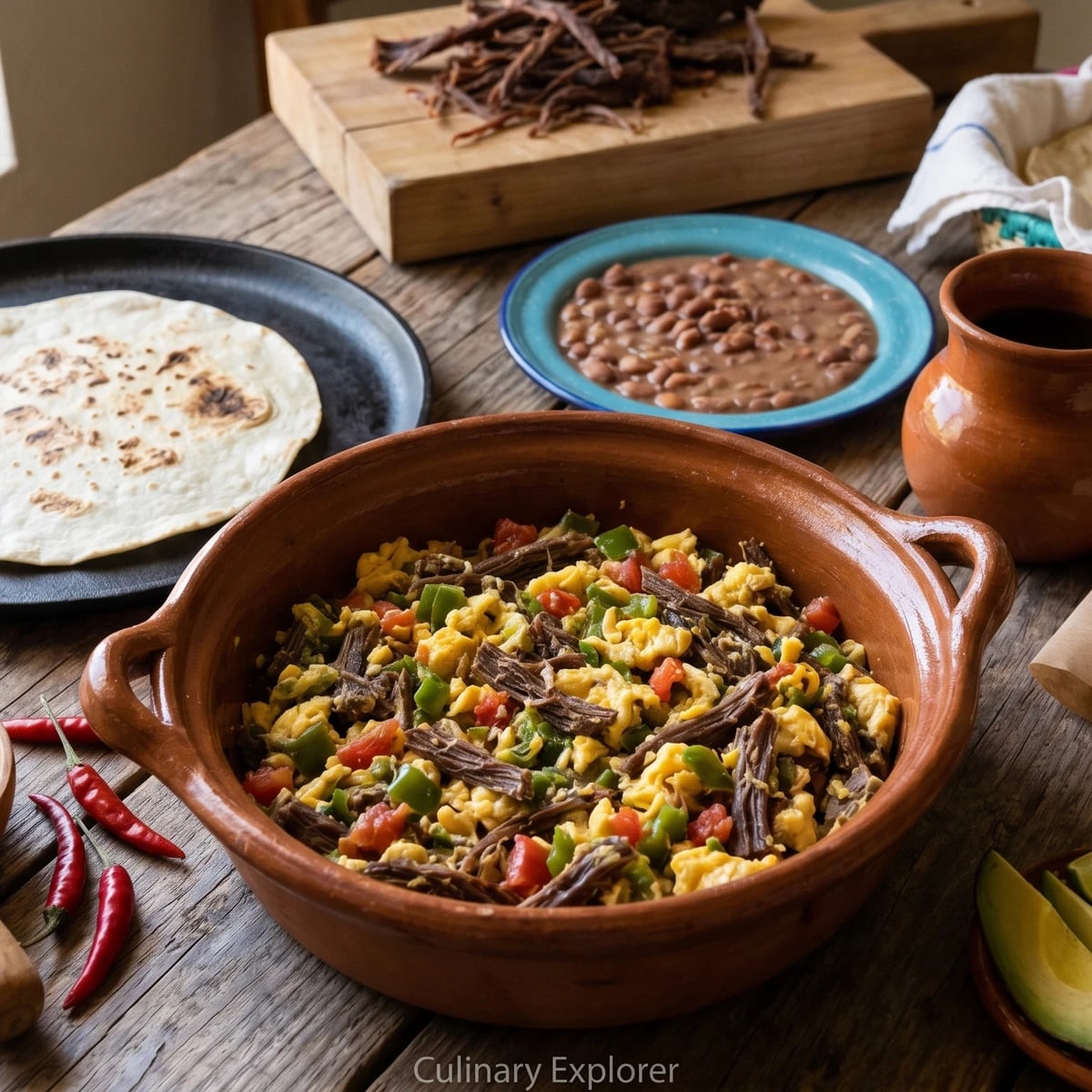
Sonora's morning ritual, sun-dried beef pounded into shreds, sauteed with chile verde and tomato, scrambled into eggs and rolled in a hot sobaquera the size of a dinner plate.
Machaca con huevo is from Sonora. Not from a generic Mexican breakfast menu, not from a Tex-Mex chain that calls a ground beef scramble by the same name. From Sonora. From the ranch kitchens between Hermosillo and the Sierra Madre Occidental, where beef is the religion and the desert sun does the work that smokers and dehydrators try to imitate.
The machaca itself is the dish. Carne seca, sun-dried beef cured with salt and dried on a line in the dry desert air, then pounded with a mesquite mallet on a wooden block until the long fibers shred apart. This is not jerky. Jerky is sweet, leathery, made for chewing. Machaca is a regional preservation art that turns a steer into months of protein for a household. The pounding is what gives it the texture, fluffy and hair-thin, that lets it scramble into the eggs without ever feeling tough. If you skip the pounding, you have ruined it before you ever turn on the stove.
The rest of the dish is the noroeste pantry. Manteca de cerdo, never butter. Chile verde del norte, the long mild Anaheim that grows from Sonora up into Chihuahua, roasted and peeled. Tomato, white onion, garlic. A crushed chiltepin or two, the wild bird's-eye chile harvested by hand from the desert foothills, the only wild chile still commercially gathered in Mexico. And then the sobaqueras, the giant flour tortillas stretched paper-thin under the arm of the tortillera, hot off a steel comal, ready to wrap the whole pan into a burrito the size of your forearm.
My mother was from Jalisco and did not make machaca, but I spent a winter in Magdalena de Kino with a senora named Dona Cleotilde who fed me this every morning before I went to work the carne seca racks behind her house. She used to say that flour tortillas in noroeste are not a compromise on corn. They are the bread of a wheat-growing region, and they belong to this food the same way corn tortillas belong to the south. Cada estado, su propia cocina. Saber cocinar es saber vivir.
The technique of drying beef under the desert sun arrived in Sonora and Chihuahua with the Spanish colonists who established cattle ranching in the northern frontier in the 17th century, building on indigenous Opata and Yaqui methods of preserving meat through salt and air-drying. Sonora became Mexico's principal beef-producing state, and machaca, also called carne machacada or carne seca, evolved as the household preservation method that allowed a single butchered animal to feed a ranch family through months without refrigeration. The wheat tortilla tradition of the noroeste, often dismissed by central Mexican cooks as a colonial imposition, is in fact rooted in the wheat-growing valleys of the Yaqui and Mayo rivers, regions that the Jesuit missions developed as wheat agriculture centers in the 18th century, making harina tortillas the regional bread long before they became a national stereotype.
Quantity
4 ounces
shredded by hand into fine threads
Quantity
8
Quantity
2 tablespoons
Quantity
1/2 medium
finely diced
Quantity
2
roasted, peeled, and chopped
Quantity
1 medium
finely diced
Quantity
2
finely minced
Quantity
2
crushed (or to taste)
Quantity
to taste
Quantity
4
warmed on a comal
Quantity
for serving
Quantity
for serving
Quantity
for serving
Quantity
for serving
| Ingredient | Quantity |
|---|---|
| carne seca sonorenseshredded by hand into fine threads | 4 ounces |
| large eggs | 8 |
| manteca de cerdo (pork lard) | 2 tablespoons |
| white onionfinely diced | 1/2 medium |
| chile verde del norte (Anaheim or New Mexico green chile)roasted, peeled, and chopped | 2 |
| Roma tomatofinely diced | 1 medium |
| garlic clovesfinely minced | 2 |
| chiltepinescrushed (or to taste) | 2 |
| kosher salt | to taste |
| sobaqueras (large hand-stretched flour tortillas)warmed on a comal | 4 |
| frijoles puercos or frijoles maneados (optional) | for serving |
| salsa de chiltepin or salsa de chile colorado (optional) | for serving |
| sliced avocado (optional) | for serving |
| lime wedges (optional) | for serving |
Take the carne seca and pound it lightly with the side of a heavy knife or a wooden mallet until the fibers loosen. Then shred it by hand into fine threads. This is how it is done in Hermosillo and in every ranch kitchen between the Rio Sonora and the Yaqui valley. Carne seca is not jerky. It is sun-dried beef, salted thin, dried on the line in the desert air, and reconstituted by your own hands. The pounding is the difference between a tough mouthful and a tender one.
Heat the manteca in a heavy skillet or cast iron pan over medium heat until it shimmers. Add the shredded carne seca and toast it in the lard for two to three minutes, stirring, until the meat darkens at the edges and the kitchen smells like the desert at dusk. La manteca es el sabor. Use butter and you have made an American breakfast. Use lard and you have made desayuno sonorense.
Push the meat to one side of the pan and add the diced onion to the open space. Cook for two minutes, until translucent. Add the garlic and the chopped chile verde and cook another minute. Add the diced tomato and the crushed chiltepin. Stir everything together now, meat and vegetables, and cook three to four minutes more, until the tomato breaks down into the lard and the mixture looks like a single dish, not separate ingredients sitting next to each other.
Crack the eggs into a bowl and beat them with a fork just until the yolks and whites combine. Do not add milk or cream. This is not a French omelet. Pour the eggs into the pan over the machaca and chile mixture. Let them sit for fifteen seconds before you start moving them, so the bottom sets.
Lower the heat to medium-low. Drag the eggs across the pan with a wooden spoon in slow, broad strokes. Lift, fold, lift, fold. The eggs should cook in soft curds, not in tight, dry pebbles. Pull the pan off the heat when the eggs are still glossy. They will finish cooking from residual heat in the pan. Taste for salt. Carne seca is salty by nature, so the eggs may not need much. Asi se hace y punto.
While the eggs finish, warm the sobaqueras one at a time on a hot comal, about ten seconds per side, until soft and pliable with a few toasted spots. A sobaquera is large, thin, and stretched by hand under the arm of a Sonoran tortillera. That is where the name comes from. In noroeste, flour is where it belongs. No me vengas con corn tortillas for this. They are not the same dish.
Spoon the machaca con huevo onto the warm sobaqueras and roll into burritos, or serve the eggs in a clay cazuela with the tortillas stacked beside in a cloth-lined basket. Set out the frijoles, the salsa de chiltepin, the avocado, and the lime. Eat with strong cafe de talega. This is breakfast in Sonora and it is meant to feed a person who is going to work hard before the sun gets high.
1 serving (about 275g)
Culinary guides, cultural storytelling, and the editorial depth that makes cooking meaningful.
Discover Culinary Explorer
Chef Lupita
Sinaloa's ancestral breakfast atole, toasted corn ground fine with canela and piloncillo, simmered slow into a nutty, thick porridge drunk warm from a clay jarro at first light.

Chef Lupita
The Sonoran ranch breakfast: steel-cut oats simmered slow with whole milk, a stick of true canela, and dark piloncillo from the mercado, until the porridge turns thick, golden, and serious.

Chef Lupita
Baja California's slow-roasted lamb, marinated overnight in chile-and-spice adobo, cooked underground over mesquite, then crisped on a screaming-hot comal at sunrise. Doña Esthela's plate, eaten with the vineyards.

Chef Lupita
Sonora's portable breakfast: shredded carne seca scrambled with egg and folded inside a paper-thin sobaquera, sealed on the comal and eaten one-handed on the way out the door.