
Chef Dean
Ghraybeh
Impossibly tender Middle Eastern shortbread that dissolves on the tongue, made from just three ingredients and a thousand years of tradition. Each bite explains why the name means swooning.
A cooking platform built around craft, culture, and the stories behind what we eat.

Created by
Fragrant semolina cookies with tender, sandy shells encasing warmly spiced date paste, pressed into decorative molds and dusted with powdered sugar. These ancient treats connect generations across the Middle East.
Ma'amoul belongs to that rare category of baking that carries the weight of centuries. Christian families make them for Easter. Muslim families prepare them for Eid. Jewish communities serve them during Purim. The cookie transcends religious boundaries because its appeal is universal: a tender, crumbly shell giving way to intensely sweet date filling perfumed with warm spices.
The dough itself teaches patience. Semolina absorbs butter slowly, transforming over rest time from a shaggy mess into something pliable and forgiving. Don't rush this. The resting period allows the coarse grain to hydrate fully, producing that distinctive sandy texture that crumbles on the tongue without being dry.
Traditional wooden molds called tabi stamp each cookie with intricate geometric patterns. If you don't own these beautiful tools, a fork pressed gently into the dough creates an honest alternative. The cookies taste identical. Only the presentation differs, and I've never met a guest who complained about homemade cookies because they lacked decorative flourishes.
Make these in quantity. They keep beautifully for weeks in airtight containers, improving as the flavors meld. Across the Middle East, families produce hundreds at a time, working assembly-line style with grandmothers, mothers, and children each handling their station. This is communal baking at its finest.
Quantity
2 cups (340g)
Quantity
1 cup (140g)
Quantity
1 cup (225g)
melted and cooled
Quantity
1/4 cup (60ml)
warmed
Quantity
1/4 cup (50g)
Quantity
1 tablespoon
Quantity
1 tablespoon
Quantity
1/2 teaspoon
ground
Quantity
1/4 teaspoon
Quantity
12 oz (340g)
pitted
Quantity
2 tablespoons
Quantity
1/2 teaspoon
Quantity
1/4 teaspoon
Quantity
1/4 teaspoon
Quantity
pinch
Quantity
1 tablespoon
Quantity
for dusting
| Ingredient | Quantity |
|---|---|
| fine semolina | 2 cups (340g) |
| all-purpose flour | 1 cup (140g) |
| unsalted buttermelted and cooled | 1 cup (225g) |
| whole milkwarmed | 1/4 cup (60ml) |
| granulated sugar | 1/4 cup (50g) |
| rose water | 1 tablespoon |
| orange blossom water | 1 tablespoon |
| mahlab (optional)ground | 1/2 teaspoon |
| fine sea salt | 1/4 teaspoon |
| Medjool datespitted | 12 oz (340g) |
| unsalted butter for filling | 2 tablespoons |
| ground cinnamon | 1/2 teaspoon |
| ground cardamom | 1/4 teaspoon |
| ground cloves | 1/4 teaspoon |
| nutmeg | pinch |
| water | 1 tablespoon |
| powdered sugar | for dusting |
Combine the pitted dates, 2 tablespoons butter, cinnamon, cardamom, cloves, nutmeg, and water in a small saucepan over low heat. Cook, stirring frequently, until the dates soften and the mixture becomes paste-like, about 5 minutes. Mash with a fork or potato masher until smooth. The filling should hold together when pressed but not be wet. Transfer to a bowl and refrigerate until cool enough to handle, at least 30 minutes.
Whisk together the semolina, flour, sugar, mahlab if using, and salt in a large mixing bowl. Create a well in the center. The mahlab adds a subtle cherry-almond fragrance traditional to Levantine baking. If you can't find it, the cookies remain delicious without it.
Pour the cooled melted butter into the well. Using your hands, work the butter into the dry ingredients until evenly distributed and the mixture resembles wet sand. Add the warm milk, rose water, and orange blossom water. Continue mixing with your hands until a soft dough forms. It will feel slightly oily and loose at this stage. This is correct.
Cover the bowl tightly with plastic wrap and let rest at room temperature for at least 1 hour, or up to 2 hours. This resting period is essential. The semolina needs time to absorb the butter and liquid fully. After resting, the dough will feel smoother, more pliable, and easier to shape. Do not skip this step.
Roll the chilled date filling into balls roughly 3/4 inch in diameter. You should get about 36 balls. Line them up on a plate or small sheet pan. Having them ready makes the assembly process efficient.
Pinch off a walnut-sized piece of dough (about 1 tablespoon). Roll it into a smooth ball, then press your thumb into the center to create a deep well with thin walls, rotating as you press. The walls should be roughly 1/4 inch thick and even. This takes practice. Your first few will be imperfect. Press on.
Place one date ball into each dough cup. Pinch the edges together to seal completely, rolling gently between your palms to form a smooth ball. No filling should be visible. If the dough cracks, the walls were too thin. Use slightly more dough for the next one.
If using a ma'amoul mold, press the filled ball firmly into the mold, then tap sharply against your work surface to release. The pattern should be crisp and defined. Without a mold, flatten each ball slightly and press the tines of a fork across the top to create lines. Place shaped cookies on parchment-lined baking sheets, spacing 1 inch apart. Refrigerate for 15 minutes to firm up before baking.
Position a rack in the center of your oven and preheat to 350°F (175°C). Bake the cookies for 15 to 18 minutes, rotating the pan halfway through. The cookies are done when the bottoms turn pale golden and the tops remain light with just the faintest hint of color. They will feel soft when warm but firm as they cool. Do not overbake. These should never brown on top.
Let cookies cool on the baking sheet for 5 minutes, then transfer to a wire rack to cool completely. The texture transforms as they rest, becoming tender and crumbly. Once fully cooled, dust generously with powdered sugar. Use a fine-mesh sieve for even coverage. Some bakers dust twice: once after cooling, again before serving.
1 cookie (about 35g)
Culinary guides, cultural storytelling, and the editorial depth that makes cooking meaningful.
Discover Culinary ExplorerChef Dean
Impossibly tender Middle Eastern shortbread that dissolves on the tongue, made from just three ingredients and a thousand years of tradition. Each bite explains why the name means swooning.

Chef Juliette
A pale short-paste shell holds silken, lightly sweet carrot purée beneath neat glazed half-discs, their butter syrup catching the light: a classical tart poised between vegetable course and sweet.
Chef Juliette
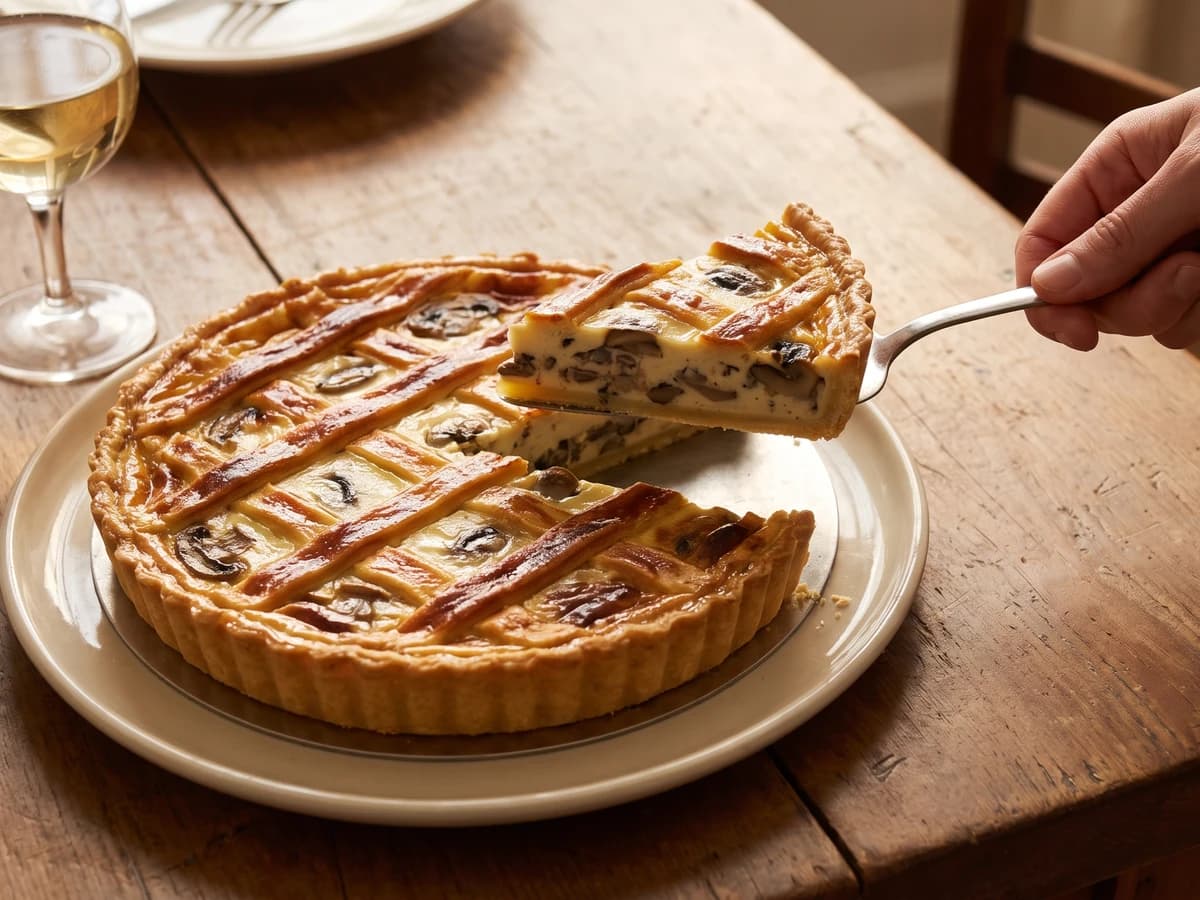
A hot mushroom flan under a butter-gold lattice, with cream reduced close around barely opened caps and a crisp short-paste base protected by one discipline: cool the filling completely.

Chef Juliette
Four little mushroom flans, latticed and gilded, baked hard and fast until butter-gold: a classical garnish scaled to the meat it accompanies and served before its crispness has time to fade.