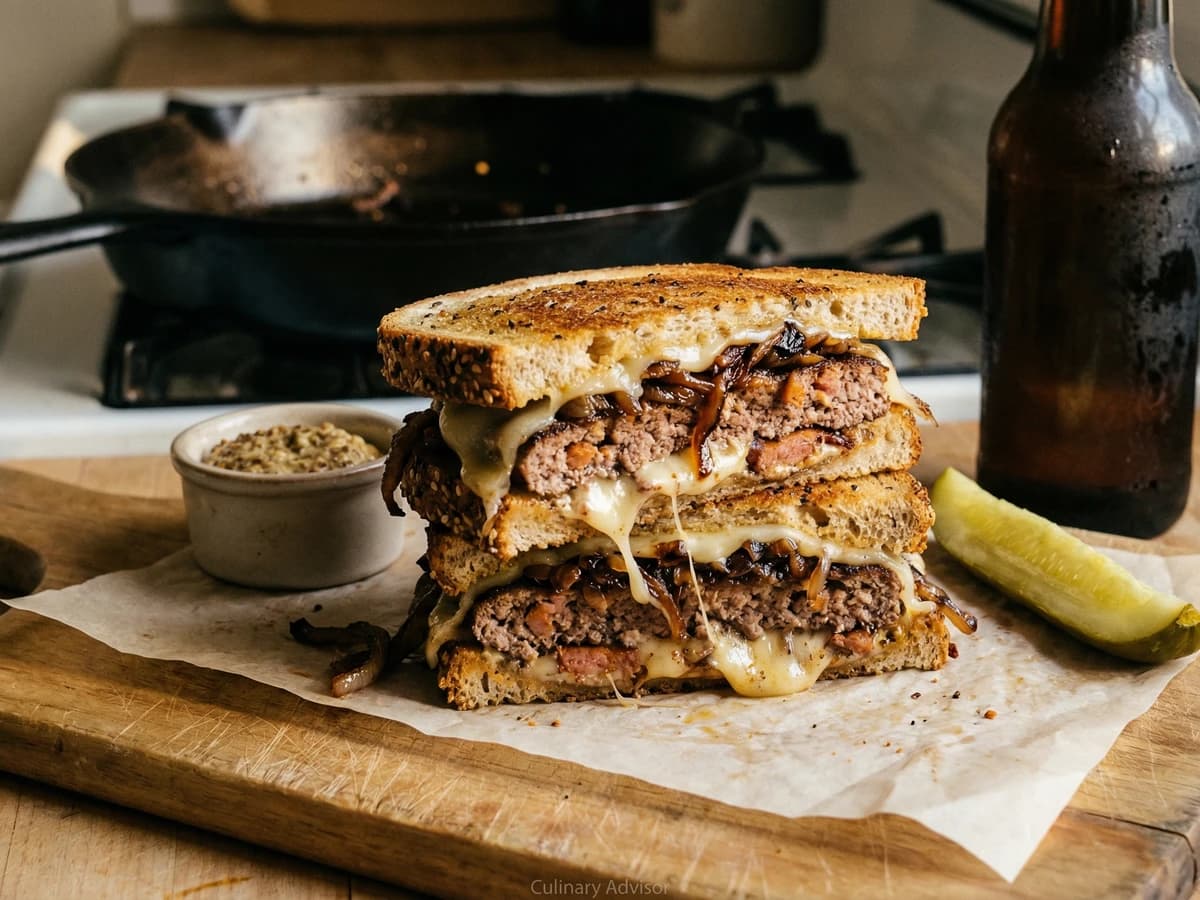
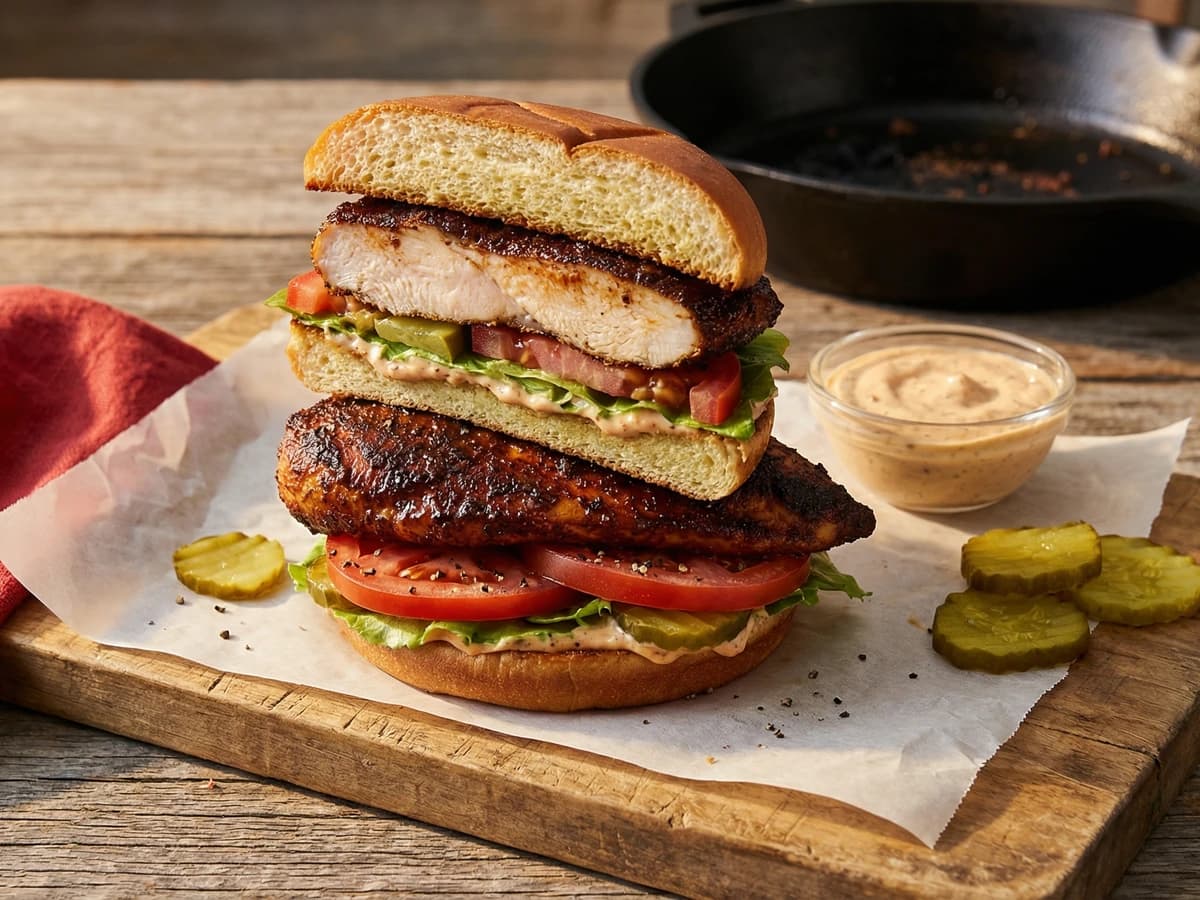
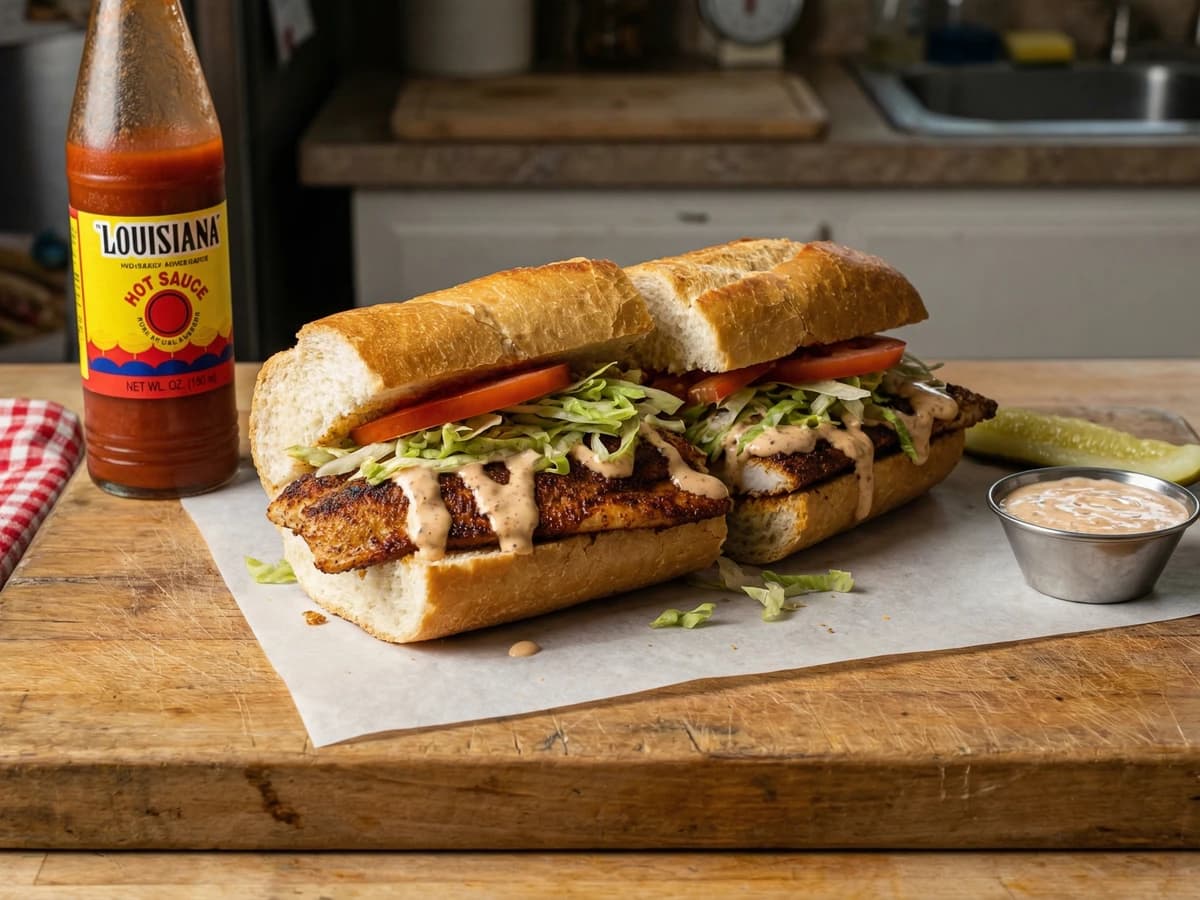
Three stories of Louisiana indulgence: golden fried Gulf oysters stacked with smoky tasso ham, crisp lettuce, ripe Creole tomatoes, and a remoulade so good you'll want to eat it with a spoon.
Sandwiches & Wraps
Cajun
Special Occasion
Dinner Party
45 min
Active Time
20 min cook•1 hr 5 min total
Yield4 sandwiches
The club sandwich is a thing of beauty when done right. Three layers of bread, each one holding its own treasures. But the country club version with its pale turkey and flavorless bacon never spoke to me. I wanted something with soul. Something that tasted like Louisiana.
So I rebuilt it from the ground up. Gulf oysters, cornmeal-crusted and fried until they shatter when you bite through. Tasso ham crisped in a hot skillet until the edges go dark and the smoke perfumes your whole kitchen. Creole remoulade instead of plain mayo, because why would you settle for less? This is how we do sandwiches down here.
The secret is in the layers. You season the oyster dredge, you season the remoulade, you use tomatoes that actually taste like something. Every component carries its weight. When you take that first bite and the crispy oyster gives way to the smoky ham and the cool crunch of lettuce, you'll understand why I put this on the lunch menu at Lagniappe and never took it off.
The technique, the tradition, and the story behind every dish.
In a medium bowl, whisk together the mayonnaise, Creole mustard, horseradish, lemon juice, and hot sauce until smooth. Fold in the minced capers, green onions, garlic, and smoked paprika. Season with salt and pepper. Taste it. The remoulade should have bite from the mustard, heat from the cayenne in the hot sauce, and brightness from the lemon. Adjust until it makes you want to keep dipping your finger in. Cover and refrigerate while you prepare everything else.
This remoulade improves if you make it a few hours ahead. The flavors marry and mellow into something special.
2
Soak the oysters
Place the drained oysters in a shallow bowl and pour the buttermilk over them. Let them soak for fifteen minutes. The buttermilk tenderizes the oysters and helps the coating stick. This is not optional.
3
Build the seasoned dredge
In another shallow bowl, whisk together the cornmeal, flour, Cajun seasoning, garlic powder, cayenne, and salt. Run your fingers through it. Smell it. This is where your flavor lives. If you want more heat, add more cayenne. The coating should smell like Louisiana before the oysters ever touch it.
Make your own Cajun seasoning if you can: equal parts paprika, garlic powder, and onion powder, with cayenne, black pepper, dried thyme, and dried oregano to taste. Store-bought works fine, but homemade is better.
4
Heat the oil
Pour vegetable oil into a large cast iron skillet to a depth of about one inch. Heat over medium-high until the oil reaches 375 degrees, or until a pinch of the cornmeal mixture sizzles immediately when dropped in. The oil should shimmer but not smoke. Too cool and the oysters absorb oil. Too hot and the coating burns before the oyster cooks through.
5
Dredge and fry the oysters
Working in batches of five or six, lift oysters from the buttermilk, let the excess drip off, then dredge thoroughly in the cornmeal mixture. Press the coating on gently. Slip them into the hot oil without crowding. Fry until deeply golden and crispy, about two minutes per side. The oysters should sizzle steadily. If the sizzle dies down, your oil cooled and you added too many. Transfer to a wire rack set over a paper towel and season with a pinch of salt immediately.
Let the oil come back to temperature between batches. Patience here means crispy oysters. Rushing means soggy ones.
6
Crisp the tasso
While the oysters rest, heat a dry skillet over medium-high heat. Add the tasso slices in a single layer. Cook until the edges darken and the fat renders, about two minutes per side. The ham should get slightly crispy at the edges and release its smoky perfume. This step transforms good tasso into something transcendent.
7
Toast and spread
Toast all twelve slices of bread until golden. Spread remoulade generously on one side of each slice. Do not be stingy. The remoulade is doing heavy lifting here, bringing moisture and flavor to every bite.
8
Build the first layer
For each sandwich, start with a slice of bread, remoulade side up. Layer butter lettuce leaves and tomato slices. Season the tomato with a tiny pinch of salt. Place another slice of bread on top, remoulade side up.
9
Add the proteins
On the middle bread layer, arrange the crisped tasso slices, then top with four or five fried oysters. The oysters should still be warm, their coating crackling with each bite. Place the final slice of bread on top, remoulade side down against the oysters.
10
Cut and serve
Press down gently on each sandwich, then secure with four long toothpicks or sandwich picks, one in each quadrant. Cut corner to corner to make four triangles. Arrange on plates with the cut sides facing out so you can see those beautiful layers. Serve immediately while the oysters are still crispy.
Chef Tips
•If you can't find tasso, thick-cut bacon with a heavy sprinkle of Cajun seasoning makes a respectable substitute. Tasso is worth seeking out, though. Check your local specialty grocer or order online.
•Gulf oysters from Louisiana or Texas have the briny, mineral flavor this sandwich demands. Pacific oysters work but taste different. Know what you're getting.
•At Lagniappe, we serve this with a pile of Cajun-spiced sweet potato fries. The sweetness against the salty, spicy sandwich is something special.
•The remoulade recipe makes more than you need for four sandwiches. Keep the extra in your refrigerator for up to a week. You'll find excuses to use it.
Advance Preparation
•The remoulade can be made up to three days ahead and refrigerated. The flavors improve with time.
•The seasoned dredge can be mixed and stored in an airtight container for up to a week.
•Do not fry the oysters ahead of time. They must be fried fresh and assembled immediately or the coating goes soft and sad.
Frequently Asked Questions
Nutrition Information
1 serving (about 400g)
Calories
950 calories
Total Fat
61 g
Saturated Fat
10 g
Trans Fat
0 g
Unsaturated Fat
49 g
Cholesterol
78 mg
Sodium
2630 mg
Total Carbohydrates
70 g
Dietary Fiber
4 g
Sugars
6 g
Protein
28 g
Where cooking meets culture.
Culinary guides, cultural storytelling, and the editorial depth that makes cooking meaningful.