
Chef Lupita
Agua de Alfalfa
Ciudad de México's highland market agua fresca, fresh alfalfa blended with pineapple and lime until bright green, strained clean, and poured cold from the vitrolero.
A cooking platform built around craft, culture, and the stories behind what we eat.
Created by
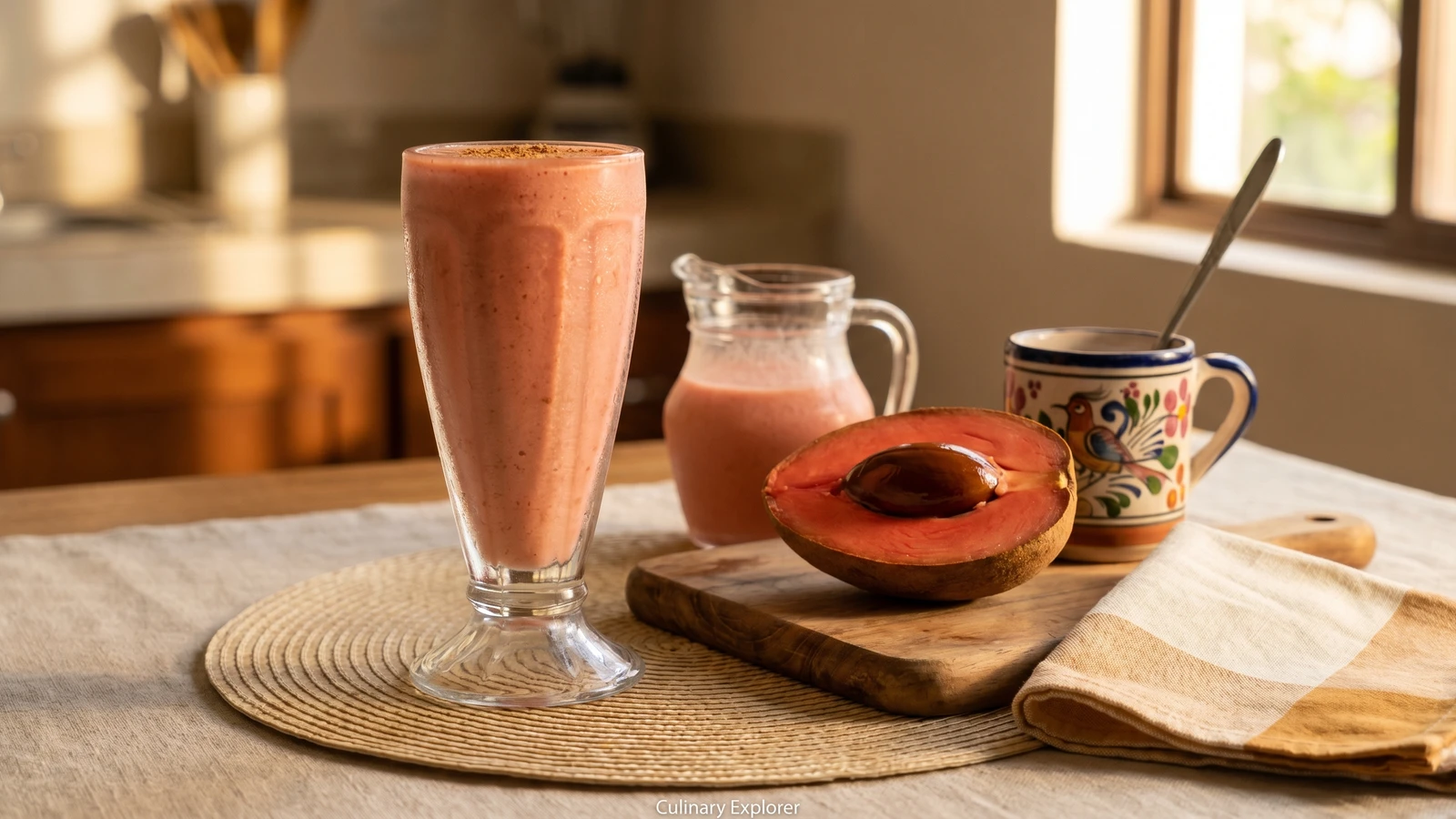
Yucatán's afternoon licuado. Ripe mamey sapote blended with cold milk, a little sugar, and ice until it pours thick and orange-pink. Drinks like dessert, sits like breakfast.
Mamey is a fruit of the tropical south. It grows across the Yucatán peninsula, into Tabasco, Chiapas, and Veracruz, but in Mérida the licuado de mamey is so common at breakfast counters and afternoon loncherias that it might as well be the official drink of the city. The fruit comes off the trees of the Yucatán hot and the licuado comes out of the blender cold. That contrast is the entire pleasure.
The flesh of a ripe mamey is a color you cannot mistake for anything else: deep salmon, almost brick orange-red, dense, and creamy with a flavor that lands somewhere between sweet potato, pumpkin, and almond custard. Blended with cold whole milk and a little sugar, it becomes a licuado so thick you could eat it with a spoon. Some cooks add canela. Some add a splash of Mexican vanilla. The Mérida version I learned from a señora at a counter near the Mercado Lucas de Galvez was direct: mamey, milk, sugar, ice, a pinch of salt to wake the fruit up. Nothing else. No me vengas con atajos.
The whole licuado depends on the ripeness of the fruit. An unripe mamey is starchy and disappointing. A ripe one is custard. The señoras at the market will pick the right one for you and explain how to ripen the rest on your counter. If you cannot get fresh mamey where you live, the frozen pulp sold in Latin grocers is a fair compromise. Not the same fruit, but the same drink. Cada estado, su propia cocina, and this one belongs to the south.
Mamey sapote (Pouteria sapota) is native to southern Mexico and Central America and was cultivated by the Maya and the Mexica long before the conquest; the Nahuatl name 'tezontzapotl' (stone sapote) refers to the large, hard central pit. The fruit's pit, called 'pixtle' in Mayan-influenced regions and 'zapuyul' farther south, is itself an ingredient, ground and used to flavor cacao drinks and the Oaxacan beverage tejate. The licuado as a drink format, fruit blended with milk and sugar, is a 20th-century development tied directly to the spread of household and counter-top blenders across Mexico in the 1940s and 1950s, which let cooks turn dense tropical fruits like mamey, guanabana, and zapote negro into the cold creamy drinks that now define the loncheria menu.
Quantity
1 large (about 2 pounds whole, yielding roughly 2 cups of flesh)
Quantity
4 cups
Quantity
1/3 cup, plus more to taste
Quantity
1/2 teaspoon
Quantity
1 small pinch
Quantity
2 cups
Quantity
for serving
| Ingredient | Quantity |
|---|---|
| ripe mamey sapote | 1 large (about 2 pounds whole, yielding roughly 2 cups of flesh) |
| cold whole milk | 4 cups |
| granulated sugar | 1/3 cup, plus more to taste |
| Mexican vanilla extract | 1/2 teaspoon |
| fine sea salt | 1 small pinch |
| ice cubes | 2 cups |
| ground canela (Mexican cinnamon) (optional) | for serving |
The fruit must be ripe. A ripe mamey gives slightly under thumb pressure at the stem end, the way a ripe avocado does, and a small scratch of the brown skin near the stem reveals salmon-pink flesh underneath. If the flesh under the scratch is pale or yellow, the fruit is not ready and no amount of blending will fix it. Set an unripe mamey on the counter for three to five days. Pregúntale a las señoras del mercado. They will pick the right one for you in five seconds.
Stand the mamey upright on a cutting board. Slice from top to bottom along the long axis, going around the large central pit. Twist the two halves to separate them. Pry out the glossy brown pit and set it aside. Scoop the deep orange-red flesh out of the brown leathery skin with a spoon, scraping close to the inside of the skin where the color is darkest and the flavor is most concentrated. Discard the skin and the pit. You should have around 2 cups of flesh.
Place the mamey flesh in the blender. Add 2 cups of the cold milk, the sugar, vanilla, and the pinch of salt. The salt is not optional. A small pinch lifts the sweetness of the fruit the same way it lifts a sweet potato. Blend on high for one full minute. The mixture will be very thick, almost the consistency of a custard or a thick paste. That density is the point. Mamey is a fruit that thinks it is a vegetable.
Add the remaining 2 cups of cold milk and the ice cubes. Blend again on high until the ice is completely broken down and the licuado is smooth, thick, and bright orange-pink. Taste. The sweetness of the mamey varies from fruit to fruit. If yours is mild, add another tablespoon of sugar and blend a few seconds more. The licuado should taste like the fruit, not like sweetened milk.
Pour into tall glasses straight from the blender. The licuado is thick enough that it climbs the sides slowly. If you want, dust the surface lightly with ground canela. Drink it cold and drink it now. Mamey separates and dulls if it sits more than 30 minutes, the way fresh juice does. Saber cocinar es saber vivir, and that includes knowing when to put the glass in someone's hand.
1 serving (about 450g)
Culinary guides, cultural storytelling, and the editorial depth that makes cooking meaningful.
Discover Culinary ExplorerChef Lupita
Ciudad de México's highland market agua fresca, fresh alfalfa blended with pineapple and lime until bright green, strained clean, and poured cold from the vitrolero.

Chef Lupita
Aguascalientes' Lenten agua fresca, jewel-red from cooked beet and full of apple, banana, orange, lettuce, and ground peanuts, served cold when Holy Week meets the Feria de San Marcos.

Chef Lupita
Sonora and Sinaloa's creamy malted barley water, built on toasted cebada perla, Mexican canela, vanilla from Papantla, and evaporated milk. Pink-beige, rich, and served cold over heavy ice in a heavy glass tumbler. Liquid cookie comfort the northwest way.

Chef Lupita
Yucatán's everyday tonic of boiled chaya leaves blended with lima agria, sugar, and ice. The bright green jarra that sits on every Peninsula table from Mérida to Valladolid.