
Chef Fai
Isan Beef Larb (Larb Nua)
No sugar. That's the rule. Isan larb strips Thai cuisine down to three pillars: nam pla for salt, manao for sour, prik for heat, bound by the smoky crunch of freshly pounded khao khua. The absence defines the dish.
A cooking platform built around craft, culture, and the stories behind what we eat.
Created by
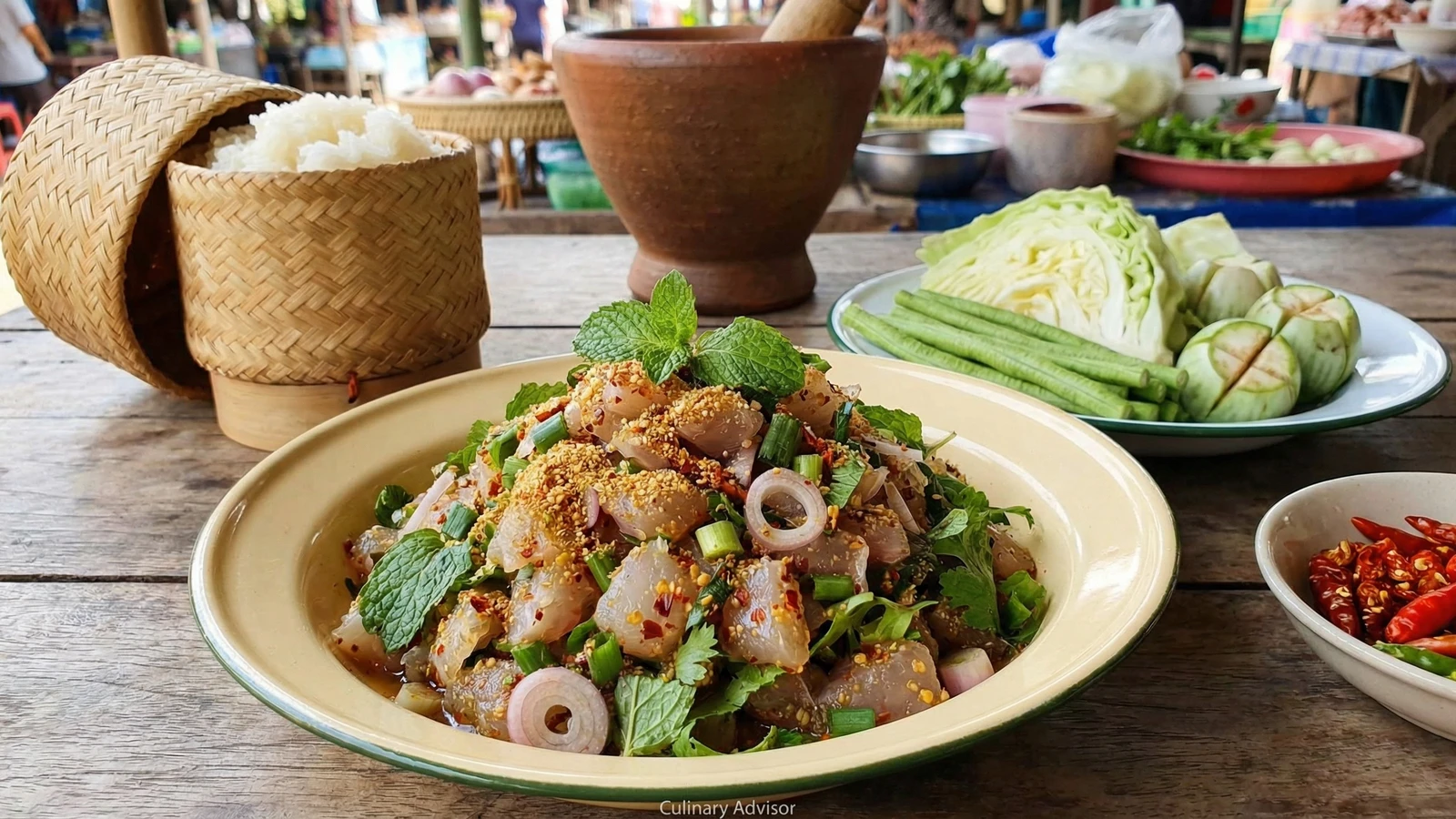
No sugar. No cooking. No compromise. Koi pla is Isan larb stripped to its rawest principle: fish sauce for salt, lime for sour, khao khua for texture, prik pon for heat, and fresh herbs as structure.
No sugar. That's the first thing you need to understand about Isan larb, and it's the thing that separates it from every Central Thai version you've ever eaten. Ajarn always said: the absence of an ingredient is just as important as its presence. In Isan, sweetness has no place in larb. Not palm sugar, not cane sugar, not a pinch, not a whisper. The balance is built on three pillars only: nam pla for salt, manao for sour, prik pon for heat. That's the Isan law.
Koi pla is that law taken to its most extreme expression. Raw fish. No heat applied. No wok, no grill, no flame. Just a knife, a cutting board, and the dressing. You chop the fish so fine it's almost a paste, then you hit it with lime juice, fish sauce, toasted rice powder, dried chili, and a storm of fresh herbs. The lime juice firms the proteins on contact. The khao khua (ข้าวคั่ว) binds the dressing to the fish. The herbs, and I mean real herbs, mint, sawtooth coriander, green onion, shallots, these aren't garnish. They're structural. Remove them and you don't have koi pla. You have raw fish in sauce.
I learned this from my mother's family in Isan. They make koi pla the way their grandparents made it: with fish pulled from the river that morning, chopped on a wooden block, dressed within the hour, eaten with sticky rice and raw vegetables before the sun gets too high. There's no refrigeration step. There's no "marinating." The dish is alive. It changes minute by minute as the lime works on the fish. You eat it now or you don't eat it.
This is the dish that demands the most respect and the most caution. Raw freshwater fish carries real risk. I'm not going to pretend otherwise. If you can't source sashimi-grade freshwater fish from a trusted supplier, don't make this dish. Use ocean fish as a safer alternative, or skip it entirely. The principle matters more than the performance. Ajarn always said: respect the ingredient first, then respect the technique.
Koi pla (ก้อยปลา) is among the oldest preparations in Isan and Lao cuisine, predating any written recipe tradition. The word 'koi' (ก้อย) refers specifically to raw meat or fish dressed with acid, herbs, and khao khua, a technique practiced along the Mekong River basin for centuries. In rural Isan, koi pla was historically made with pla chon (snakehead fish) or pla nil (tilapia) caught fresh from paddies and rivers, chopped and eaten within hours. The dish has become controversial in modern Thai public health discourse due to the risk of liver fluke (Opisthorchis viverrini) from raw freshwater fish, leading health authorities to discourage the traditional preparation while Isan communities continue the practice as a point of cultural identity.
Quantity
400g
skin removed, bones removed, patted dry
Quantity
4 tablespoons (about 4 limes)
freshly squeezed
Quantity
2 tablespoons
Quantity
2 tablespoons
freshly toasted and pounded
Quantity
1 tablespoon
Quantity
3 tablespoons
raw, uncooked grains for toasting
Quantity
4
sliced thin
Quantity
3
sliced thin
Quantity
1 cup
Quantity
1/2 cup
sliced into thin ribbons
Quantity
1/4 cup
Quantity
for serving
Quantity
1 plate
cabbage wedges, long beans, Thai eggplant, mint sprigs
| Ingredient | Quantity |
|---|---|
| very fresh sashimi-grade fish filletsskin removed, bones removed, patted dry | 400g |
| lime juice (nam manao)freshly squeezed | 4 tablespoons (about 4 limes) |
| fish sauce (nam pla) | 2 tablespoons |
| khao khua (toasted sticky rice powder)freshly toasted and pounded | 2 tablespoons |
| dried roasted chili flakes (prik pon) | 1 tablespoon |
| sticky rice (khao niew) for khao khuaraw, uncooked grains for toasting | 3 tablespoons |
| shallots (hom daeng)sliced thin | 4 |
| green onions (ton hom)sliced thin | 3 |
| fresh mint leaves (bai saranae) | 1 cup |
| sawtooth coriander (pak chi farang)sliced into thin ribbons | 1/2 cup |
| fresh cilantro leaves (pak chi) | 1/4 cup |
| sticky rice (khao niew) | for serving |
| raw vegetables for servingcabbage wedges, long beans, Thai eggplant, mint sprigs | 1 plate |
Put the raw sticky rice grains in a dry wok or skillet over medium heat. No oil. Shake the pan constantly. The rice will start to pop and crackle after a minute or two. Watch the color. You want it deep golden brown, not pale, not burned black. It should smell nutty, smoky, almost like popcorn. This takes 3 to 5 minutes. The moment it's evenly toasted, get it out of the pan and onto a plate to cool. Once cool, pound it in a mortar to a coarse powder. Not fine dust. You want texture: some grains cracked in half, some reduced to grit, all of it fragrant. This is khao khua. It's the signature of every Isan larb and it must be freshly made. Store-bought powder tastes like cardboard.
This is the step where sourcing matters more than skill. Your fish must be impeccably fresh. If it smells like anything other than clean water, stop. Don't make this dish. Pat the fillets completely dry with paper towels. Place on a clean cutting board. Using a sharp knife, chop the fish very finely, almost to a mince but not a paste. You want tiny pieces that hold their shape, not mush. The texture should be somewhere between tartare and a rough chop. Some Isan cooks scrape the flesh off the bone with a spoon for an even finer result. Either way, the fish should be cold and the work should be fast. Keep it on ice until the moment you dress it.
Transfer the chopped fish to a mixing bowl. Add the fish sauce first. Toss gently. Then the lime juice. Toss again. Watch the fish: the surface will start to turn opaque as the citric acid firms the proteins. This is not cooking. This is chemistry. The fish is still raw at its core. Now add the prik pon (dried roasted chili flakes) and the khao khua. Toss once more. The khao khua will absorb excess moisture and bind everything together, giving the larb its characteristic texture: not wet, not dry, coated and cohesive. Taste. Sour should lead. Salty should support. Heat should build. No sweetness. If your instinct is to add sugar, fight it. That instinct comes from Central Thai larb. This is Isan. The absence of sweet is the point.
Add the sliced shallots, green onions, mint leaves, sawtooth coriander, and cilantro. Toss gently to distribute. The herbs are not decoration. They are half the dish. Every bite should have fish, khao khua, chili, and a leaf of something fresh. The mint provides coolness against the heat. The sawtooth coriander gives a sharp, almost citrus-like edge. The shallots bring bite and crunch. The green onions tie it all together. If you're skimping on herbs, you're making a different dish.
Transfer to a plate or shallow bowl. Serve immediately with sticky rice (khao niew) from a kratip basket and a plate of raw vegetables: cabbage wedges, long beans, halved Thai eggplant, extra mint sprigs. The way you eat this: tear off a piece of sticky rice, pinch some koi pla onto it, add a piece of vegetable or a mint leaf. That's one bite. The combination is the design. Eat it at room temperature. Never cold from the fridge. Never stored. Koi pla is made and eaten in the same hour. There are no leftovers. There is no reheating. The dish lives and dies in the moment you make it.
1 serving (about 190g)
Culinary guides, cultural storytelling, and the editorial depth that makes cooking meaningful.
Discover Culinary ExplorerChef Fai
No sugar. That's the rule. Isan larb strips Thai cuisine down to three pillars: nam pla for salt, manao for sour, prik for heat, bound by the smoky crunch of freshly pounded khao khua. The absence defines the dish.

Chef Fai
No sugar. That's the line between Isan and Central Thai larb. Grilled catfish flaked while warm, dressed with nam pla, manao, khao khua, prik pon, and a storm of fresh herbs. The plateau on a plate.

Chef Fai
No sugar. That's the rule. Isan larb strips Thai cuisine down to three pillars: nam pla for salt, manao for sour, prik for heat, with khao khua tying it together in a way nothing else can.

Chef Fai
Duck brings gamey depth to the Isan larb formula. No sugar. Lime, fish sauce, khao khua, prik pon, and a wall of fresh herbs. This is the celebration table standard, and the governing rule is restraint.