
Chef Klaus
Aachener Printen
Aachen's Advent biscuit is dark, hard, and spiced, with beet syrup doing the deep work and a closed tin finishing what the oven only starts.
A cooking platform built around craft, culture, and the stories behind what we eat.
Created by
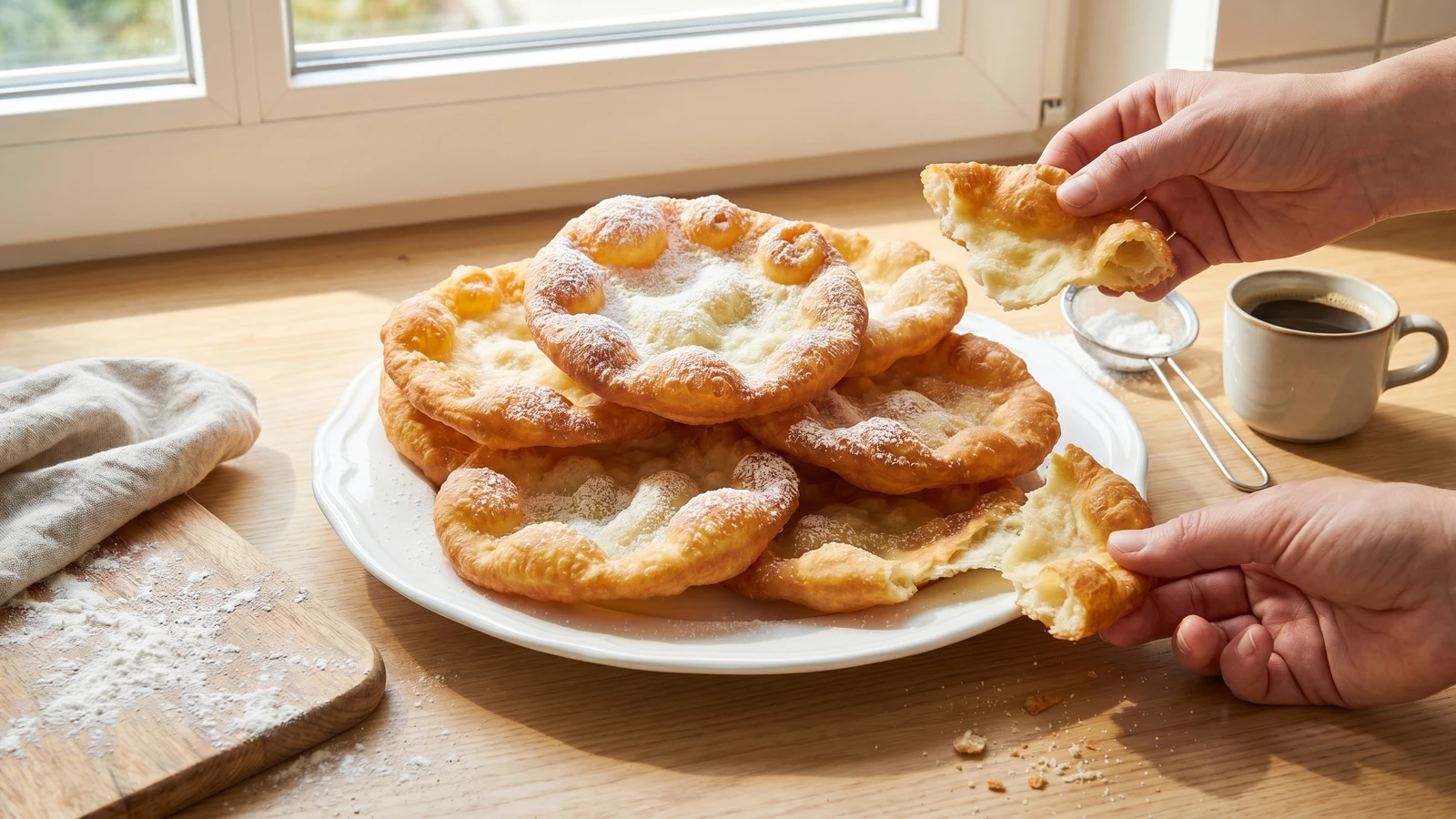
Knieküchle works when the middle is stretched thin enough to read through, while the rim stays fat; the fryer then gives you paper-crisp center and soft bread in one pastry.
Knieküchle belongs to the southern feast table, especially Kirchweih, weddings, Fasching, and a Sunday coffee table that knows what it's doing. In Franconia you hear Knieküchle, Küchla, or Kirchweihküchle; in Upper Bavaria it becomes Auszogne, the pulled-out ones. Same dough family, same hot fat, different dialect and different pride. Im Norden anders, im Süden anders, and here the south has the pan.
The argument is in the middle. Franconian cooks want the center so thin you could read newspaper through it, with a thick rim puffing up around it. Some Bavarian versions leave the center a little softer and broader, more cushion than glass. I pull mine over the knuckles, not with a rolling pin, because the rolling pin flattens the rim and then you've made a sad doughnut with a story attached.
The dough must rest before you stretch it. Tight dough snaps back, so the center stays thick and fries bready instead of crisp; relaxed dough opens under your hands and lets the rim keep its strength. The fat must sit around 170C, hot enough to seal the surface before it drinks oil, not so hot that the rim browns before the center dries. Das braucht seine Zeit, but not much fuss.
This is flour, milk, yeast, eggs, and the fat in the pot. Festival food from an ordinary larder. Dust it with sugar, set it down while the edges still shine, and don't decorate it into nonsense. Schön ist, was schmeckt.
Knieküchle, Auszogne, Küchla, and Kirchweihnudeln belong to the southern German family of yeast-raised festival fritters recorded in Bavarian and Franconian household cooking by the 19th century, especially around Kirchweih, the annual parish church dedication fair. The name Knieküchle points to the older Franconian method of stretching the dough over a cloth-covered knee; Auszogne in Bavaria means pulled-out, naming the same work in dialect. The regional dispute is visible in the pastry itself: Franconian cooks prize a nearly transparent center, while many Bavarian versions keep a softer middle and a generous puffed rim.
Quantity
500g
plus extra for dusting
Quantity
21g fresh / 7g instant
Quantity
250ml
lukewarm
Quantity
60g
Quantity
2
room temperature
Quantity
60g
melted and cooled
Quantity
1 teaspoon
Quantity
1 teaspoon
Quantity
1 tablespoon
Quantity
about 1.5 liters oil / 1.5kg lard
for frying
Quantity
to dust
| Ingredient | Quantity |
|---|---|
| German Type 550 flour or unbleached all-purpose flourplus extra for dusting | 500g |
| fresh yeast or instant yeast | 21g fresh / 7g instant |
| whole milklukewarm | 250ml |
| sugar | 60g |
| large eggsroom temperature | 2 |
| unsalted buttermelted and cooled | 60g |
| fine salt | 1 teaspoon |
| finely grated lemon zest (optional) | 1 teaspoon |
| dark rum (optional) | 1 tablespoon |
| neutral oil or lardfor frying | about 1.5 liters oil / 1.5kg lard |
| powdered sugar | to dust |
Warm the milk to lukewarm, about 35 to 38C, then stir in the yeast and a spoon of the sugar. Let it stand until creamy and lively, about 10 minutes. Hot milk kills yeast before it can lift the dough; cold milk makes it slow and sulky, and this pastry needs a clean rise before it ever sees the fat.
Mix the flour, remaining sugar, salt, and lemon zest if using, then add the yeast milk, eggs, and rum if using. Knead until the flour has taken the liquid, then work in the cooled butter and knead 8 to 10 minutes, until the dough is soft, smooth, and just a little tacky. Butter goes in after the flour is wet because fat coats dry flour and makes a weaker dough; you want strength in the rim, not heaviness in the center.
Cover the bowl and leave the dough in a warm place until doubled, about 60 to 75 minutes. The dough is ready when a floured finger pressed into it leaves a slow dent; if it springs back at once, the yeast has not built enough gas to puff the rim.
Turn the dough onto a lightly floured board, divide it into 12 equal pieces, and shape each piece into a smooth ball. Cover them with a towel and rest 20 to 30 minutes. This rest is not laziness. It relaxes the dough so the middle stretches thin without tearing and the rim stays thick enough to rise in the fat.
Flatten one ball slightly, then lift it over your knuckles and work around the rim, pulling the center thinner and thinner while keeping a fat ring around the edge. The center should be almost transparent, 1 to 2mm thick, with a rim about 2cm wide. Do not use a rolling pin; it crushes the rim flat, and the rim is the part that gives you the proper shape.
Heat 5 to 6cm of oil or lard in a wide heavy pot to 170C. Use a thermometer if you have one. Too cool, and the pastry drinks fat before the crust sets; too hot, and the rim browns while the middle is still thick and leathery. Runter mit der Temperatur if the fat races.
Slide one or two stretched rounds into the fat, center first, and fry until the rim is golden underneath, about 60 to 90 seconds. Turn carefully and fry the second side another 45 to 60 seconds, spooning a little hot fat over the rim if it needs help puffing. Crowd the pot and the temperature drops; cold fat walks into the dough, and then no sugar can save it.
Lift the Knieküchle onto a wire rack, not a flat stack of paper towels, so the underside stays crisp instead of sweating soft. Dust with powdered sugar while still warm enough for it to cling, then serve the same day with coffee. The first bite should crack lightly in the center and give way to a soft rim. That's the dish.
1 serving (about 85g)
Culinary guides, cultural storytelling, and the editorial depth that makes cooking meaningful.
Discover Culinary ExplorerChef Klaus
Aachen's Advent biscuit is dark, hard, and spiced, with beet syrup doing the deep work and a closed tin finishing what the oven only starts.

Chef Klaus
The Baden-Wuerttemberg apple fritter that lives between weeknight dessert and Sunday coffee, built on tart rings, a light batter, and oil kept steady.

Chef Klaus
The Carnival doughnut lives by proofing and fat temperature: a light yeast round floats high, cooks through with one pale belt, then takes its jam without turning greasy.

Chef Klaus
A cold Mürbeteig ball, one clean hollow, and a spoon of tart jelly: Engelsaugen are Advent cookies that fail only when the dough gets warm.