
Chef Klaus
Allgäuer Krautkrapfen
The Allgäu pan dish that makes a meal from noodle dough, winter kraut, onion, and fat: brown the cut sides first, then cook gently so the rolls hold.
A cooking platform built around craft, culture, and the stories behind what we eat.
Created by
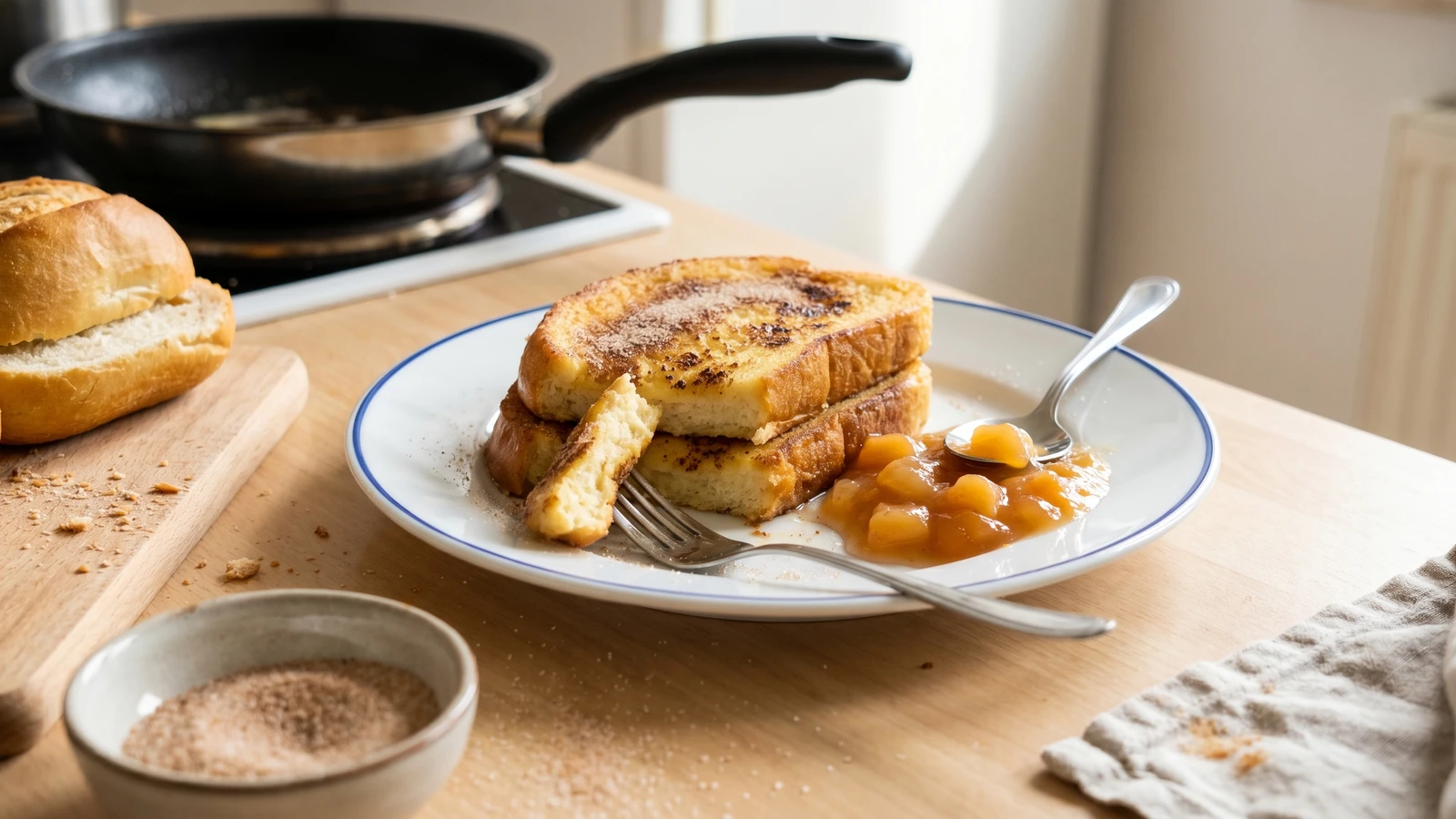
The old sweet supper that saves yesterday's loaf: stale bread drinks eggy milk, the pan stays moderate, and butter browns the outside only after the centre has set.
Arme Ritter belongs to the German thrift table, the sweet main course, Süßspeise, that can be dinner when the bread box has yesterday's white loaf and the apple cellar still has fruit. It isn't tied to a feast. It is tied to the rule the old kitchens lived by: Weggeworfen wird nichts, nothing gets thrown away.
All over Germany you find it, but the names and fillings start quarrels. In the north and middle, I expect plain slices, cinnamon sugar, and Apfelkompott, apple compote. In Bavaria and down toward Austria, the cousins Pofesen or Pavesen often trap Powidl, plum butter, between two slices before frying. Im Norden anders, im Süden anders.
The method is the whole dish: stale bread drinks the Eiermilch, the egg-and-milk soak, until the centre is wet but still holds its edges, then it goes into a moderate pan. Fresh bread collapses to paste. A pan that's too hot browns the outside before the egg sets inside; too cool and the bread drinks fat. Wait for the butter to bubble and quiet down, then fry.
I cook the apples first because compote can wait and fried bread cannot. Nicht aus dem Glas. Four tart apples, a splash of water, a little lemon, and you've got the sharp side the buttery bread needs. Dust with cinnamon sugar after frying, not before, or the sugar burns in the pan and you learn the lesson the hard way.
Arme Ritter is recorded in Das Buoch von guoter Spise, compiled around 1350 in Würzburg in the household of Michael de Leone, one of the earliest German-language cookbooks; its recipe dips sliced bread in egg and fries it in fat. The dish belongs to the same European thrift family as French pain perdu and English Poor Knights, names that point at bread saved after it had lost its first freshness. German regional language later split the plate: northern and central households kept Arme Ritter, while southern German and Austrian kitchens use Pofesen or Pavesen, often filled with Powidl before frying.
Quantity
8 thick slices or 4 split rolls
about 2cm thick
Quantity
300ml
Quantity
3
Quantity
1 packet (8g)
Quantity
60g
divided
Quantity
1 pinch
Quantity
1 teaspoon
Quantity
60g
for frying
Quantity
4 medium
peeled, cored, and cut into chunks
Quantity
3 tablespoons
Quantity
1 tablespoon
Quantity
1
| Ingredient | Quantity |
|---|---|
| stale white bread or day-old Brötchenabout 2cm thick | 8 thick slices or 4 split rolls |
| whole milk | 300ml |
| large eggs | 3 |
| vanilla sugar | 1 packet (8g) |
| fine sugardivided | 60g |
| fine salt | 1 pinch |
| ground cinnamon | 1 teaspoon |
| butter or Butterschmalz (clarified butter)for frying | 60g |
| tart apples such as Boskoop or Elstarpeeled, cored, and cut into chunks | 4 medium |
| water or apple juice | 3 tablespoons |
| lemon juice | 1 tablespoon |
| cinnamon stick | 1 |
Put the apples, water or apple juice, lemon juice, 1 tablespoon of the sugar, and the cinnamon stick in a small saucepan. Cover and cook over medium heat for 8 to 10 minutes, then uncover and cook 2 to 3 minutes more, until the apple pieces are soft at the edges and the juices cling to a spoon. The apples go first because Apfelkompott, apple compote, can wait; fried bread loses its edge while it sits.
Whisk the milk, eggs, vanilla sugar, salt, and 1 tablespoon of the sugar in a wide dish until the egg is fully broken up. Strands of white fry into rubbery streaks, so whisk until the mixture looks even and pale. This is Eiermilch, the egg-and-milk soak, and it has to reach the middle of the bread.
Lay the bread slices in the Eiermilch in one layer, or work in batches, and leave them 3 to 4 minutes per side. They should feel heavy when lifted but still hold a square edge; that tells you the stale crumb has drunk enough without dissolving. Very dry rolls need a minute longer, fresh slices need to be dried first or they turn to paste.
Set a heavy frying pan over medium heat and add a knob of butter or Butterschmalz, clarified butter. When the butter bubbles, smells nutty, and the loud crackle has quieted, the pan is ready. Runter mit der Temperatur if it darkens before the bread goes in; the egg needs time to set through before the milk sugars brown too far.
Lift each slice with a spatula and let the excess Eiermilch drip back into the dish, because puddles in the pan burn and leave ragged edges. Fry 2 to 3 slices at a time for 3 to 4 minutes per side, adding fresh butter between batches, until both sides are deep gold and the centre feels softly set when pressed. Wipe out dark milk solids before the next batch; burnt butter teaches nothing useful.
Mix the remaining sugar with the ground cinnamon. Dust the hot Arme Ritter as soon as they leave the pan so the sugar clings, then spoon the apple compote alongside. The cinnamon sugar goes on after frying because sugar in the pan burns faster than the bread cooks. Schön ist, was schmeckt.
1 serving (about 360g)
Culinary guides, cultural storytelling, and the editorial depth that makes cooking meaningful.
Discover Culinary ExplorerChef Klaus
The Allgäu pan dish that makes a meal from noodle dough, winter kraut, onion, and fat: brown the cut sides first, then cook gently so the rolls hold.

Chef Klaus
Swabian egg pasta turned toward the apple cellar: fresh Spätzle tossed with browned butter, tart apples, cinnamon, and enough restraint to stay supper, not cake.

Chef Klaus
Hesse's pork goulash belongs to Apfelwein country: shoulder, onions, and tart cider cooked low until the cheap cut turns soft and the sauce lands sweet-sour, not sour-sweet.

Chef Klaus
Backfisch works when the batter is cold, the fish is dry, and the oil is steady. Miss one of those and you get a wet coat, not a crisp one.