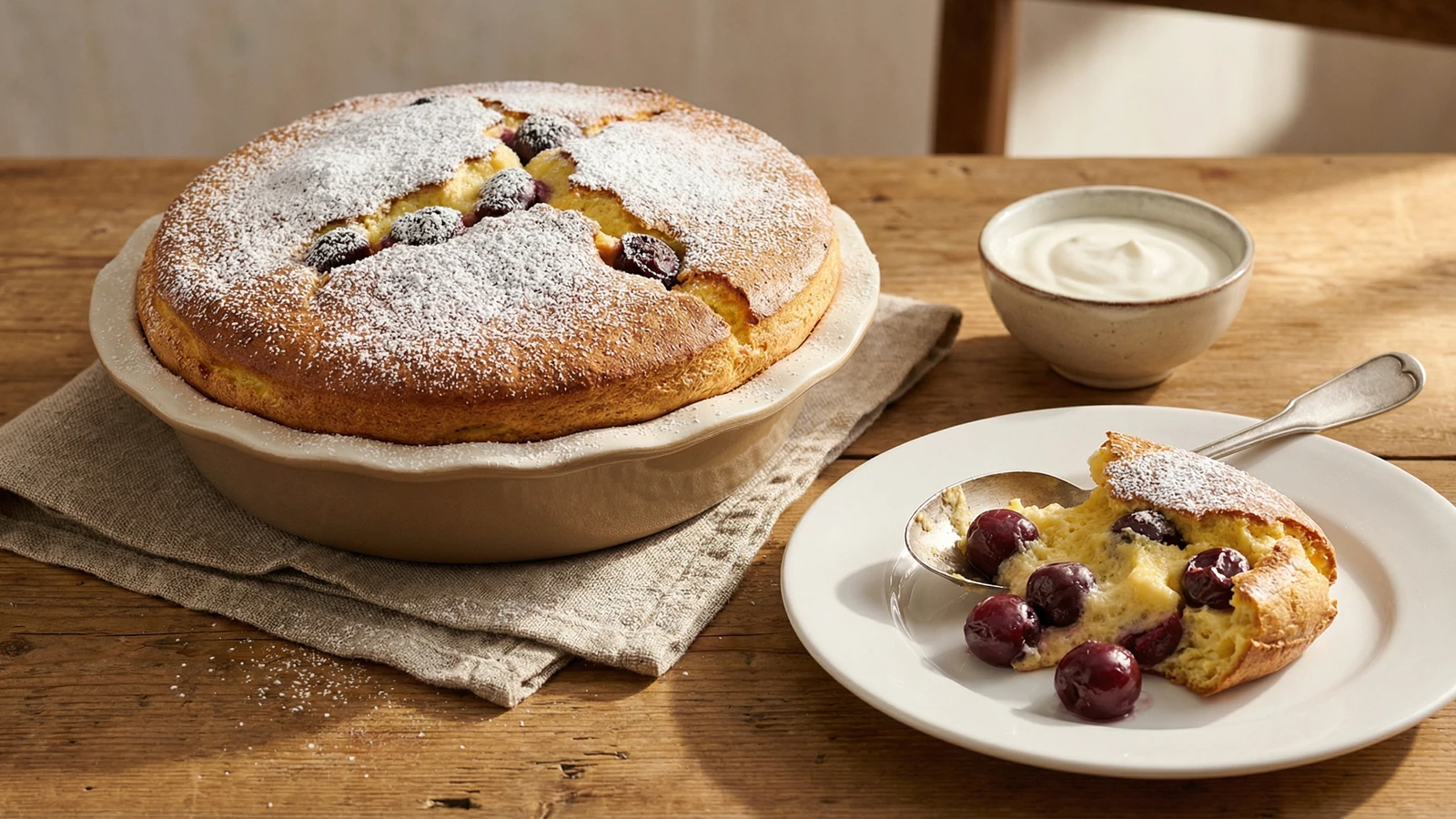
A golden, trembling cherry soufflé baked in a buttered dish until it puffs above the rim, dusted with powdered sugar, and rushed to the table before it remembers gravity exists.
Desserts
Austrian
Dinner Party
Special Occasion
25 min
Active Time
35 min cook•1 hr total
Yield4 servings
Every June, the Grünmarkt in Salzburg fills with cherries. Dark ones, almost black, their skins taut and shining. Light ones with a blush of red that deepens when you hold them up to the sun. The farmers pile them in wooden crates and the whole row smells like summer has finally made up its mind. I buy more than I need every time. That's how a Kirschenauflauf happens.
An Auflauf is one of the great categories of Austrian Mehlspeisen, and it deserves more attention than it gets. The word means something like 'a running up,' which is exactly what happens in the oven: a rich, buttery egg batter climbs the sides of the dish and puffs into a golden dome with fruit suspended through it like jewels in a cloud. It's not a French soufflé, though the technique is related. An Auflauf is sturdier, warmer, more forgiving. It won't collapse into nothing if you look at it sideways. It will sink gradually, gracefully, which is why you serve it the moment it comes out.
Gretel always said that the best Austrian desserts depend on three things: good butter, good eggs, and knowing what to do with the whites. Kirschenauflauf is the proof. The batter takes ten minutes. The oven does the rest. What you get is something that looks like you spent all afternoon on it, golden and trembling and spectacular, when really you spent most of that time pitting cherries and listening to the radio. In my grandmother Eva's kitchen, that counted as a perfect afternoon.
Aufläufe belong to the broader Mehlspeisen tradition that defined Austrian Bürgerlich cooking from the 18th century onward, when the middle classes developed an elaborate repertoire of flour-based sweet dishes served as a main course at midday or as the centerpiece of a light supper. The technique of folding beaten egg whites into a rich yolk-and-butter base was shared across the Habsburg culinary world, appearing in Czech, Hungarian, and Austrian kitchens with regional variations in fruit and flavoring. Cherry Aufläufe were particularly prized in regions with access to good stone fruit, including Lower Austria, the Wachau, and the orchards around Salzburg, where Kirschenernte (cherry harvest) in June and July shaped the seasonal rhythm of home kitchens.
The technique, the tradition, and the story behind every dish.
fresh sweet cherriespitted (about 350g after pitting)
500g
unsalted buttersoftened
80g, plus extra for the dish
caster sugar
80g, plus 1 tablespoon for the dish
eggsseparated
4 large
Vanillezucker (vanilla sugar)
1 packet (8g)
salt
pinch
lemonzested
half
plain flour
50g
whole milk
2 tablespoons
Kirschwasser (cherry brandy) (optional)
1 tablespoon
fine breadcrumbs (Semmelbröseln)
for the dish
powdered sugar
for dusting
Schlagobers (unsweetened whipped cream)
for serving
Equipment Needed
•Ceramic or porcelain baking dish (24cm, at least 6cm deep)
•Hand mixer or stand mixer
•Cherry pitter (or patience and a chopstick)
•Large metal spoon or spatula for folding
•Fine-mesh sieve for powdered sugar
Instructions
1
Prepare the dish and cherries
Heat your oven to 180°C (350°F). Butter a ceramic or porcelain baking dish, about 24 centimeters across and fairly deep. Sprinkle a tablespoon of sugar and a thin coating of fine breadcrumbs over the butter, tilting the dish to cover the bottom and sides evenly. Tap out any excess. The breadcrumbs give the Auflauf something to grip as it climbs the sides of the dish. Without them, it slides back down and you lose that beautiful puff.
If your cherries aren't perfectly ripe and sweet, toss the pitted fruit with a teaspoon of sugar and the Kirschwasser and let them sit while you make the batter. Ten minutes gives the juices time to wake up.
2
Cream the butter and yolks
Beat the softened butter with the caster sugar and Vanillezucker until pale and fluffy, about three minutes with a hand mixer. Add the egg yolks one at a time, beating well after each. The mixture should be light and almost white. This is where you're building the structure of your Auflauf. The air you beat in now is what makes the final dish light rather than dense. Add the lemon zest, the milk, and the flour, mixing gently until just combined. Don't overwork it once the flour goes in or you'll develop the gluten and the texture will turn tough.
3
Whip the egg whites
In a clean, dry bowl, whisk the egg whites with a pinch of salt until they hold stiff, glossy peaks. You want them firm enough that you could turn the bowl upside down and nothing would move, but not so beaten that they look dry and grainy. Over-whipped whites break apart when you fold them and your Auflauf will be flat where it should be pillowy. If the whites start to look chalky or clumpy at the edges, you've gone too far. Better to stop ten seconds early.
Eggs at room temperature whip better and higher. Pull them out of the fridge thirty minutes before you start. And make sure the bowl is spotless. Even a trace of fat on the glass or the whisk and the whites won't climb.
4
Fold and assemble
Stir one large spoonful of the beaten whites into the butter-yolk mixture. This loosens the base so the rest of the whites can fold in without losing all their air. Now add the remaining whites in two batches, folding with a large spatula or metal spoon. Cut down through the center, sweep along the bottom of the bowl, and bring the mixture up and over. Turn the bowl a quarter after each stroke. Stop the moment you can't see any white streaks. A few small lumps are fine. Over-folding is worse than under-folding. Scatter the pitted cherries into the batter and fold them through with two or three gentle strokes. Pour the batter into your prepared dish. It should fill it about two-thirds full.
5
Bake the Auflauf
Set the dish on the middle rack of the oven and bake for 30 to 35 minutes. Don't open the oven door for the first 25 minutes. The Auflauf will rise steadily as the egg whites expand in the heat, and a blast of cool air will collapse it before the structure has set. After 25 minutes, check through the glass if you have it. The top should be golden brown and puffed well above the rim of the dish. A skewer inserted into the center should come out with just a few moist crumbs, not wet batter. The edges will be set and slightly pulling away from the dish. The center will still have a gentle wobble. That's right. It firms as it cools.
Every oven is different. If your top is browning too fast but the center is still liquid, lay a sheet of foil loosely over the dish for the last ten minutes. Don't tuck it tight or the trapped moisture will turn your golden crust soft.
6
Dust and serve immediately
Pull the Auflauf from the oven and dust it generously with powdered sugar through a fine sieve. The sugar will settle on the puffed, golden surface and begin to melt slightly from the residual heat. Bring the whole dish to the table immediately with a bowl of cold, unsweetened Schlagobers on the side. Spoon it out while it's still trembling. A Kirschenauflauf starts sinking the moment it leaves the oven. That's not a failure. That's its nature. You have about five minutes of full glory, so don't waste them. Mahlzeit!
Chef Tips
•This is a June dish. Make it when cherries are dark, heavy for their size, and so ripe they stain your fingers when you pit them. If your cherries taste like nothing, the Auflauf will taste like nothing. Wait for the right fruit or make something else.
•Use real Vanillezucker, not vanilla extract. Austrian Mehlspeisen rely on the rounded, fragrant sweetness of vanilla sugar. You can make your own by burying a split vanilla pod in a jar of caster sugar for a week. Once you have a jar going, you'll never run out.
•Pat your pitted cherries dry with a clean cloth before folding them into the batter. Wet fruit sinks straight to the bottom and releases too much juice, which makes the base soggy instead of custardy.
•Serve the Schlagobers unsweetened and cold. The contrast between the warm, sweet Auflauf and the cool, neutral cream is the whole point. Sweetened whipped cream would push the dish into cloying territory.
Advance Preparation
•Cherries can be pitted up to a day ahead and stored in the fridge, spread on a plate lined with kitchen paper to absorb excess juice.
•The butter-yolk base can be prepared up to one hour ahead and left covered at room temperature. Whip the whites and fold everything together just before baking.
•A Kirschenauflauf cannot be made ahead. It must go from oven to table without stopping. Plan your dinner so the main course plates are cleared by the time the oven timer rings.
Frequently Asked Questions
Nutrition Information
1 serving (about 225g)
Calories
555 calories
Total Fat
34 g
Saturated Fat
20 g
Trans Fat
0 g
Unsaturated Fat
14 g
Cholesterol
270 mg
Sodium
145 mg
Total Carbohydrates
54 g
Dietary Fiber
2 g
Sugars
40 g
Protein
10 g
Where cooking meets culture.
Culinary guides, cultural storytelling, and the editorial depth that makes cooking meaningful.