
Chef Jeong-sun
Baechu-jeon (배추전, Napa Cabbage Pancake)
A Gyeongsang home pancake made from one whole napa cabbage leaf at a time, flattened at the rib, brushed in thin salted batter, and fried until sweet, tender, and quietly crisp at the edges.
A cooking platform built around craft, culture, and the stories behind what we eat.
Created by
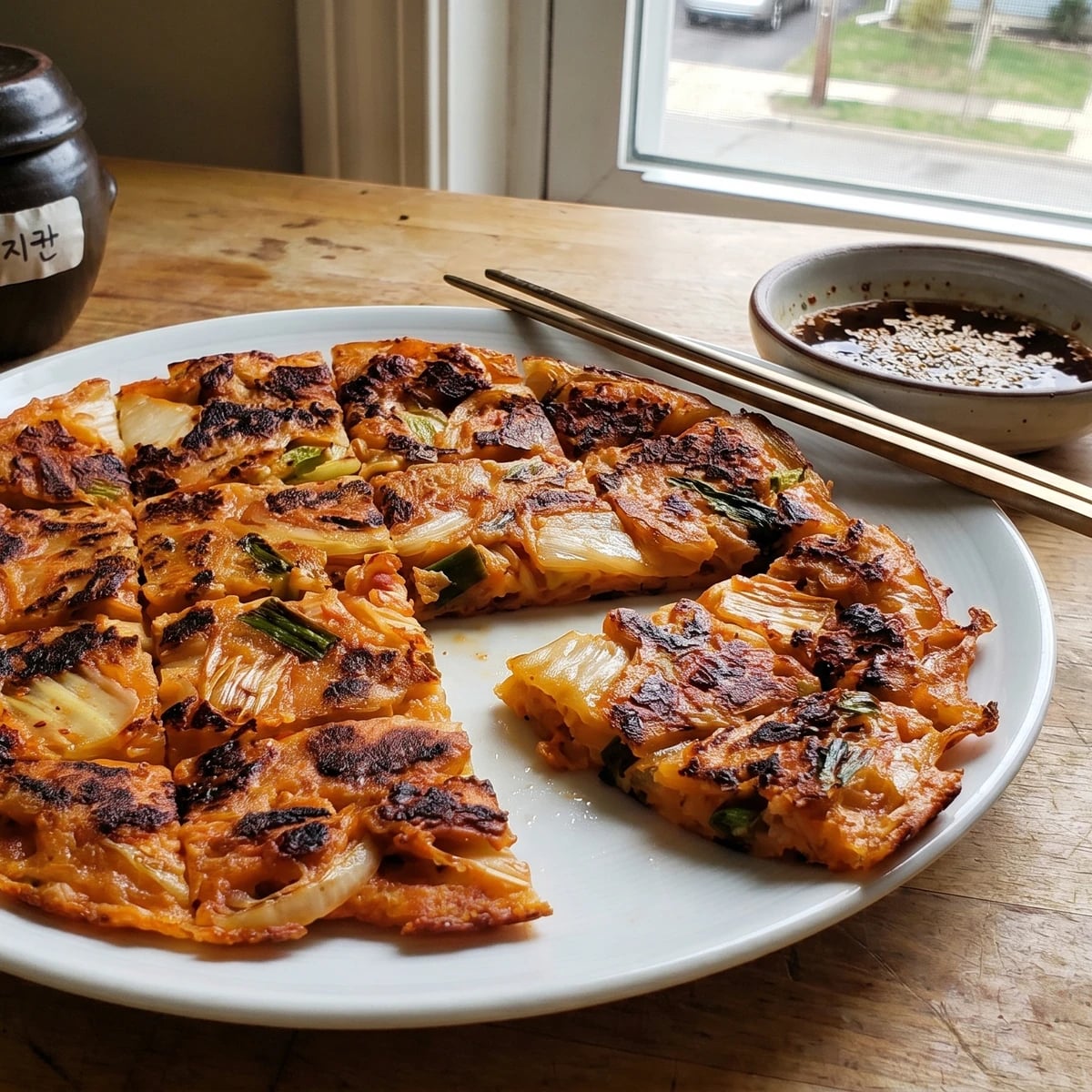
The fridge-clearing pancake Koreans make when the kimchi has gone properly sour, fried thin in a hot pan until the red batter sets crisp at the rim.
Kimchi-jeon begins when the kimchi has passed its polite stage. Fresh kimchi is good for the table, but it makes a flat pancake. You want the jar that smells sharp when you open it, the one pushed to the back of the refrigerator after a week of more obedient meals.
This is budget food, rainy-day food, late-night food, and it deserves exactness like anything else. The batter must be thinner than people expect, and the pan must be hot before it enters. Too much flour makes a heavy cake. Too little oil gives you a pale, damp center. Spread it wide, press it thin, and let the kimchi do the seasoning.
Notebook 41 says 180 grams of chopped kimchi to 90 grams of flour and 30 grams of potato starch. That gives enough structure without muffling the sour cabbage. 손맛 is real. I still measure it, so it can be handed on.
Jeon, the family of Korean pan-fried battered foods, appears across everyday tables, drinking tables, and ritual foods, but kimchi-jeon belongs most plainly to the home kitchen, where sour kimchi was never wasted. Its modern form depends on napa cabbage kimchi with red chili seasoning, a style that became widespread after chili peppers entered Korean cooking in the late Joseon period. The dish is strongly tied to anju, food eaten with drink, and to Korea's rainy-day habit of frying jeon when the sound of oil in the pan seems to answer the weather.
Quantity
180g
chopped into 1/2-inch pieces
Quantity
1/3 cup
Quantity
3/4 cup
Quantity
1/4 cup
Quantity
1/2 cup, plus 1 to 2 tablespoons if needed
Quantity
1 large
Quantity
1
thinly sliced
Quantity
1/2 small
thinly sliced
Quantity
1 teaspoon
Quantity
1/2 teaspoon
Quantity
1/4 teaspoon
Quantity
5 to 6 tablespoons
divided
Quantity
1 tablespoon
for dipping sauce
Quantity
1 tablespoon
for dipping sauce
Quantity
1 tablespoon
for dipping sauce
Quantity
1/2 teaspoon
for dipping sauce
| Ingredient | Quantity |
|---|---|
| well-fermented napa cabbage kimchichopped into 1/2-inch pieces | 180g |
| kimchi juice | 1/3 cup |
| all-purpose flour | 3/4 cup |
| potato starch | 1/4 cup |
| ice-cold water | 1/2 cup, plus 1 to 2 tablespoons if needed |
| egg (optional) | 1 large |
| scallionthinly sliced | 1 |
| onionthinly sliced | 1/2 small |
| gochugaru (Korean chili flakes) (optional) | 1 teaspoon |
| sugar (optional) | 1/2 teaspoon |
| fine salt (optional) | 1/4 teaspoon |
| neutral oildivided | 5 to 6 tablespoons |
| soy saucefor dipping sauce | 1 tablespoon |
| rice vinegarfor dipping sauce | 1 tablespoon |
| waterfor dipping sauce | 1 tablespoon |
| toasted sesame seedsfor dipping sauce | 1/2 teaspoon |
Chop the kimchi into small, even pieces, about 1/2 inch. Big leaves drag through the batter and tear the pancake when you flip it. Measure the kimchi juice separately; it gives sourness, salt, and color, so do not replace it with plain water unless the jar is dry.
In a bowl, whisk the flour, potato starch, kimchi juice, ice-cold water, egg if using, gochugaru, sugar if needed, and salt only if your kimchi juice tastes weak. Stop as soon as the dry patches disappear. A few small lumps are better than a beaten batter, because overmixing makes the pancake tough.
Fold in the chopped kimchi, scallion, and onion. The batter should coat the vegetables loosely and fall from a spoon in a thick ribbon. If it sits like paste, add 1 tablespoon ice-cold water at a time. Thin batter spreads wide and fries crisp; thick batter sulks in the pan.
Set a 10-inch skillet over medium-high heat and add 2 to 3 tablespoons oil. Wait until the oil shimmers and a drop of batter sizzles at once. This is not deep frying, but it is not a dry pancake either. Kimchi-jeon needs enough oil to lace the edges and cook the center before the outside burns.
Pour in half the batter and spread it quickly into a thin 8-inch round. Press the thicker kimchi pieces down with the spatula so the surface touches the pan evenly. Fry 3 to 4 minutes, until the rim is crisp, the underside is deep red-brown in spots, and the top has mostly set.
Slide a wide spatula under the pancake and flip it in one steady motion. Add 1 teaspoon more oil around the edge and tilt the pan so it runs underneath. Fry 2 to 3 minutes more, pressing once or twice, until the second side is crisp and the middle no longer feels wet.
Move the pancake to a board and cut it into squares while it is still crisp. Stir together the soy sauce, rice vinegar, water, and sesame seeds for dipping. Serve the first pancake while the second one fries, because kimchi-jeon is honest only for a short time after it leaves the pan.
1 serving (about 210g)
Culinary guides, cultural storytelling, and the editorial depth that makes cooking meaningful.
Discover Culinary Explorer
Chef Jeong-sun
A Gyeongsang home pancake made from one whole napa cabbage leaf at a time, flattened at the rib, brushed in thin salted batter, and fried until sweet, tender, and quietly crisp at the edges.

Chef Jeong-sun
A holiday jeon of fresh shiitake or oyster mushrooms, salted lightly, dusted thinly, and carried through egg in a quiet pan until the mushroom stays earthy and the coating stays tender.

Chef Jeong-sun
Soaked mung beans ground coarse, folded with pork, bracken, sprouts, and kimchi, then fried thick until the edges crisp and the center stays tender enough for a shared table.

Chef Jeong-sun
A summer garlic chive pancake fried thin, crisp at the edges and chewy in the center, with just enough batter to hold the green pile together and a sharp soy-vinegar dip.