
Chef Elsa
Apfelradeln
Thick apple rings in a light, eggy batter, fried golden in butter and oil, then buried under cinnamon sugar while they're still hot enough to melt it on contact.
A cooking platform built around craft, culture, and the stories behind what we eat.
Created by
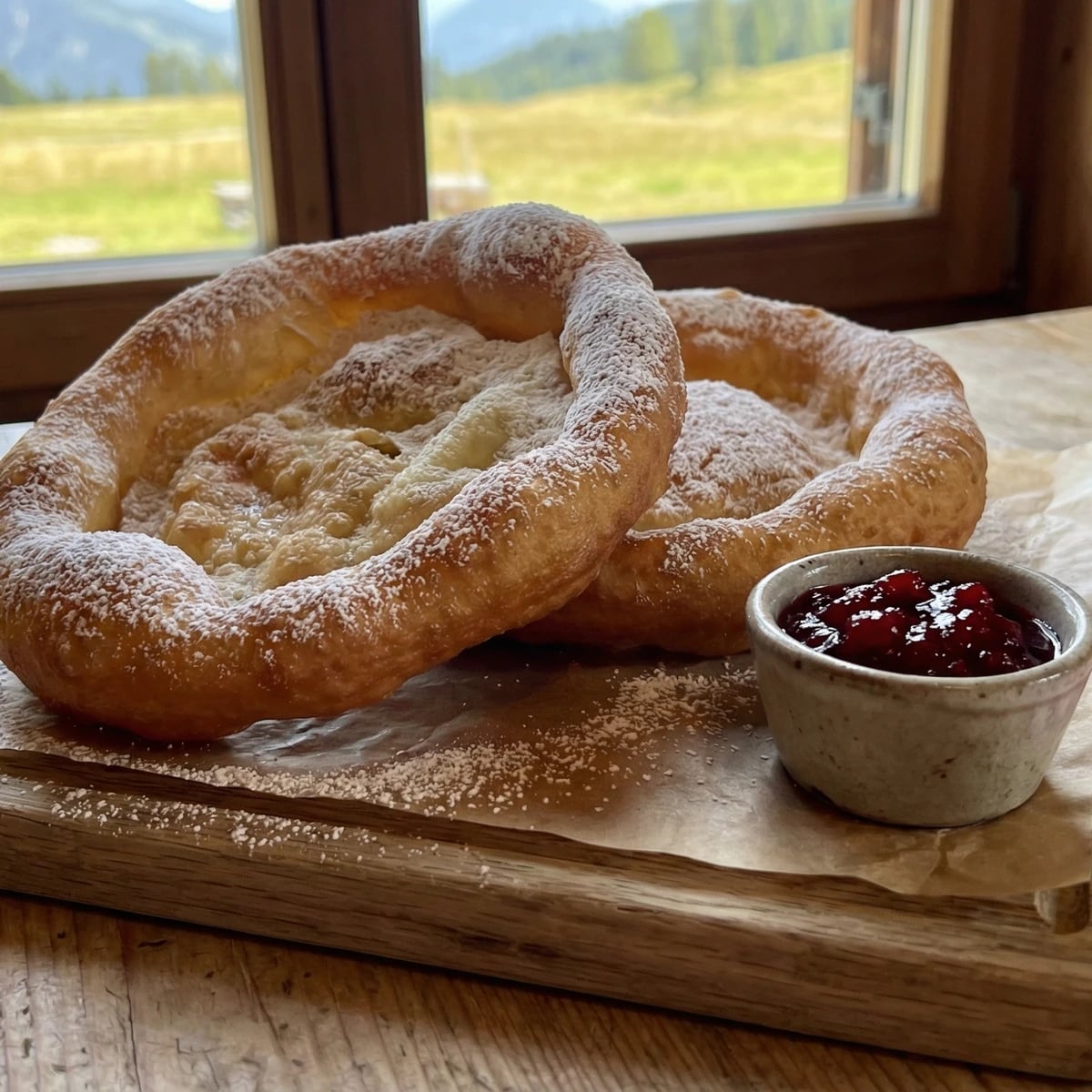
Tyrol's beloved fried dough, stretched thin over the back of your hand until you can nearly see through it, then dropped into hot lard where the center crisps and the rim puffs into golden clouds.
The first time I ate Kiachl I was eight years old, sitting on a wooden bench outside an Alm above Innsbruck with Gretel and my grandmother Eva. A woman brought them to the table on a board, still hot, dusted in powdered sugar with a dish of Preiselbeeren alongside. The centers were so thin they shattered when you bit through them. The rims were soft, golden, pillowy, almost like fresh bread. I ate two and asked for a third.
Kiachl is Tyrolean to its bones. You won't find it on Kaffeehaus menus in Vienna or in the pastry cases of Salzburg's Konditoreien. It belongs to the mountains, to Almen and Bauernhöfe, to village festivals and ski huts where the air smells like pine and hot fat. The dough is simple: flour, milk, butter, eggs, yeast. You let it rise, pull off a piece, and stretch it over the backs of your floured fists until the center is nearly translucent while the rim stays thick. Then it goes into hot lard. The thin center hits the fat and crisps almost instantly. The thick rim puffs and floats. That contrast is the whole point.
Gretel always said Tyrolean cooking doesn't try to impress you. It tries to feed you well with what's there. Kiachl is exactly that: good dough, good fat, a warm kitchen, and the patience to stretch it properly. The technique takes a few tries to learn. Your first one will probably tear. Your second will be better. By the fourth you'll feel it, the moment the dough stops resisting and lets itself be pulled thin without breaking. That moment is worth every torn practice round.
Kiachl (also spelled Kiachln or Kiachel, depending on which Tyrolean valley you're standing in) are among the oldest documented fried pastries in the Alpine region, appearing in Tyrolean household records from the 16th century. They were traditionally made for feast days, weddings, and harvest celebrations, when the household could justify using the quantities of lard required for deep frying. The name derives from the Middle High German 'kuoche,' meaning cake, and the technique of stretching dough over the knee (Kniakiachl) gave rise to one of the dish's most distinctive regional names. Today Kiachl remain a fixture at Tyrolean Almen, Christkindlmärkte, and village festivals across the Inntal, Zillertal, and Wipptal.
Quantity
500g
Quantity
250ml
lukewarm
Quantity
70g
melted and cooled slightly
Quantity
2 large
Quantity
7g
Quantity
40g
Quantity
1 teaspoon
Quantity
from half a lemon
Quantity
about 1 liter
for deep frying
Quantity
for dusting
Quantity
for serving
| Ingredient | Quantity |
|---|---|
| plain flour (glattes Mehl) | 500g |
| whole milklukewarm | 250ml |
| unsalted buttermelted and cooled slightly | 70g |
| egg yolks | 2 large |
| dried yeast (or 20g fresh yeast) | 7g |
| granulated sugar | 40g |
| salt | 1 teaspoon |
| lemon zest | from half a lemon |
| lard or vegetable oilfor deep frying | about 1 liter |
| powdered sugar | for dusting |
| Preiselbeeren (lingonberry jam) | for serving |
Warm the milk until it feels like bath water, not hot. Stir in the yeast and a teaspoon of the sugar. Let it sit for ten minutes. When the surface turns frothy and smells yeasty, it's alive and ready. If nothing happens, your milk was too hot and you killed the yeast. Start again with fresh.
Put the flour in a large bowl and make a well in the center. Pour in the yeast mixture, melted butter, egg yolks, remaining sugar, salt, and lemon zest. Work everything together with your hands, then turn it out onto a floured surface and knead for a good ten minutes. The dough should become smooth, soft, and slightly tacky. It won't be as stiff as bread dough. That softness is what lets you stretch it thin later. If it clings to your hands, add flour a pinch at a time, but keep it on the softer side.
Shape the dough into a ball and place it back in the bowl. Cover with a clean tea towel and let it rise in a warm spot for about one hour, until it has doubled in size. A warm kitchen is fine. Near a radiator is better. Don't put it in a hot oven or the butter will start to melt out and the dough will turn greasy.
Punch the dough down gently and turn it out onto a lightly floured surface. Divide it into eight equal pieces. Roll each piece into a smooth ball between your palms. Set them on a floured tray, cover again, and let them rest for fifteen minutes. This second rest relaxes the gluten so the dough stretches willingly instead of snapping back at you.
This is the step that makes Kiachl what they are. Take one ball of dough and press it flat with your fingers on a floured surface, working it into a rough disc about ten centimeters across. Now pick it up and drape it over the backs of both fists, knuckles together, palms facing down. Gently pull your fists apart and let gravity and the weight of the dough do the work. Rotate it slowly, stretching the center thinner and thinner while leaving the outer rim thick, about a finger's width. The center should be nearly translucent, thin enough to see the shadow of your hands through it. The rim stays plump. That contrast is everything.
Pour the lard or oil into a deep, wide pan or pot to a depth of at least five centimeters. Heat it to 170 to 175 degrees Celsius. Use a thermometer if you have one. If you don't, drop a small pinch of dough into the fat. It should sink briefly, then rise and start bubbling steadily within a few seconds. If it browns instantly, the fat is too hot. If it just sits there looking pale, it's too cool.
Carefully lay a stretched Kiachl into the hot fat. It will sink for a moment, then the rim will puff and float to the surface. Spoon hot fat over the top to help the rim puff evenly. Fry for about two minutes on the first side until the underside is deep golden. Flip it once with a slotted spoon or two forks and fry for another minute or so. The thin center will be crisp and blistered. The rim will be golden brown and airy inside, almost hollow. Lift it out and drain on kitchen paper. Fry one at a time so the fat temperature stays steady.
Dust each Kiachl generously with powdered sugar while it's still warm. Set a spoonful of Preiselbeeren (lingonberry jam) on one side or in a small dish alongside. Serve immediately. Kiachl are best eaten within minutes of leaving the fat, when the center still shatters and the rim is soft and warm. Mahlzeit!
1 serving (about 150g)
Culinary guides, cultural storytelling, and the editorial depth that makes cooking meaningful.
Discover Culinary Explorer
Chef Elsa
Thick apple rings in a light, eggy batter, fried golden in butter and oil, then buried under cinnamon sugar while they're still hot enough to melt it on contact.

Chef Elsa
Day-old bread dipped in sweetened egg and milk, fried golden in butter, and rolled through cinnamon sugar while still hot. Austria's beloved Poor Knights, served with warm apple compote.

Chef Elsa
Austria's flat country doughnut with a blistered, paper-thin center and a fat golden rim, pooled with warm apricot jam and buried under powdered sugar. The thing people queue for at every Bauernmarkt from Salzburg to Vienna.

Chef Elsa
Pillowy yeast buns with a hidden pocket of dark Powidl plum jam, baked together so the sides stay impossibly soft, then set swimming in a warm vanilla custard that pools into every crack when you pull them apart.