
Chef Fai
Southern Cucumber Relish (Ajad)
The one Thai condiment where vinegar replaces lime as the sour pillar, and the system still holds. Palm sugar for sweet, nam pla for salt, prik for heat. Ajad is the four pillars in a jar.
A cooking platform built around craft, culture, and the stories behind what we eat.
Created by
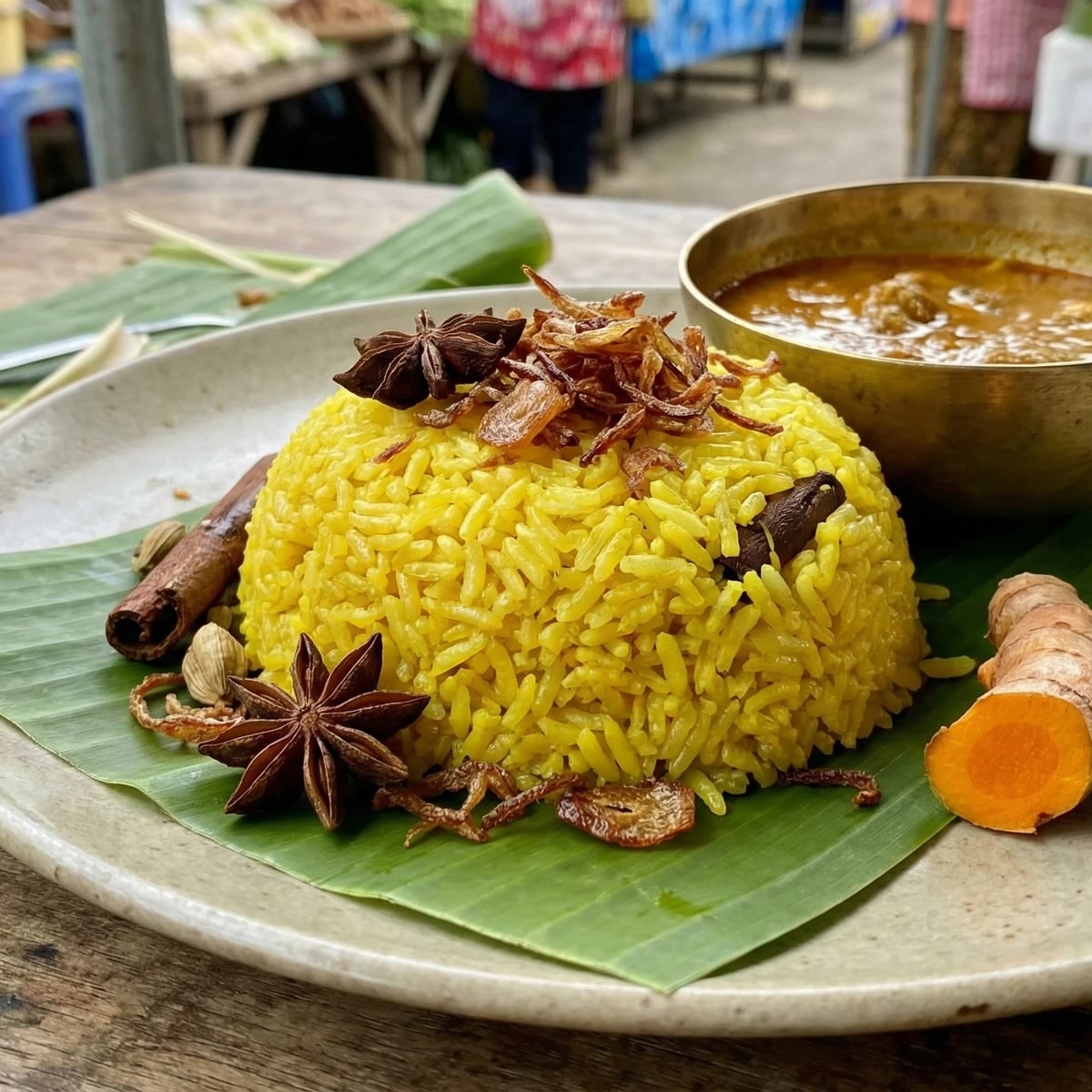
Fresh turmeric root pounded and cooked into every grain with coconut milk and whole spices. The golden rice of Thailand's deep south, where Malay-Muslim kitchens stain their hands yellow and call it tradition.
Not every dish needs a kreung tam. But every dish follows the principles. Khao kunyit is proof.
This is the golden rice of Thailand's deep south: Pattani, Yala, Narathiwat, Songkhla. The Muslim provinces where Islamic communities have been cooking along the Malaysian border for centuries. Khao kunyit is a side dish, a base, the starch that sits under khao mok gai, beside roti kaeng, beneath the rich Southern curries that define this region. And even though it's "just rice," every element has a reason.
Fresh turmeric root (kamin, ขมิ้น). Not dried powder. Not the stuff in a jar that tastes like chalk. Fresh kamin, with its bright orange flesh and sharp, peppery, almost medicinal earthiness. When you pound it in the krok or grate it against a fine rasp, it stains everything: your hands, your cutting board, your shirt if you're careless. That stain is the signature of Southern Thai cooking. You can tell a Southern cook by the yellow under her fingernails. Ajarn always said turmeric is one of the most misunderstood ingredients in Thai cuisine because people reach for the powder and think they've done the job. They haven't. Fresh kamin has volatile oils and a bitterness that dried powder lost months ago on a warehouse shelf.
Coconut milk provides the fat that carries turmeric's color and flavor into every grain. Fish sauce (nam pla) provides the salt pillar. A pandan leaf (bai toey) tied in a knot gives that sweet, grassy fragrance that defines Southeast Asian rice. Whole spices, cinnamon, cardamom, star anise, tell you this isn't Central Thai. This is the Muslim south, where Indian and Malay flavors walked across the border and stayed. The technique is simple: bloom the turmeric and spices in warm coconut milk, add the rice, cook low and slow. But simple doesn't mean careless. The ratio of coconut milk to water matters. Too much coconut and the rice turns greasy, grains clumping together. Too little and you lose the richness that makes khao kunyit worth eating instead of plain jasmine. Principles, not recipes.
Khao kunyit is a staple of Thailand's southern Muslim provinces (Pattani, Yala, Narathiwat, and parts of Songkhla), where Malay-Thai culture and Islamic culinary traditions have coexisted for centuries. The dish shares direct roots with nasi kunyit found across Malaysia and Indonesia, reflecting the deep south's cultural continuity with the Malay world rather than with Central Thai cuisine. It serves as the foundational starch for the Muslim-Thai table, most notably as the rice in khao mok (Thai biryani), and is traditionally present at ceremonial meals, wedding feasts, and Friday gatherings at the mosque.
Quantity
2 cups
Quantity
1 cup
thick first extraction
Quantity
1 cup
Quantity
50g
peeled, finely grated or pounded
Quantity
1
tied into a knot
Quantity
1 small, about 2 inches
Quantity
3
lightly crushed
Quantity
1
Quantity
1 tablespoon
Quantity
1/2 teaspoon
Quantity
for garnish
| Ingredient | Quantity |
|---|---|
| Thai jasmine rice (khao hom mali) | 2 cups |
| coconut milk (kathi)thick first extraction | 1 cup |
| water | 1 cup |
| fresh turmeric root (kamin)peeled, finely grated or pounded | 50g |
| pandan leaf (bai toey)tied into a knot | 1 |
| cinnamon stick | 1 small, about 2 inches |
| cardamom pods (luk krawan)lightly crushed | 3 |
| star anise | 1 |
| fish sauce (nam pla) | 1 tablespoon |
| salt | 1/2 teaspoon |
| fried shallots (hom daeng tod) (optional) | for garnish |
Rinse the jasmine rice in several changes of cold water until the water runs mostly clear. Three or four rinses. You're washing off surface starch so the grains cook separate and fluffy, not gummy. Drain well in a fine sieve and let it sit while you prepare everything else. Ten minutes of draining makes a difference.
Peel the fresh turmeric root with a spoon edge (the skin comes right off) and grate it finely, or pound it in a krok hin to a rough pulp. Fresh kamin is fibrous, so grating on a microplane or fine grater works best if you want it to disappear into the rice. If you pound it, you'll get small bits of fiber, which is fine. That's how they do it in Songkhla market stalls. The moment you cut into fresh turmeric, you'll smell it: earthy, sharp, slightly peppery. That's the volatile oil. Dried powder doesn't have it.
In a heavy-bottomed pot over medium-low heat, pour in the coconut milk. Add the grated turmeric, cinnamon stick, crushed cardamom pods, and star anise. Stir gently and let the coconut milk warm until it's just starting to simmer. Don't boil. You'll see the coconut milk turn a deep, saturated gold as the turmeric releases its color. The kitchen will smell like a Southern Thai market: warm spice, coconut fat, earthy kamin. Two to three minutes is enough. You're extracting flavor and color into the fat. That's what carries it into every grain.
Add the drained rice to the pot and stir it gently through the golden coconut milk, coating every grain. Add the water, fish sauce, salt, and the knotted pandan leaf. Stir once. Bring the liquid to a boil over medium-high heat. The surface will bubble and the color will be a rich turmeric gold. As soon as it boils, drop the heat to the lowest possible setting. Cover tightly. Don't touch the lid. Don't peek. Fifteen minutes.
After fifteen minutes, kill the heat but leave the lid on. Let the rice rest for ten minutes. This is not optional. The steam trapped inside finishes cooking the top layer and evens out the moisture. When you finally lift the lid, the rice should be uniformly golden, each grain separate, fragrant with turmeric and coconut. Remove the pandan leaf, cinnamon stick, cardamom pods, and star anise. Fluff with a fork, not a spoon, working gently from the edges toward the center. Pile it onto a plate or a banana leaf. Scatter fried shallots on top if you have them. Serve it under curry, beside roti, next to grilled chicken. This rice doesn't compete. It supports.
1 serving (about 220g)
Culinary guides, cultural storytelling, and the editorial depth that makes cooking meaningful.
Discover Culinary Explorer
Chef Fai
The one Thai condiment where vinegar replaces lime as the sour pillar, and the system still holds. Palm sugar for sweet, nam pla for salt, prik for heat. Ajad is the four pillars in a jar.

Chef Fai
Southern Thailand's border-town fried chicken: garlic and white pepper kreung tam rubbed into bone-in pieces, fried golden, buried under a mountain of crispy shallots. The shallots aren't garnish. They're the point.

Chef Fai
Three ingredients, one principle: fish sauce seasons the eggs, not salt. Hot oil fries the omelet into a golden, lacy puff. Cha-om's bitter punch makes this Southern Thai, not Central Thai. Over rice. Done.

Chef Fai
No coconut milk, just a kreung tam stained electric yellow with fresh turmeric root, dissolved into water with fish and tamarind. Southern Thailand strips the four pillars bare: sour dominates, sweet barely shows up, and the paste has nowhere to hide.