Culinary Explorer

A cooking platform built around craft, culture, and the stories behind what we eat.
Discover Culinary Explorer
Southern Fish Curry Noodles (Khanom Jeen Nam Ya Tai)

Southern Fish Curry Noodles (Khanom Jeen Nam Ya Tai)

Created by

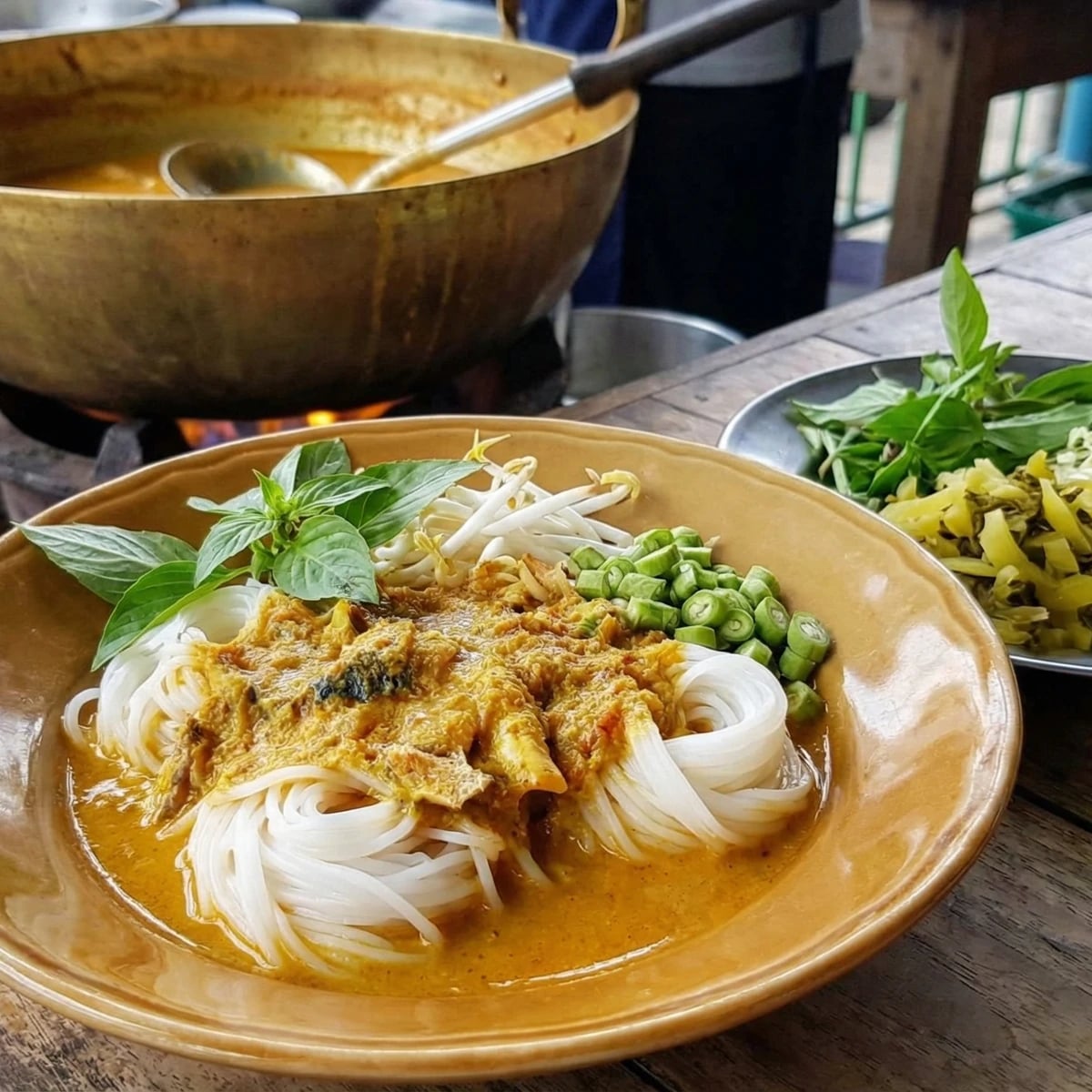
The kreung tam changes when you cross south of Chumphon: turmeric root, not powder, dried chilies dark as mahogany, and a curry built to carry flaked fish over fresh fermented rice noodles. The paste tells you where you are.

Main Dishes
Thai
Weeknight
Comfort Food
45 min
Active Time
30 min cook1 hr 15 min total
Yield4 servings

The paste tells you which Thailand you're standing in. That's the principle this dish teaches.

Ajarn always said the kreung tam is everything. And khanom jeen nam ya is the proof. There are versions of this dish from the Central Plains, from the North, from the deep South. They all start with rice noodles and fish curry. But the paste is different every time. Central Thai nam ya leans on krachai (fingerroot) and galangal, delicate and aromatic. Southern nam ya hits you with fresh turmeric root (kamin), fat dried chilies, and a kreung tam so heavy with shrimp paste you can smell it from across the market. Same dish name. Completely different food. That's because the paste is the identity. Change the kreung tam, change the dish.

This is how I learned Southern Thai cooking: standing at a khanom jeen stall in Nakhon Si Thammarat at six in the morning, watching a woman who'd been doing this for thirty years. Five curry pots lined up on a low table, each one a different sauce. You don't order. You point. She grabs a plate of khanom jeen, noodles coiled into nests by hand, and ladles whatever you want on top. Nam ya. Gaeng tai pla. Gaeng lueng. The curry IS the sauce. The noodles are just the vehicle. If you don't understand that, you don't understand khanom jeen.

The Southern kreung tam starts with dried red chilies, soaked and drained. Then fresh turmeric root, not powder (powder is dead turmeric, Ajarn would say, it lost its oils the day it was ground). Lemongrass, galangal, shallots, garlic, white peppercorns, and a serious amount of kapi (shrimp paste). You pound all of it in a granite mortar until your arm burns and the paste is smooth enough that the coconut milk will absorb it completely. Then the fish: poached, flaked, worked into the curry until the whole thing is thick and rich and stained gold from the kamin. Fish sauce for salt. The South doesn't lean on sweetness. This curry is savory and spicy with a coconut richness that coats the noodles. The side vegetables, bean sprouts, long beans, shredded cabbage, they're not optional. They're the crunch and freshness that completes the bite. That's the design.

Khanom jeen is one of Thailand's oldest noodle traditions, with the fresh fermented rice noodles likely predating any Chinese noodle influence. The word 'khanom jeen' may derive from the Mon language, pointing to Mon-Khmer origins rather than Chinese. Southern Thailand's nam ya distinguishes itself from Central and Northern versions through heavy use of fresh turmeric root (kamin) and a more assertive shrimp paste presence, reflecting the South's proximity to Malaysian and Malay-Muslim culinary traditions. In Nakhon Si Thammarat and Songkhla provinces, khanom jeen stalls are a morning institution, with vendors preparing multiple curry pots before dawn and serving until the pots run dry, usually by mid-morning.

The technique, the tradition, and the story behind every dish.

Discover Culinary Explorer

Ingredients

fresh khanom jeen noodles (fresh fermented rice noodles)

Quantity

400g

or 300g dried rice vermicelli as backup

whole mackerel (pla thu) or firm white fish

Quantity

400g

thick coconut milk (hua kati)

Quantity

400ml

thin coconut milk (hang kati)

Quantity

400ml

dried red chilies (prik haeng)

Quantity

15

soaked in warm water 15 minutes, drained

fresh turmeric root (kamin)

Quantity

50g

peeled and sliced

lemongrass (takhrai)

Quantity

3 stalks

sliced thin

galangal (kha)

Quantity

30g

peeled and sliced

shallots (hom daeng)

Quantity

8

peeled

garlic (kratiam)

Quantity

8 cloves

white peppercorns (prik thai khao)

Quantity

1 teaspoon

shrimp paste (kapi)

Quantity

2 tablespoons

fish sauce (nam pla)

Quantity

3 tablespoons, plus more to taste

palm sugar (nam tan pip)

Quantity

1 teaspoon

water

Quantity

2 cups

for poaching fish

bean sprouts (thua ngok)

Quantity

150g

long beans (thua fak yao)

Quantity

100g

cut into 2-inch pieces

white cabbage

Quantity

100g

shredded

Thai basil leaves (horapha) (optional)

Quantity

for serving

pickled mustard greens (phak kat dong) (optional)

Quantity

for serving

sliced

Equipment Needed

  • Heavy granite mortar and pestle (krok hin) for the kreung tam
  • Wide heavy-bottomed pot or Dutch oven for the curry
  • Medium pot for poaching fish

Instructions

  1. 1

    Poach and flake the fish

    Bring two cups of water to a gentle simmer. Add the whole mackerel or fish fillets and poach for 8 to 10 minutes until the flesh is cooked through and flakes easily. Don't boil it hard. Gentle heat keeps the fish moist. Pull the fish out and let it cool enough to handle. Pick every bone. Every single one. Flake the flesh with your fingers, feeling for pin bones as you go. You want the fish broken into small, almost shredded pieces. Reserve the poaching liquid. That water is now fish stock and it's going into the curry.

    Pla thu (short mackerel) is the traditional choice in the South and it's cheap and full of flavor. If you can't find it, any firm white fish works. What matters is the flaking: the fish needs to dissolve into the curry, not sit in chunks.
  2. 2

    Pound the kreung tam

    This is where the dish lives or dies. Start with the white peppercorns in your granite mortar (krok hin). Pound them to a powder. Add the soaked, drained dried chilies and pound until they break down into a rough paste. Then the lemongrass, galangal, and fresh turmeric root. Pound each addition until it's integrated before adding the next. The turmeric will stain your mortar, your pestle, your hands, your cutting board. Accept it. That gold is the color of Southern Thai food. Next, the shallots and garlic. Pound until smooth. Last, the kapi (shrimp paste). Work it through the whole paste until everything is uniform: a deep orange-gold, intensely aromatic paste that smells like the sea and the earth at the same time. This should take 20 to 25 minutes. Your arm will hurt. That's how you know the kreung tam is right.

    Ajarn always said: the kreung tam tells you when it's ready. When the aroma fills the room, you're there. If you can still see individual pieces of lemongrass fiber, keep pounding. The paste needs to be smooth enough that the coconut milk absorbs it completely.
  3. 3

    Crack the coconut cream

    Pour the thick coconut milk (hua kati) into a wide, heavy pot over medium heat. Stir occasionally. Watch. After 5 to 7 minutes, the cream will begin to separate: you'll see pools of clear coconut oil forming on the surface. That's called 'cracking' the coconut cream and it's the foundation of every coconut-based Thai curry. If you skip this step, the curry tastes flat and the paste never properly blooms. Once the oil has separated and the surface looks broken and oily, you're ready.

    Use real coconut milk, not the ultra-stabilized kind in tetrapaks. You need the fat to separate. If your coconut milk won't crack, the emulsifiers in it are fighting you. Look for brands with a thick layer of cream on top when you open the can.
  4. 4

    Fry the paste

    Add the kreung tam to the cracked coconut cream. Stir it in and let it fry in the coconut oil. This is the critical moment. The paste needs to cook in that oil for 3 to 4 minutes, stirring constantly. The color will deepen. The aroma will shift from raw to roasted. The turmeric will turn the whole pot a deep golden orange. You'll see the oil start to pool around the edges of the paste again. That's the paste telling you it's done. It's cooked through and its oils have released into the coconut.

  5. 5

    Build the curry

    Pour in the thin coconut milk (hang kati) and about one cup of the reserved fish poaching liquid. Stir well. Bring to a gentle simmer. Add the flaked fish and stir it through the curry. The fish should dissolve into the liquid, thickening it naturally. This is the body of the sauce. Simmer for 10 minutes, stirring occasionally to prevent sticking. The curry should be thick enough to coat the noodles but still pourable. If it's too thick, add more poaching liquid. If it's too thin, simmer longer.

  6. 6

    Season the curry

    Add the fish sauce and palm sugar. Stir. Taste. The balance should be: savory and salty first from the fish sauce and kapi, with heat building from the chilies, a faint sweetness from the palm sugar (barely there, this isn't Central Thai), and the richness of coconut pulling it all together. The South doesn't lean sweet. The curry should be bold, spicy, and deeply savory with that unmistakable turmeric backbone. Adjust fish sauce if it needs more salt. A squeeze of lime at serving is optional but welcome. Keep the curry at a low simmer while you prepare the noodles.

  7. 7

    Prepare the noodles and vegetables

    If using fresh khanom jeen, they're ready to go. These are soft, slightly fermented, and come in coiled nests. Don't rinse them. Don't cook them further. They're already done. If you're using dried rice vermicelli as a backup, cook according to the packet and drain well, but know you're losing the slight tang that makes real khanom jeen special. Blanch the bean sprouts and long beans in boiling water for 30 seconds, just enough to take the raw edge off. Drain. Arrange them with the raw shredded cabbage, pickled mustard greens, and Thai basil on a plate. These aren't garnish. They're the other half of the dish.

  8. 8

    Assemble and serve

    Place nests of khanom jeen on each plate or in shallow bowls. Ladle the hot curry generously over the noodles. Don't be shy. The curry is the point. The noodles are just the vehicle. Serve the vegetable plate alongside. Each bite should be noodles, curry, and a piece of raw or blanched vegetable: crunch against silk against spice. That contrast is the design of every khanom jeen stall in the South. Fai Thai, baby.

Chef Tips

  • Fresh khanom jeen noodles are fermented rice noodles with a slightly sour tang. They're sold in Thai grocery stores in the refrigerated section, coiled into small nests. If you've only ever had dried rice vermicelli, fresh khanom jeen is a different experience: softer, chewier, with a subtle fermented flavor that pairs with the curry in a way dried noodles can't replicate. Seek them out. They're the real thing.
  • Fresh turmeric root (kamin) is non-negotiable in Southern Thai cooking. Dried turmeric powder is a different ingredient with a different flavor profile. Fresh kamin has a sharp, slightly bitter, earthy bite and an intense golden color that powder can't match. Find it at Asian grocery stores or Indian markets. It looks like a smaller, more orange version of ginger. Peel it, slice it, and accept that your fingers will be yellow for two days.
  • The Southern kreung tam is heavier on shrimp paste (kapi) than Central Thai pastes. Don't flinch. Kapi is fermented shrimp, and it provides a deep umami backbone that fish sauce alone can't deliver. When you fry the paste in cracked coconut cream, the raw funkiness cooks off and what remains is pure savory depth. Trust the process.
  • In the deep south near Pattani and Songkhla, some cooks use budu (nam budu, Southern fermented fish sauce) instead of standard nam pla. Budu is thicker, more pungent, with a deeper funk. If you can find it, try replacing half the fish sauce with budu. That's the real Southern flavor.
  • The vegetable plate is structural, not decorative. Bean sprouts give crunch. Long beans give snap. Raw cabbage gives freshness. Pickled mustard greens give sour contrast. Each one has a job. Skipping the vegetables is like eating pasta sauce without the pasta. The components work together.

Advance Preparation

  • The kreung tam can be pounded a day ahead and stored in an airtight container in the refrigerator. Bring to room temperature before frying in the coconut cream.
  • Fish can be poached and flaked up to a day ahead. Store the flaked fish and poaching liquid separately in the refrigerator.
  • The finished curry reheats well the next day. The flavors deepen overnight. Add a splash of coconut milk when reheating to loosen it. Khanom jeen noodles, however, must be fresh. They don't store well once opened.

Frequently Asked Questions

Nutrition Information

1 serving (about 480g)

Calories
620 calories
Total Fat
34 g
Saturated Fat
23 g
Trans Fat
0 g
Unsaturated Fat
11 g
Cholesterol
50 mg
Sodium
1600 mg
Total Carbohydrates
58 g
Dietary Fiber
6 g
Sugars
9 g
Protein
23 g

Note: Chef personas and recipes are created with AI assistance. Cook with care: follow safe food-handling practices, check doneness with a thermometer when needed, and adapt for allergies and your kitchen.

Where cooking meets culture.

Culinary guides, cultural storytelling, and the editorial depth that makes cooking meaningful.

Discover Culinary Explorer

More from Southern Thai Salads, Soups & Sides

Browse the full collection