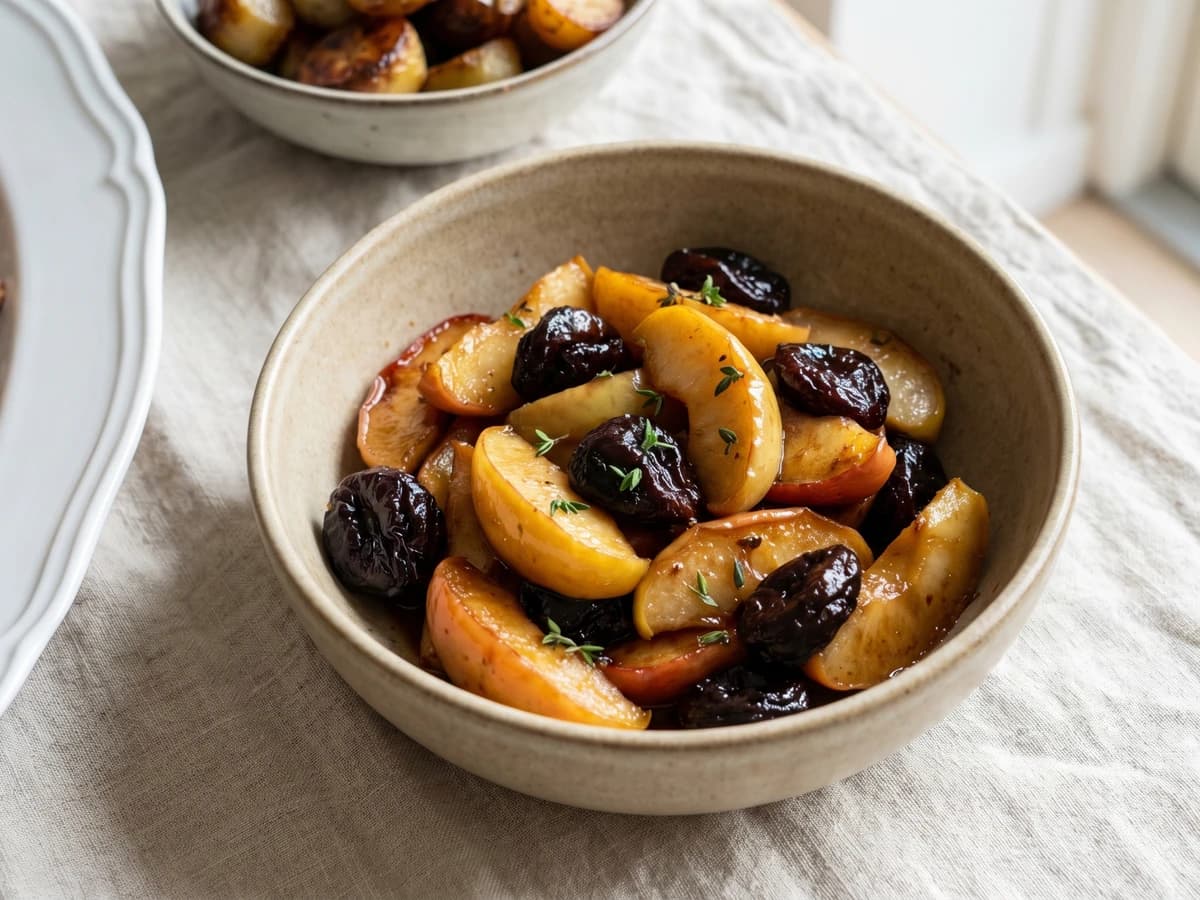
Ground pork and veal bound with cold cream, spiced with cloves, allspice, and nutmeg, and studded with soft chopped prunes. The Danish Christmas meat loaf that belongs beside the roast on juleaften and returns, sliced cold, at the julefrokost the day after.
Side Dishes
Danish
Christmas
Holiday
Make Ahead
25 min
Active Time
1 hr cook•1 hr 25 min total
Yield8 servings
December in Denmark smells like cloves and allspice before it smells like pine. The spices come first because the cooking starts days ahead, and farsbrod is one of the first things you make. It sits in the fridge, patient and ready, waiting for its moment beside the roast pork on juleaften, Christmas Eve, the meal that holds the whole season together.
Farsbrod is the Danish answer to a question every Christmas table asks: what goes beside the meat? Not under it, not inside it. Beside it. This is a loaf made from ground pork and veal, bound with cold cream, scented with the warm spice trinity of cloves, allspice, and nutmeg, and studded with chopped prunes whose dark sweetness cuts through the richness of the meat like a breath of cold air through a warm room. It bakes slowly until the outside firms and the inside stays pale and moist. You slice it thick on juleaften, warm from the oven. You slice it thin the next day, cold, for the julefrokost, the long Christmas lunch that unfolds over hours with pickled herring, leverpostej, and too many kinds of cheese.
Two things matter here. First: the cream must be cold. Cold cream emulsifies into the meat and stays trapped there during baking, which is what gives you a loaf that's tender and moist instead of dense and dry. Second: don't skip the prunes. They're not decoration. They're the reason this farsbrod tastes like Christmas and not like Tuesday. I'll walk you through every step, and you'll know when it's right.
Farsbrod descends from the broader European forcemeat tradition, the French farce, that reached Danish kitchens through the royal court's French-trained chefs in the 18th century. By the 1800s, ground meat loaves spiced with cloves and allspice had become a fixture of the Danish Christmas table, with the addition of prunes reflecting a Scandinavian taste for combining meat and dried fruit that stretches back to medieval cooking. The julefrokost tradition, the communal Christmas lunch where farsbrod appears cold alongside dozens of other dishes, was formalized in Copenhagen's restaurants and workplaces in the late 19th century and remains one of the most distinctly Danish food rituals of the year.
The technique, the tradition, and the story behind every dish.
Put the ground pork and veal together in a large bowl. Add the grated onion, flour, salt, white pepper, allspice, cloves, and nutmeg. Use your hands or a wooden spoon to mix everything until the spices are evenly distributed. You grate the onion rather than chop it because grated onion melts into the mixture and gives you flavor without texture. Chopped onion stays distinct and interrupts the smoothness of the loaf.
Grate the onion on the fine side of a box grater, catching the juice. That juice carries more flavor than the pulp.
2
Bind with cream and eggs
Beat the eggs lightly and add them to the meat. Now pour in the cold cream in a slow, steady stream, working it into the mixture with a wooden spoon or your hand. Stir in one direction only and keep going for two to three minutes. The cream needs to be cold because cold fat emulsifies into the meat proteins and stays trapped there during baking, which is what keeps the loaf moist and tender. Warm cream breaks the bind and the loaf turns dry. You'll feel the mixture change under your hand: it goes from loose and grainy to smooth and cohesive, pulling away from the sides of the bowl. That's when it's ready.
Stirring in one direction builds a protein network that holds the cream in suspension. If you stir randomly, the mixture stays loose and the loaf crumbles when you slice it.
3
Fold in the prunes
Add the chopped prunes and fold them through the mixture gently, distributing them as evenly as you can. Don't overwork it now. The prunes are doing two things: they bring a dark, caramel sweetness that cuts through the richness of the pork, and they keep the interior moist because they hold water as the loaf bakes. This balance between savoury spiced meat and sweet fruit is the heart of Danish Christmas farsbrod. Without the prunes, it's just a meat loaf. With them, it belongs to December.
4
Prepare the loaf pan
Heat the oven to 175C. Butter a 24cm loaf pan generously, getting into the corners. Scatter the breadcrumbs across the butter and turn the pan so they coat the bottom and sides evenly. Tap out any excess. The breadcrumbs form a thin crust that protects the outside of the loaf from drying out and gives you clean slices when you turn it out. Butter alone sticks. Breadcrumbs give you release.
If you don't have a loaf pan, a deep ovenproof dish works. The shape will be different but the result is the same.
5
Fill and shape
Spoon the mixture into the prepared pan, pressing it down firmly with the back of the spoon to eliminate air pockets. Air pockets become holes in the finished loaf, and holes mean dry spots. Smooth the top so it's level. If you're using bacon, lay the slices lengthwise across the surface, overlapping slightly. The bacon renders its fat into the top of the loaf as it bakes, basting it from above and giving the surface a salty, bronzed finish.
6
Bake the farsbrod
Place the pan in the centre of the oven and bake for fifty-five minutes to one hour. The loaf is done when the top is deep golden brown and the internal temperature reads 72C on a probe thermometer. If you don't have a thermometer, press the centre gently with your finger. It should feel firm and spring back, not soft or yielding. When it's ready, the juices that pool around the edges will run clear, not pink.
If the top is browning too fast, lay a piece of foil loosely over the pan for the last fifteen minutes. Don't tuck it in. You want the steam to escape so the surface stays firm.
7
Rest and slice
Let the farsbrod rest in the pan for fifteen minutes before turning it out. Resting is not optional. The proteins need time to relax and reabsorb the juices that the heat pushed to the centre. If you slice immediately, those juices run out onto the board and the loaf goes dry. After fifteen minutes, run a knife around the edges and invert the loaf onto a board or serving platter. Slice it about a centimetre thick. The inside should be pale and moist, flecked with dark prunes and fragrant with spice. Serve it warm beside the roast, or let it cool and serve it at room temperature at the julefrokost the next day.
Chef Tips
•Ask your butcher to grind the pork and veal together, twice through the fine plate. The finer the grind, the smoother the loaf. Coarse mince gives you a crumbly texture that falls apart when sliced.
•Use soft, moist prunes, not the hard dried kind that need soaking. If yours are firm, cover them with warm water for twenty minutes and drain well before chopping. Wet prunes release too much liquid into the mixture and throw off the bind.
•The spicing should be present but not loud. You want to taste cloves, allspice, and nutmeg as a single warm note, not as individual spices competing with each other. If in doubt, use less. You can always add more next time.
•Farsbrod improves overnight. The spices settle into the meat and the flavors knit together. Make it on the 23rd and it will be better on the 24th. Cooked with love and a day of patience.
Advance Preparation
•Farsbrod can be baked two days ahead of juleaften. Cool completely, wrap tightly in foil, and refrigerate. Reheat in a 160C oven for twenty to twenty-five minutes, still wrapped, until warmed through.
•The uncooked mixture can be prepared the morning of and kept covered in the fridge until you're ready to bake. The resting time actually helps the cream bind more fully into the meat.
•Leftover farsbrod is traditionally served cold at the julefrokost, sliced thin and laid on rugbrod with pickled red cabbage and mustard. It keeps for four days in the fridge.
Frequently Asked Questions
Nutrition Information
1 serving (about 170g)
Calories
460 calories
Total Fat
34 g
Saturated Fat
16 g
Trans Fat
0 g
Unsaturated Fat
17 g
Cholesterol
165 mg
Sodium
450 mg
Total Carbohydrates
18 g
Dietary Fiber
2 g
Sugars
8 g
Protein
21 g
Where cooking meets culture.
Culinary guides, cultural storytelling, and the editorial depth that makes cooking meaningful.