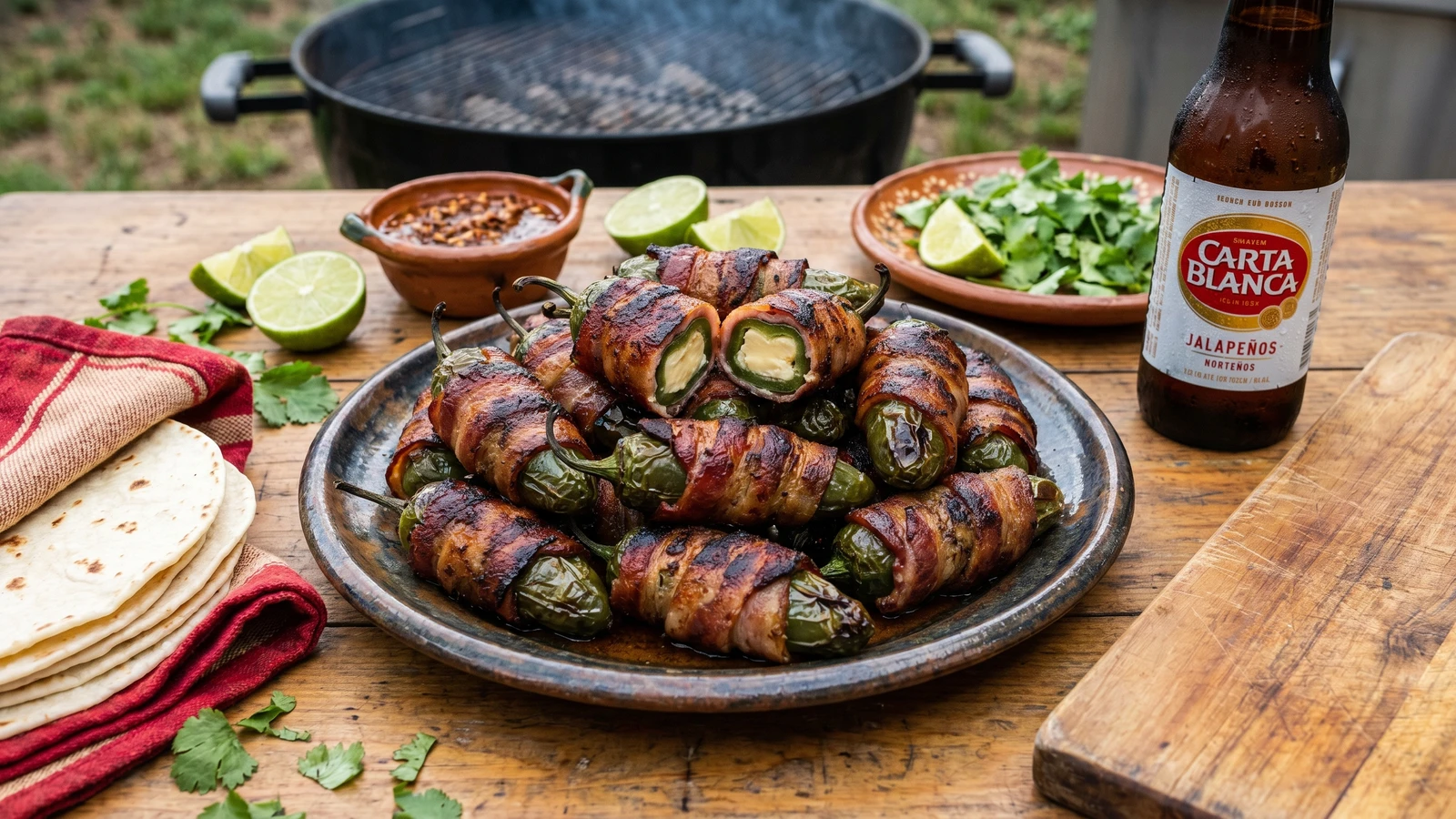
Nuevo León's bar-and-backyard classic: whole jalapeños cored and stuffed with queso crema and machaca, wrapped tight in thick-cut bacon, grilled until the skin blisters and the wrap crackles.
Appetizers & Snacks
Mexican
BBQ
Game Day
Potluck
30 min
Active Time
20 min cook•50 min total
Yield12 toritos (4 to 6 servings)
Toritos belong to el Norte. Nuevo León claims them, Coahuila and Tamaulipas serve them at every carne asada, and Sonora has its own version with carne seca instead of machaca. This is a northern dish through and through, and you can read every part of it on the map: the bacon, the cattle country, the flour tortilla on the side, the cold beer it is meant to be eaten with.
The filling is the argument. Some norteño cooks fill the chile with nothing but queso crema and call it done. Others insist on machaca, the air-dried beef of the Norte, rehydrated and cooked with onion and tomato into what they call machaca a la mexicana. I cook it both ways depending on who is at the table, but the version with machaca is the one I learned from a señora in Monterrey who fed her sons toritos every Sunday before the futbol game. She told me the cheese alone is fine, but the machaca is what makes it Norteño. She was right.
Flour tortillas at the table, not corn. That is one of the things people get wrong about Mexican food. The flour tortilla is a northern tradition, born of the wheat country of Sonora and Chihuahua, and it belongs with this dish the way the corn tortilla belongs with carnitas. Do not put a corn tortilla next to a torito just because somebody on the internet said all Mexican food eats with corn. Esto no es comida de un solo Mexico.
One more thing. The chile here is jalapeño, fresh and whole, and the heat depends on the season and the harvest. Taste a sliver from the chile before you commit. If it is mild, leave the veins in. If it is fierce, take them out. Saber cocinar es saber vivir.
The torito as it is eaten today emerged from the carne asada culture of Nuevo León in the second half of the 20th century, when the backyard grill became central to family life in Monterrey and the surrounding industrial cities. Machaca itself is far older, an air-drying preservation technique brought into the Norte through the meeting of Spanish charqui traditions and the indigenous practice of jerking game meat in the dry desert air, and it became the defining beef product of Sonora and Nuevo León long before refrigeration. The bacon-wrapped chile is a more recent regional flourish, popularized in cantinas and grills along the Texas-Mexico border, and it traveled freely in both directions: the dish is claimed in Mexico as norteño and in South Texas as borderlands cooking, which is exactly the kind of shared inheritance the border has always produced.
The technique, the tradition, and the story behind every dish.
queso crema (Mexican cream cheese, full fat)at room temperature
8 ounces
machaca de res (dried shredded beef)shredded fine by hand
4 ounces
queso Chihuahuagrated
1/2 cup
white onionfinely diced
1/4 medium
garlic clovesminced
2
manteca de cerdo (pork lard)
1 tablespoon
Roma tomatoseeded and finely diced
1 small
dried Mexican oreganocrumbled between the palms
1 teaspoon
kosher salt
1/2 teaspoon
thick-cut baconat room temperature
12 strips
lime wedges (optional)
for serving
salsa de chile de árbol (optional)
for serving
flour tortillas (optional)warmed on the comal
for serving
Equipment Needed
•Sharp paring knife or jalapeño corer
•Small skillet for the machaca filling
•Wooden toothpicks soaked in water for thirty minutes
•Charcoal or gas grill with two heat zones
•Long-handled tongs
Instructions
1
Rehydrate the machaca
Place the machaca in a small bowl and cover with a few tablespoons of warm water. Let it sit for ten minutes while you prepare the rest of the filling. Good machaca is bone dry when you buy it. The water wakes it up just enough to cook with, not enough to make it soggy. Squeeze it gently between your fingers when the time is up and pull apart any clumps. The strands should look like fine threads.
Real machaca de res is air-dried beef from the Norte, salty and concentrated. The pre-shredded carne seca in plastic bags from the supermarket is a compromise. If you can find machaca from Sonora or Nuevo León, that is what you want.
2
Cook the machaca filling
Melt the manteca in a small skillet over medium heat. Add the onion and cook until translucent, about three minutes. Add the garlic and cook one minute more. Add the rehydrated machaca and the diced tomato. Cook for five to seven minutes, stirring, until the tomato breaks down and the machaca takes on the fat and the color of the onion. La manteca es el sabor. Stir in the crumbled oregano off the heat. Let it cool to warm before mixing with the cheese.
3
Prepare the jalapeños
Wear gloves if your hands are sensitive. Slice off the very tip of the stem end of each jalapeño, keeping the stem itself intact, you want the cap to hold. Using a small paring knife or a corer, hollow out the chile through the cut end, scraping out the seeds and the white veins. The veins are where the heat lives. Leave them in for a torito with bite. Take them out for one that lets the filling sing. Most of the white membrane should come out either way. Rinse the chiles upside down to flush any loose seeds and shake them dry.
If your jalapeños are very hot, soak the hollowed chiles in salted water for fifteen minutes and pat them dry. This is what they do in the bars in Monterrey when the chiles come in fierce. Cada estado, su propia cocina.
4
Mix the filling
In a medium bowl, combine the queso crema, the cooled machaca mixture, the grated queso Chihuahua, and the salt. Mix with a fork until evenly combined. Taste it. The machaca is salty and the cheese is rich, you want them in balance. If it tastes flat, more salt. If it tastes one-note, a little more oregano. The filling should be thick enough to hold its shape on a spoon.
5
Stuff the chiles
Transfer the filling to a small zip-top bag and snip the corner, or use a small spoon. Pipe or push the filling into each hollowed jalapeño, packing it firmly to the bottom and stopping at the rim. Do not overstuff. The cheese expands on the grill and a chile that is bursting at the seam will leak everything onto the coals. A flush, packed fill is what you want.
6
Wrap with bacon
Lay a strip of bacon flat on the cutting board. Place a stuffed jalapeño at one end at a slight diagonal. Roll the chile across the bacon, wrapping it in a tight spiral so the strip overlaps slightly with each turn. The bacon should cover the chile from the cut end almost to the stem. Secure the loose end with a toothpick driven through the bacon and into the flesh of the chile. Repeat with the rest. This is the moment that turns a stuffed pepper into a torito.
Thick-cut bacon is the only kind that works here. Thin bacon cooks faster than the chile blisters and you end up with a soft, pale wrap. The whole point is the contrast between the crackling bacon and the tender chile.
7
Set up the grill
Build a medium-hot fire in a charcoal grill, or heat a gas grill to medium. You want a temperature where the bacon renders steadily without flaring. If you have two zones, set up one direct and one indirect. The toritos start over indirect heat to let the chile soften and the filling warm through, then finish over direct heat to crisp the bacon. A backyard grill in Monterrey is rarely fancy. A simple charcoal pit will do everything you need.
8
Grill the toritos
Lay the wrapped chiles seam-side down on the cooler side of the grill. Cover and cook for ten to twelve minutes, turning every three minutes, until the bacon is rendered and just starting to brown. Move them over the direct heat and grill four to six more minutes, turning often, until the bacon crackles and the jalapeño skin blisters and chars in spots. The cheese should be soft inside and the chile should bend slightly when you press the side. Pull the toothpicks before serving or warn your guests.
9
Rest and serve
Let the toritos rest for three minutes on a cutting board. The filling is molten right off the grill and a torito eaten too soon will burn the roof of your mouth and disappoint everybody at the same time. Pile them on a platter with lime wedges, salsa de chile de árbol, and warm flour tortillas on the side. In Nuevo León, the flour tortilla is the bread of the table. The torito is meant to be eaten with one in your other hand. Asi se hace y punto.
Chef Tips
•Buy thick-cut bacon. Thin bacon cooks before the chile has a chance to soften and the whole texture falls apart. If you can find Mexican-style tocino from a carniceria, even better, it has a deeper smoke and more fat to render.
•Real machaca, the air-dried shredded beef of Sonora and Nuevo León, is worth seeking out. Look for it at a Mexican carniceria or order it from a Norte producer. The vacuum-packed carne seca strands at the supermarket are a compromise, not an upgrade, but they will get you most of the way there.
•If you cannot grill outdoors, these can be roasted on a sheet pan at 425F for about 25 minutes, turning halfway, then finished under the broiler for two minutes to crisp the bacon. It is not the same as charcoal smoke, but it is honest indoor cooking.
•Queso crema in Mexico is not the same as American cream cheese. The Mexican version is softer, tangier, and less sweet. Philadelphia-style works in a pinch, but if you find queso crema or queso doble crema at a Mexican market, use it.
Advance Preparation
•The machaca filling can be cooked one day ahead and refrigerated. Bring to room temperature before mixing with the cheese.
•The toritos can be fully assembled, wrapped in bacon, and refrigerated up to six hours before grilling. Pull them out twenty minutes before they hit the fire so the chiles do not seize over the heat.
•Do not assemble more than half a day ahead. The salt in the bacon and the moisture in the cheese start to break down the structure of the chile and you lose the snap of the fresh jalapeño.
Frequently Asked Questions
Nutrition Information
1 serving (about 200g)
Calories
540 calories
Total Fat
41 g
Saturated Fat
19 g
Trans Fat
0 g
Unsaturated Fat
20 g
Cholesterol
140 mg
Sodium
1670 mg
Total Carbohydrates
6 g
Dietary Fiber
1 g
Sugars
3 g
Protein
35 g
Where cooking meets culture.
Culinary guides, cultural storytelling, and the editorial depth that makes cooking meaningful.