
Chef Lupita
Aporreadillo Michoacano con Huevo
Michoacán's Tierra Caliente almuerzo, where salted beef is softened, pounded, fried in lard, folded with egg and chile perón salsa, then served beside morisqueta like a proper working table.
A cooking platform built around craft, culture, and the stories behind what we eat.
Created by
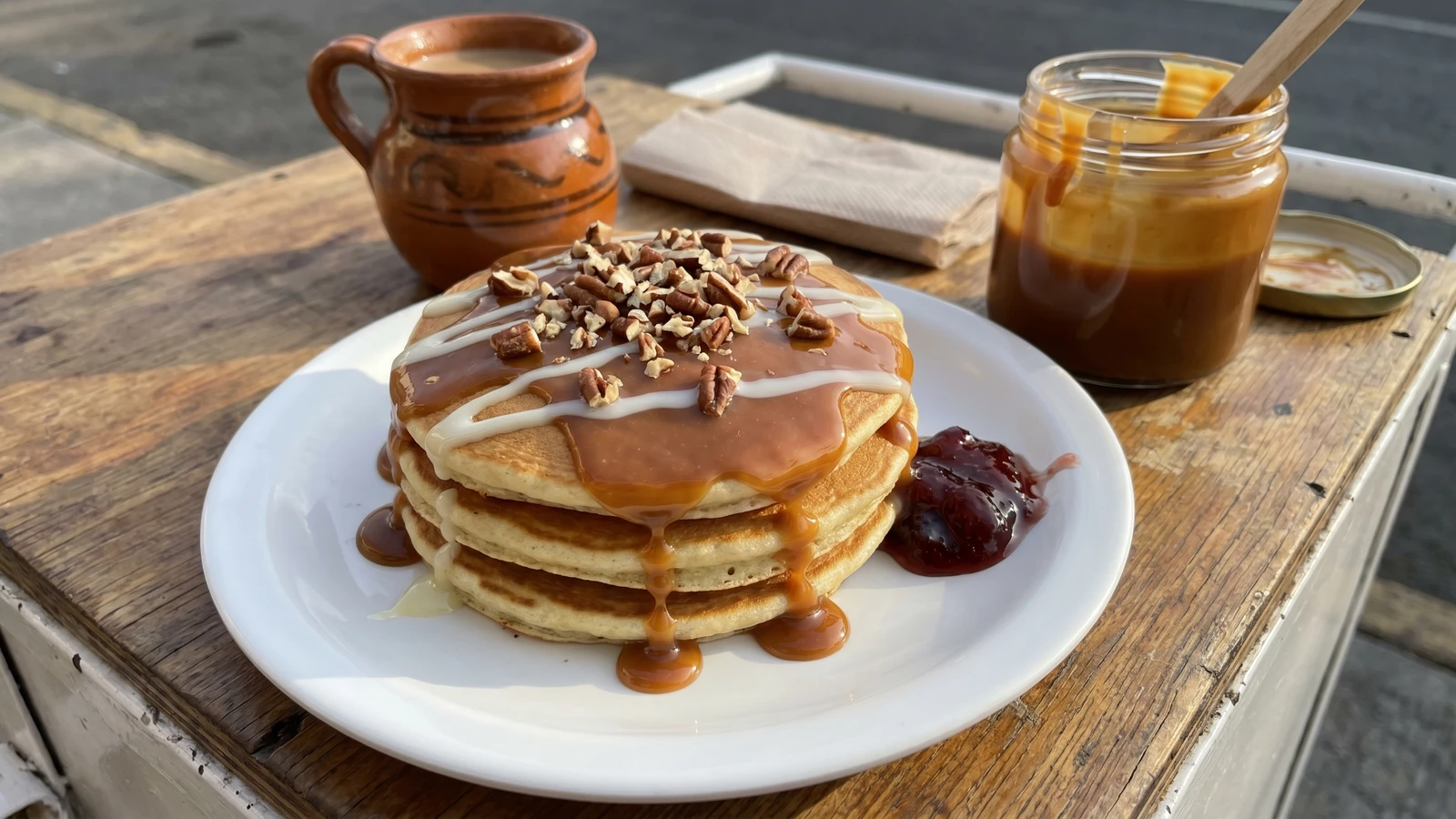
Ciudad de Mexico's Sunday morning carrito hotcakes, thick and cottony off a sidewalk plancha, drowned in cajeta de Celaya and showered with chopped pecans the moment they hit the plate.
These hotcakes are from Ciudad de Mexico. Not from a brunch restaurant, not from a hotel buffet. From the folding metal cart parked at the corner of a park on a Sunday morning, run by a man or a woman in a white apron with a flat plancha bolted to the top and a propane tank underneath. You order at the cart, you eat standing up or sitting on a bench, and you go home sticky.
The batter is not American pancake batter. It is leavened harder, with a full tablespoon of baking powder, so the hotcake rises into something tall and cottony that can stand up to the weight of cajeta without going limp. The cajeta has to be from Celaya, Guanajuato. That is where the dish gets its sweetness, its smokiness, its long slow goat-milk depth. Cajeta is not caramel sauce. Caramel is cooked sugar. Cajeta is goat milk and sugar reduced for hours until it turns the color of an old penny and tastes like the inside of a candy store. If your jar says dulce de leche, that is cow milk and it is not the same thing. La cajeta de Celaya es la cajeta.
The pecan is nuez pecanera, the same pecan that grows in the orchards of Coahuila and Chihuahua. Chopped rough, not ground. You want the crunch against the cotton of the hotcake and the slow pull of the cajeta. The carrito vendors will also offer you lechera, condensed milk, drizzled on top in a second sweet layer, and a spoon of strawberry jam on the side. None of this is subtle and none of it is meant to be. This is the breakfast of a city that walks to the park on Sunday morning and wants something sweet before it walks home. Saber cocinar es saber vivir.
The carrito de hotcakes is a 20th-century Mexico City institution, emerging in the 1950s and 1960s as part of the broader street-food economy that fed working families and Sunday park-goers in the capital. The hotcake itself is a Mexican adaptation of the North American pancake, but the heavy leavening and the cajeta finish are distinctly Mexican choices. Cajeta, from the town of Celaya in Guanajuato, takes its name from the small wooden boxes (cajetes) it was historically sold in, and the technique of slowly reducing goat milk with sugar dates to the colonial period when the Bajio region became the center of Mexican goat farming. The pairing of carrito hotcakes with cajeta de Celaya and nuez was popularized in chilango parks like Alameda Central, Parque Mexico, and Chapultepec, where the carts still appear on weekend mornings.
Quantity
2 cups
Quantity
3 tablespoons
Quantity
1 tablespoon
Quantity
1/2 teaspoon
Quantity
1 1/2 cups
at room temperature
Quantity
2
at room temperature
Quantity
1 teaspoon
Quantity
3 tablespoons, plus more for the griddle
melted and slightly cooled
Quantity
1 cup
Quantity
3/4 cup
coarsely chopped
Quantity
for serving
Quantity
for serving
| Ingredient | Quantity |
|---|---|
| all-purpose flour | 2 cups |
| granulated sugar | 3 tablespoons |
| baking powder | 1 tablespoon |
| fine salt | 1/2 teaspoon |
| whole milkat room temperature | 1 1/2 cups |
| large eggsat room temperature | 2 |
| Mexican vanilla extract | 1 teaspoon |
| unsalted buttermelted and slightly cooled | 3 tablespoons, plus more for the griddle |
| cajeta de Celaya (quemada or envinada) | 1 cup |
| raw pecans (nuez pecanera)coarsely chopped | 3/4 cup |
| sweetened condensed milk (lechera) (optional) | for serving |
| strawberry jam (mermelada de fresa) (optional) | for serving |
Whisk the flour, sugar, baking powder, and salt in a large bowl. Use the full tablespoon of baking powder. The hotcakes del carrito are taller and fluffier than American pancakes because the batter is leavened hard. This is what gives them that thick, cottony interior that soaks up cajeta without falling apart.
In a separate bowl, whisk the milk, eggs, and vanilla until the eggs are fully broken up and the mixture is pale yellow. Stream in the melted butter while whisking. Room temperature ingredients matter here. Cold milk and cold eggs will seize the butter into little lumps the moment they meet, and you will see the white specks in your batter.
Pour the wet ingredients into the dry. Whisk just until the flour disappears. There should still be a few small lumps. Do not chase them. Overmixing develops the gluten and you will end up with rubber instead of cotton. Let the batter rest for 10 minutes on the counter. The flour hydrates, the baking powder activates, and the batter thickens into something closer to a thin yogurt. This rest is the difference between a flat hotcake and one that stands tall on the comal.
Heat a heavy comal, cast iron skillet, or flat griddle over medium-low. Not medium. Not medium-high. The carrito vendors cook these slow on a wide flat plancha because the batter is thick and the inside needs time to set before the outside burns. Rub a thin film of butter across the surface with a paper towel. You do not want a pool of butter, you want a sheen.
Use a 1/4 cup measure or a small ladle. Pour the batter from a height of about six inches so it spreads into an even round of about four inches across. Cook undisturbed for two to three minutes. Watch for the bubbles. They will start at the edges and work inward, and the surface will go from glossy wet to matte and pocked. Only when the bubbles pop and stay open is it time to flip.
Slide a thin spatula under the hotcake and flip it in one motion. Do not press on it. Pressing crushes the air the baking powder worked to build. Cook the second side for another minute and a half to two minutes. The hotcake should feel springy when you tap it. Move it to a plate and keep it warm under a clean kitchen towel while you cook the rest. Add a fresh sheen of butter to the comal between batches.
Stack three or four hotcakes on each plate. Pour the cajeta de Celaya generously over the top so it runs down the sides and pools on the plate. Do not measure it. The carrito vendor does not measure it. Shower with chopped pecans. If you want the full street version, add a zigzag of lechera over the cajeta. A small spoon of strawberry jam on the side is how the carrito on Avenida Reforma serves it. Eat immediately, while the cajeta is still warm from the hot hotcakes underneath.
1 serving (about 310g)
Culinary guides, cultural storytelling, and the editorial depth that makes cooking meaningful.
Discover Culinary ExplorerChef Lupita
Michoacán's Tierra Caliente almuerzo, where salted beef is softened, pounded, fried in lard, folded with egg and chile perón salsa, then served beside morisqueta like a proper working table.

Chef Lupita
Guerrero's Costa Grande aporreado is salted cecina pounded soft, scrambled with egg, and finished in a red guajillo and chile de árbol salsa loud with garlic and cilantro.

Chef Lupita
Los Altos de Chiapas turns two-night fermented white corn into a tart-sweet atole, cooked with canela and piloncillo, then poured hot into jícaras for desayuno.

Chef Lupita
Oaxaca's Mixteca region ferments nixtamalized masa for days until it turns tart and alive, then simmers it with piloncillo and canela into a thick, warm atole served at first light in clay.