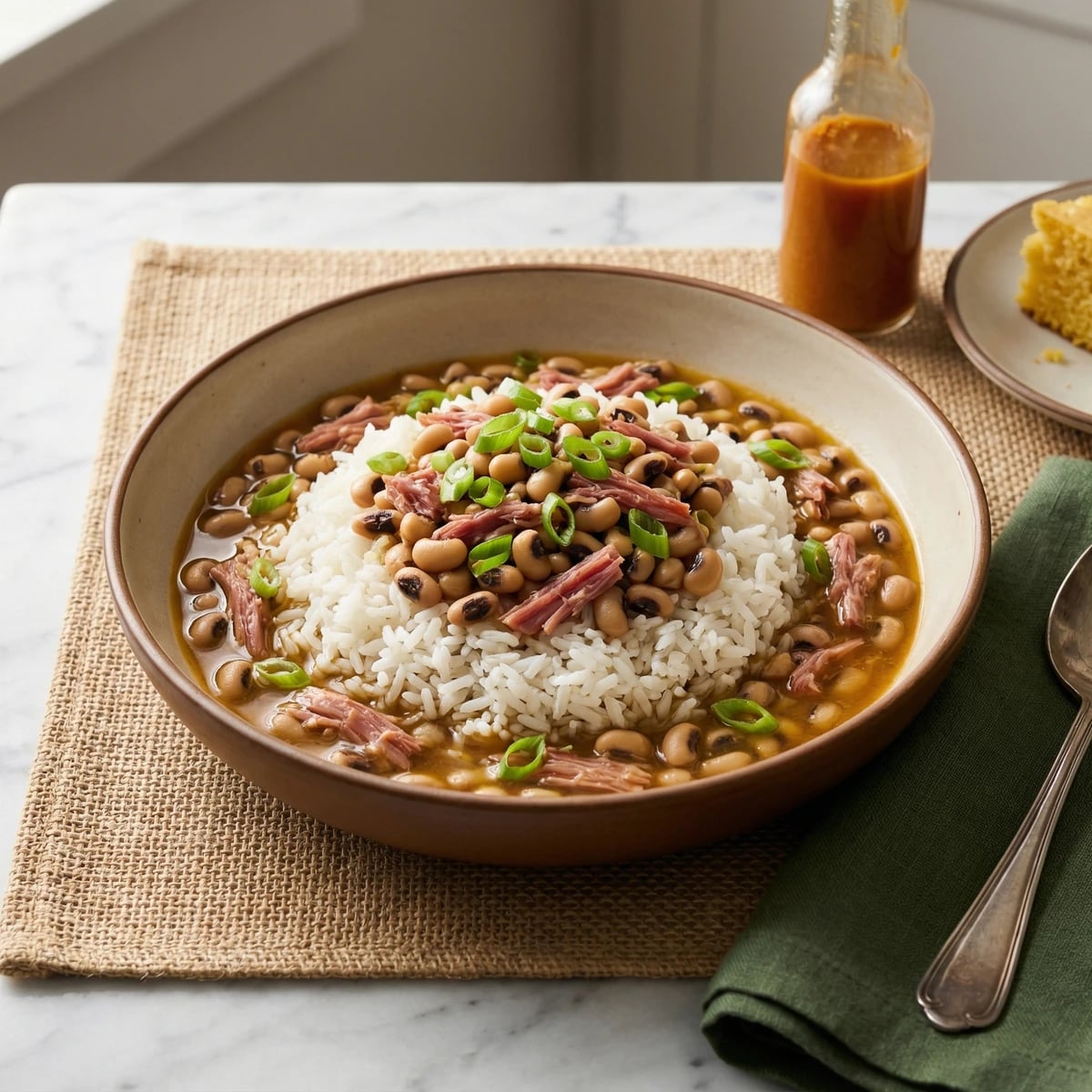
Smoky ham hock, creamy black-eyed peas, and fluffy rice combine in this time-honored Southern dish that has graced New Year's tables for generations, promising good fortune with every spoonful.
Main Dishes
Southern
New Year's
30 min
Active Time
2 hr 30 min cook•3 hr total
Yield8 servings
Every culture has its lucky foods. The Italians have lentils. The Germans have sauerkraut. In the American South, we have Hoppin' John. This dish has been bringing in the New Year since before anyone can remember, a tradition that likely traveled from West Africa to the Carolina Lowcountry with enslaved cooks who understood the power of rice and field peas.
The superstition holds that black-eyed peas represent coins, the rice stands for prosperity, and the greens you serve alongside promise folding money in the year ahead. Leave one pea on your plate and you've secured good luck. Eat every bite and you risk gluttony's consequences. I've never believed the folklore, but I've never tested it either. Some traditions deserve respect.
What I do believe is this: a properly made Hoppin' John is one of the most satisfying dishes in the American canon. The ham hock releases its smoky essence into the cooking liquid, which the peas absorb completely. The onion and celery melt into the background, becoming sauce rather than vegetable. When you spoon this over rice, the pot liquor soaks into every grain. It's humble food that fills you up and makes you grateful.
This is not a dish that rewards rushing. The ham hock needs time to surrender its collagen. The peas need time to turn creamy without becoming mush. Plan for three hours from start to table, or better yet, make the peas a day ahead. They improve overnight. Your New Year's guests will think you're a genius. You'll know you just followed directions.
The technique, the tradition, and the story behind every dish.
•6 to 8 quart Dutch oven or heavy-bottomed pot with lid
•Fine-mesh strainer for rinsing rice
•Heavy-bottomed pot for rice (2 to 3 quart capacity)
•Rimmed baking sheet for sorting peas
•Sturdy tongs
Instructions
1
Sort and rinse the peas
Spread the black-eyed peas on a rimmed baking sheet and pick through them carefully. You're looking for small stones, broken peas, and any debris that snuck through processing. This takes five minutes and saves you from cracking a tooth. Rinse the sorted peas in a colander under cold running water until the water runs clear.
Unlike most dried beans, black-eyed peas don't require overnight soaking. Their thin skins allow them to cook through in a reasonable time. Skip the soak and go straight to simmering.
2
Build the flavor base
Place a large Dutch oven or heavy-bottomed pot over medium heat. Add the ham hock and let it render for 3 to 4 minutes per side, developing color and releasing some of its smoky fat. The kitchen should smell like a country smokehouse. Add the diced onion and celery, stirring to coat in the rendered fat. Cook until the vegetables soften and turn translucent, about 6 minutes. Add the garlic and cook for 1 minute more, until fragrant but not browned.
3
Simmer the peas
Add the sorted peas, water or stock, bay leaves, thyme, cayenne, and black pepper to the pot. Do not add salt yet. Salt toughens the skins of dried legumes during cooking. Bring the liquid to a boil, then reduce to a gentle simmer. You want lazy bubbles breaking the surface, not a rolling boil. Cover the pot with the lid slightly ajar to allow steam to escape.
If using stock, choose low-sodium. The ham hock contributes significant salt, and you can always add more at the end. You cannot remove it.
4
Cook until tender
Simmer the peas for 1 1/2 to 2 hours, stirring occasionally and checking the liquid level. Add more water if the peas begin to look dry. The peas are done when they're completely tender but still hold their shape. Bite one. It should yield immediately without any chalky resistance in the center. The cooking liquid will have reduced and thickened into a rich, smoky pot liquor.
5
Shred the ham hock
Transfer the ham hock to a cutting board using tongs. Let it cool for 5 minutes. Pull the meat from the bone, discarding the skin, fat, and bone itself. Some people leave the fat. I find it unpleasant. Shred the meat into bite-sized pieces and return it to the pot. You should have about 1 cup of tender, smoky meat.
6
Season and finish the peas
Remove and discard the bay leaves. Now taste the pot liquor and season with salt. Start with 1 teaspoon and adjust from there. The ham hock may have contributed enough. Add the apple cider vinegar and stir well. The vinegar brightens everything, cutting through the richness without announcing its presence. If serving immediately, keep warm over low heat. If making ahead, cool completely before refrigerating.
The vinegar is essential. It provides the acidity that lifts this dish from good to memorable. Don't skip it, and don't substitute. Apple cider vinegar has the right sweetness for Southern cooking.
7
Cook the rice
Rinse the rice in a fine-mesh strainer under cold water until the water runs clear. This removes excess starch and prevents gummy results. Combine the rice with 4 1/2 cups of water and 1 teaspoon of salt in a heavy-bottomed pot. Bring to a boil over high heat, stir once, then cover tightly and reduce heat to the lowest setting. Cook for 18 minutes without lifting the lid. Remove from heat and let stand, still covered, for 5 minutes. Fluff with a fork and stir in the butter until melted and distributed.
8
Serve traditionally
Mound hot rice in the center of each bowl or plate. Ladle the black-eyed peas generously over and around the rice, making sure everyone gets plenty of pot liquor. Scatter the sliced green onions over the top. Set the hot sauce on the table and let people doctor their own portions. In the South, this is served alongside collard greens and cornbread, which completes the prosperity symbolism and fills out the meal.
Chef Tips
•Seek out a meaty ham hock from a proper butcher or specialty grocer. The supermarket versions are often mostly bone and skin with little meat to shred. If you can find smoked pork neck bones, they work beautifully as a substitute and offer more meat per pound.
•For a lighter version, substitute a smoked turkey leg for the ham hock. The technique remains identical, and you'll get that essential smoky flavor with less fat. Turkey legs are often easier to find and less expensive.
•The peas improve dramatically after a night in the refrigerator. Make them on December 30th and reheat gently on New Year's Day. Add a splash of water or stock when reheating if the mixture has thickened.
•If feeding a crowd, double the peas but not the cooking liquid. Start with 12 cups and add more as needed. Two ham hocks will serve 16 generously.
•Pair this with an off-dry Riesling or a cold beer. The slight sweetness complements the smoke and heat.
Advance Preparation
•Black-eyed peas can be made up to 3 days ahead and stored refrigerated in their pot liquor. Reheat gently over medium-low heat, adding water or stock if too thick.
•The ham hock can be simmered in plain water for 2 hours a day ahead to create a smoky stock. Refrigerate overnight and use this stock as the cooking liquid for faster day-of preparation.
•Rice should be made fresh but can be held for up to 30 minutes in the covered pot off heat without losing quality.
•For New Year's gatherings, set up a buffet station with a slow cooker of peas on warm setting, a large rice pot, and bowls of garnishes (green onions, hot sauce, additional vinegar) for self-service.
Frequently Asked Questions
Nutrition Information
1 serving (about 310g)
Calories
480 calories
Total Fat
14 g
Saturated Fat
5 g
Trans Fat
0 g
Unsaturated Fat
7 g
Cholesterol
32 mg
Sodium
850 mg
Total Carbohydrates
57 g
Dietary Fiber
1 g
Sugars
2 g
Protein
25 g
Where cooking meets culture.
Culinary guides, cultural storytelling, and the editorial depth that makes cooking meaningful.