
Chef Joost
Bavarois met Frambozensaus
A French-Bavarian name, a Dutch party mould, and the quiet trick of gelatine: custard cooled just enough, cream folded gently, and a dessert made ahead like a host with sense.
A cooking platform built around craft, culture, and the stories behind what we eat.
Created by
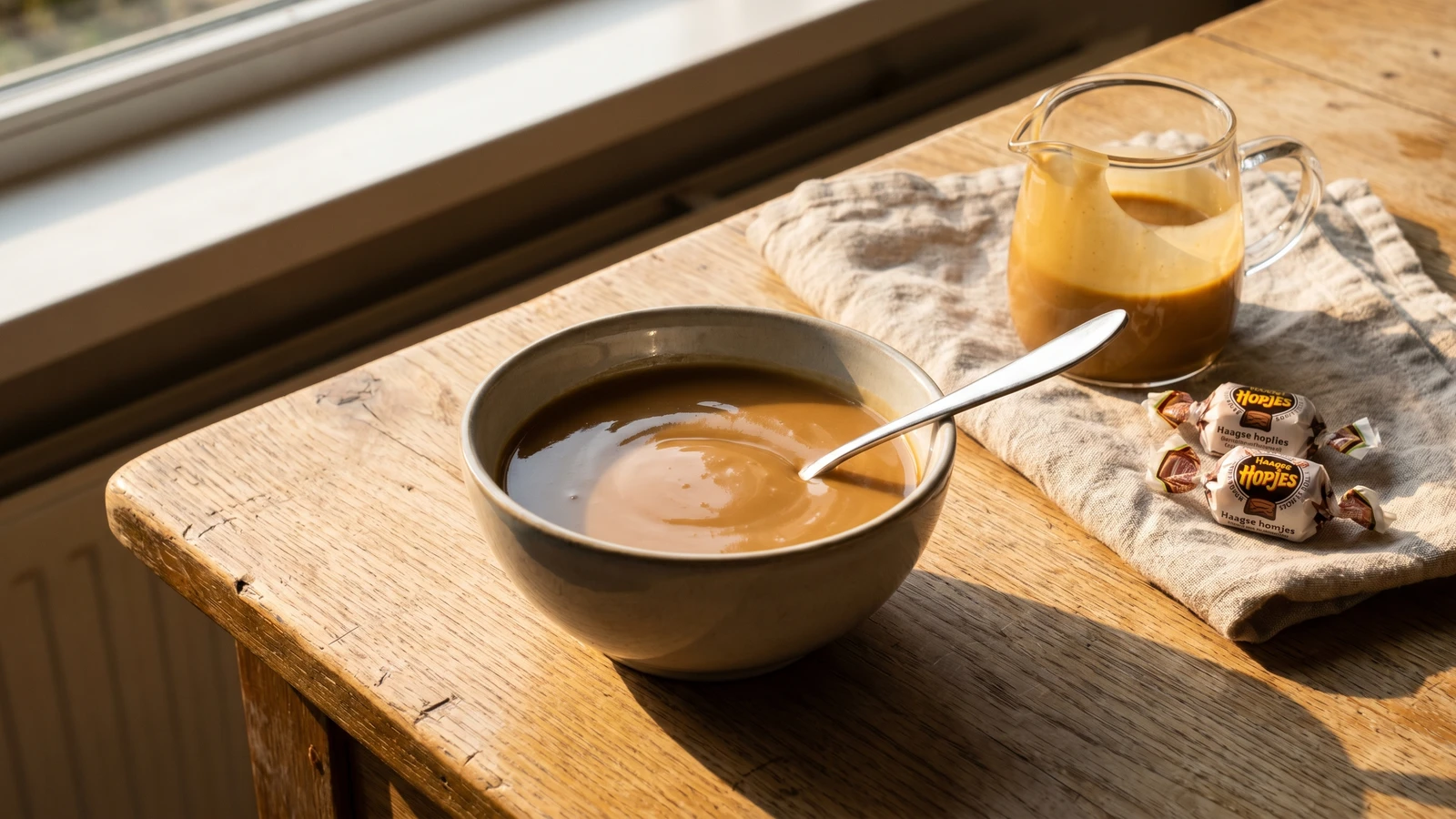
The Hague put its coffee in a caramel sweet, then melted that memory back into milk: hopjesvla is the citys little brown toetje with a baron hiding in the spoon.
Some dishes begin in a farmhouse pot, and some begin with a baron who liked his coffee too much. Hopjesvla belongs to The Hague, that polished city of diplomats, ministries, and quiet confectioners, where the Haagse hopje, the coffee-caramel sweet, became so famous that its flavour escaped the candy jar and settled into pudding bowls across the country.
The name already tells you the joke. Hopjes are named for Baron Hendrik Hop, whose fondness for strong coffee, sugar, and cream gave The Hague one of its most enduring sweets around 1800. Vla is the Dutch everyday custard, pourable, gentle, eaten after supper from the refrigerator with no ceremony at all. Put them together and you get something very Dutch: a grand little history reduced to a weekday toetje, dessert, and somehow improved by the reduction.
But let me tell you a secret. This is not just coffee pudding. The point is caramel first, coffee second: sugar cooked until it smells dark and grown-up, then loosened with milk so the bitterness of the coffee has something to lean against. Rush the caramel and the vla tastes pale; burn it and every spoonful scolds you. Hou het altijd simpel, always keep it simple, but watch the pan. History and cookery, they cannot be separated, and neither can sugar and attention.
Haagse hopjes are traditionally linked to Baron Hendrik Hop, an eighteenth-century diplomat who lived on the Lange Voorhout in The Hague and whose coffee, sugar, and cream mixture was turned into a hard sweet by a local confectioner around 1800. The sweets became strongly associated with The Hague in the nineteenth century, especially through commercial makers who wrapped and exported them as a city specialty. Hopjesvla carries that flavour into the Dutch dairy tradition of vla, the pourable custard that became a standard supermarket and home dessert in the twentieth century.
Quantity
150g
Quantity
2 tablespoons
Quantity
750ml
divided
Quantity
250ml
Quantity
2 tablespoons
Quantity
35g
Quantity
3 large
Quantity
1 teaspoon
Quantity
1/4 teaspoon
| Ingredient | Quantity |
|---|---|
| granulated sugar | 150g |
| water | 2 tablespoons |
| whole milkdivided | 750ml |
| heavy cream | 250ml |
| instant espresso powder or very strong instant coffee | 2 tablespoons |
| cornstarch | 35g |
| egg yolks | 3 large |
| vanilla extract | 1 teaspoon |
| fine sea salt | 1/4 teaspoon |
Put the sugar and water into a heavy saucepan and set it over medium heat. Let it cook without stirring until the syrup turns deep amber and smells like toasted sugar, not smoke. Swirl the pan if one side darkens faster. This is where the hopje flavour is born, so stay with it.
Pull the pan off the heat and slowly pour in 500ml of the milk and all the cream, a little at first, then the rest. The caramel will seize and complain, for obvious reasons: hot sugar has a dramatic temperament. Return the pan to low heat and stir until the caramel dissolves completely into a coffee-brown milk.
Whisk in the espresso powder and salt until the milk is smooth and evenly coloured. Taste a spoonful carefully. It should be more caramel than cafe, with the coffee giving bitterness and depth rather than marching at the front.
In a bowl, whisk the remaining 250ml cold milk with the cornstarch until no lumps remain, then whisk in the egg yolks and vanilla. Cold milk matters here; cornstarch dropped straight into hot milk clumps like bad theology.
Pour a ladle of the hot coffee-caramel milk into the yolk mixture while whisking, then pour the warmed mixture back into the saucepan. Cook over medium-low heat, stirring constantly with a spatula along the bottom and corners, until the vla thickens enough to coat the spatula and a line drawn through it stays clear, about 5 to 7 minutes. Do not boil it hard; egg yolks forgive many things, but not bullying.
Strain the vla through a fine sieve into a jug or bowl, press a piece of parchment or plastic wrap directly onto the surface, and chill for at least 4 hours. Stir before serving so it pours smoothly. Serve in small bowls or glasses, cold and glossy, with nothing more than a spoon.
1 serving (about 205g)
Culinary guides, cultural storytelling, and the editorial depth that makes cooking meaningful.
Discover Culinary ExplorerChef Joost
A French-Bavarian name, a Dutch party mould, and the quiet trick of gelatine: custard cooled just enough, cream folded gently, and a dessert made ahead like a host with sense.

Chef Joost
An old Dutch moulded toetje, where bitter-almond macaroons soften into milk pudding and turn thrift, patience, and one good puddingvorm into celebration.

Chef Joost
A bowl of vanillevla with bitterkoekjes folded through it is the quiet Dutch trick that turns milk, eggs, sugar, and a few almond biscuits into a proper toetje.

Chef Joost
Goat-hoof biscuits made into a whole taart: almond meringue, chocolate, advocaat, and cream, the Dutch bakery counter quietly becoming a dinner-party secret.