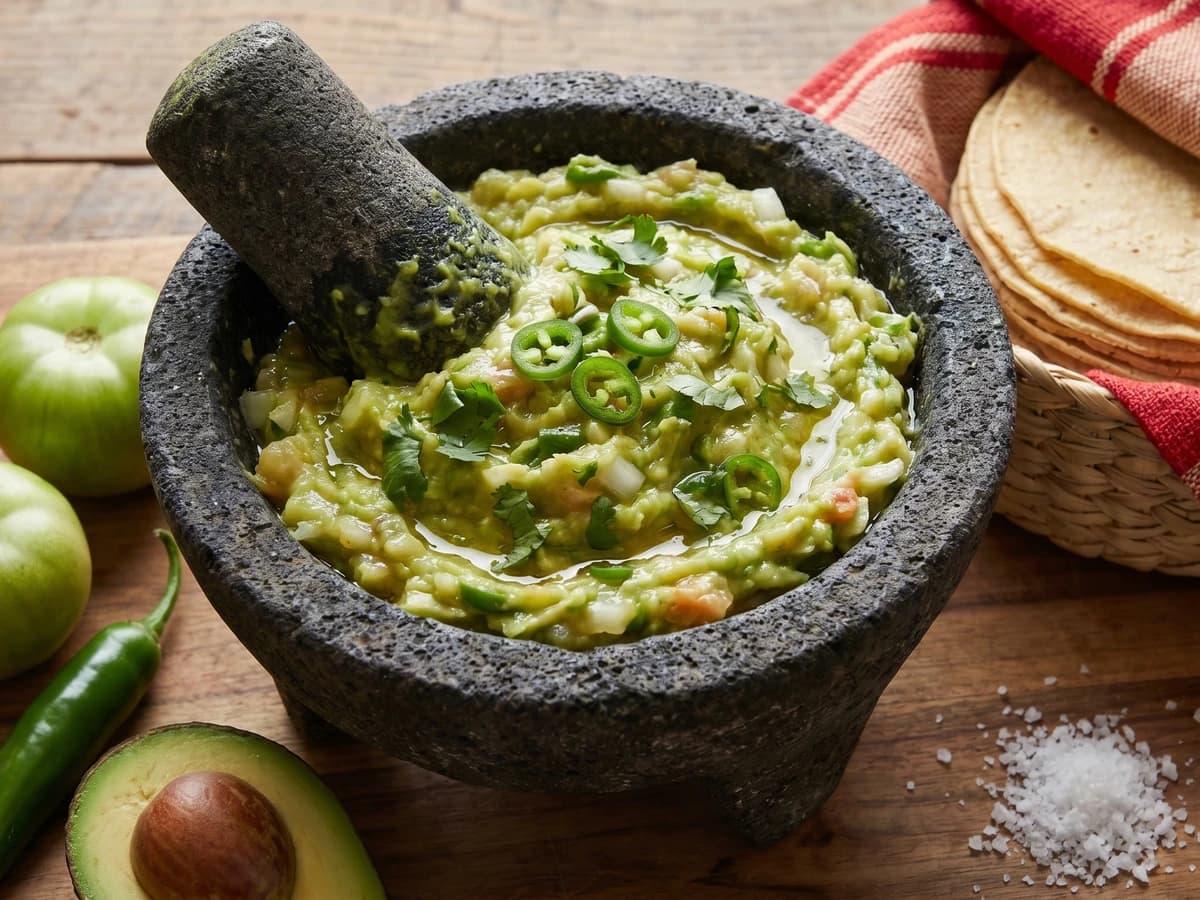
Guadalajara's cantina guacamole, smashed by hand with chile serrano, cilantro, lime, crumbled chicharrón de cerdo, and queso Cotija añejo. Chunky, salty, and nothing like the smooth green paste.
Appetizers & Snacks
Mexican
Game Day
Potluck
Budget Friendly
20 min
Active Time
0 min cook•20 min total
Yield6 servings
Jalisco first. Guadalajara, specifically, where tapatío food knows how to sit on a cantina table without apologizing. This guacamole is a botana from Occidente, not a generic bowl of mashed avocado. It belongs beside tostadas, cold beer, lime halves, and the sharp little crunch of chicharrón de cerdo.
The avocado is only the base. The character comes from the molcajete: chile serrano, white onion, cilantro, and sal de grano ground first into a rough green paste. Then the avocado is folded in, not whipped. You want ridges, chunks, and places where the lime catches. Smooth guacamole is for people afraid of texture.
The crown matters: crumbled chicharrón and queso Cotija añejo. The chicharrón brings pork fat, salt, and crunch. The Cotija brings that dry, aged bite from the borderlands of Jalisco and Michoacán. I learned this style from a señora near Mercado Libertad who tapped the molcajete with her spoon and told me, 'No lo hagas crema.' Don't make it cream. She was right. Así se hace y punto.
The word guacamole comes from the Nahuatl ahuacamolli, from ahuacatl, avocado, and molli, sauce or mixture, showing that mashed avocado preparations existed in central Mexico before the Spanish conquest. The tapatío version reflects Jalisco's cantina and botanero culture, where guacamole is served as a salty table snack rather than a delicate sauce. Queso Cotija, traditionally associated with the highlands around Cotija in Michoacán and neighboring Jalisco, became a common finishing cheese across western Mexico because its dry, salty texture travels well and keeps longer than fresh cheese.
The technique, the tradition, and the story behind every dish.
tostadas or totopos made from corn tortillas (optional)
Quantity
for serving
lime halves (optional)
Quantity
for serving
Ingredient
Quantity
ripe Hass avocadoshalved and pitted, preferably Mexican
3
fresh chile serranostemmed and roughly chopped
2
white onionfinely chopped
1/4 cup
fresh cilantro leaves and tender stemschopped
1/3 cup
sal de grano or kosher salt
1 teaspoon, plus more to taste
fresh Mexican lime juice
2 tablespoons, plus more to taste
Roma tomatoseeded and diced
1 small
chicharrón de cerdocrumbled, added just before serving
1/2 cup
queso Cotija añejocrumbled
1/3 cup
tostadas or totopos made from corn tortillas (optional)
for serving
lime halves (optional)
for serving
Equipment Needed
•Volcanic stone molcajete with tejolote
•Sharp paring knife
•Heavy spoon for folding
•Woven basket for tostadas
Instructions
1
Grind the base
Put the chile serrano, white onion, cilantro, and sal de grano in a volcanic stone molcajete. Grind with the tejolote until the chile releases its juice and the onion turns wet and sharp. You are making the seasoning paste first. If you just stir chopped chile into avocado, the heat stays in little pieces instead of seasoning the whole bowl.
Use chile serrano, not jalapeño, for this version. Serrano gives a cleaner, brighter heat and works better against the fat of the avocado and chicharrón.
2
Add the avocado
Scoop the avocado flesh into the molcajete. Mash with the tejolote in short presses, leaving visible chunks. Do not beat it smooth. A tapatío guacamole should have uneven texture, with soft avocado, sharp chile paste, and little pockets of lime and salt.
3
Season with lime
Add the lime juice and fold with a spoon. Taste before adding more. The lime should brighten the avocado, not make it sour. If the avocados are very rich, add another squeeze. If they are underripe, stop and make something else. Bad avocado cannot be fixed with lime. Pregúntale a las señoras del mercado.
4
Fold in tomato
Fold in the seeded Roma tomato gently. It should stay in small red pieces, not bleed water into the guacamole. This is why you seed it. Watery guacamole is what happens when the cook is in a hurry and the tomato punishes her.
5
Crown and serve
Just before serving, scatter the crumbled chicharrón de cerdo over the top, then the queso Cotija añejo. Serve immediately with tostadas or sturdy totopos. The chicharrón must stay crisp. If it sits for twenty minutes, it turns tired. No me vengas con atajos.
Chef Tips
•Buy avocados that yield gently at the stem end but are not soft all over. If the market only has hard avocados, cook another botana today. The calendar belongs to the ingredient.
•Use real chicharrón de cerdo from a carnicería or mercado stall, not bagged pork-flavored chips. The crunch and pork fat are part of the dish.
•Queso Cotija añejo is salty and dry. Queso fresco is not the same thing. If you use queso fresco, you made a softer guacamole, not this one.
•Make it in the molcajete if you have one. A fork in a bowl works in a rented kitchen, but it will not give you the same crushed chile and onion base. A substitution is a compromise, not an upgrade.
Advance Preparation
•The chile, onion, cilantro, and salt paste can be ground in the molcajete up to 30 minutes ahead.
•Do not mash the avocado ahead if you can avoid it. Guacamole is best made close to serving, before oxidation dulls the color.
•Crumble the chicharrón and Cotija ahead, but keep them separate until the final moment so the chicharrón stays crisp.
Frequently Asked Questions
Nutrition Information
1 serving (about 130g)
Calories
290 calories
Total Fat
19 g
Saturated Fat
4 g
Trans Fat
0 g
Unsaturated Fat
15 g
Cholesterol
10 mg
Sodium
690 mg
Total Carbohydrates
26 g
Dietary Fiber
6 g
Sugars
1 g
Protein
6 g
Where cooking meets culture.
Culinary guides, cultural storytelling, and the editorial depth that makes cooking meaningful.