
Chef Joost
Bavarois met Frambozensaus
A French-Bavarian name, a Dutch party mould, and the quiet trick of gelatine: custard cooled just enough, cream folded gently, and a dessert made ahead like a host with sense.
A cooking platform built around craft, culture, and the stories behind what we eat.
Created by
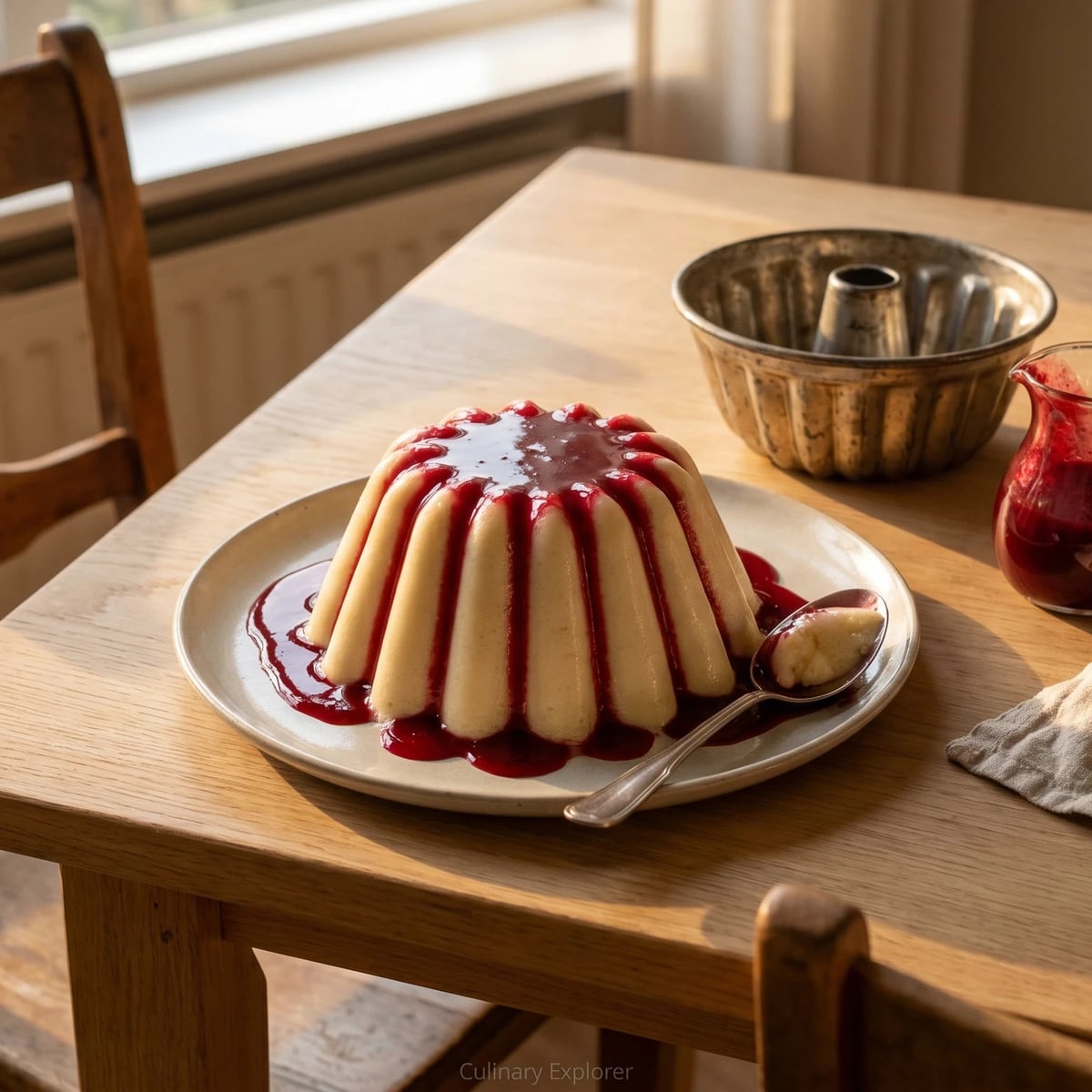
A white semolina pudding that trembles like a held breath, then takes its courage from sharp red-currant juice: frugal milk, summer berries, and the Dutch talent for making thrift look tender.
In my grandmother's second notebook, the grand desserts had their own pages, apple pie with neat handwriting, pudding with egg yolks, little feast-day things. Griesmeelpudding sat elsewhere, among the weekday recipes, written as if everyone already knew it. Milk, griesmeel, sugar, mould. Bessensap beside it in the margin. That little note was the whole Dutch household economy: the cow in the pail, the wheat in the cupboard, the red currants of July waiting in a bottle for a grey day.
The name is not trying to impress you, which is one of its virtues. Griesmeel is semolina, the fine meal of wheat; bessensap is berry juice, and at the Dutch table it usually means the sharp red-currant juice that wakes up anything pale and milky. But let me tell you a secret: this is not nursery food because it is childish. It is nursery food because whole generations learned from it what a proper toetje, a little after-dish, could be. Cheap. Tender. Exact.
The method asks for no theatre, only attention. Sprinkle the semolina into moving milk, or it will clump into little pale pebbles and sulk there. Stir until the spoon leaves a slow track, then let the cold do its quiet work. The sauce must stay tart enough to argue with the pudding. Hou het altijd simpel, always keep it simple: a white pudding, a red sauce, a spoon, and the old pleasure of turning something modest out of a mould as if it were a guest of honour.
Griesmeelpudding belongs to the family of Dutch milk puddings that household schools helped standardize around 1900; C.J. Wannee's Kookboek van de Amsterdamsche Huishoudschool first appeared in 1910 and taught domestic cookery through exact weights, timings, and economical ingredients. Bessensap, usually red-currant juice, came from summer preserving: currants were strained, bottled, and later thickened with starch or poured over pale puddings when fresh fruit was gone. The pairing teaches a very Dutch lesson: thrift was not a lack of pleasure, but a way of storing July for a winter table.
Quantity
1 liter
Quantity
90g
Quantity
75g
Quantity
1 bean or 2 teaspoons
bean split lengthwise
Quantity
1 strip
Quantity
1/4 teaspoon
Quantity
a few drops
for the mould if needed
Quantity
500ml
Quantity
60g, or to taste
Quantity
15g
Quantity
2 tablespoons
| Ingredient | Quantity |
|---|---|
| whole milk | 1 liter |
| fine wheat semolina (griesmeel) | 90g |
| granulated sugar | 75g |
| vanilla bean or vanilla extractbean split lengthwise | 1 bean or 2 teaspoons |
| lemon peel (optional) | 1 strip |
| fine salt | 1/4 teaspoon |
| neutral oil (optional)for the mould if needed | a few drops |
| unsweetened red-currant juice (bessensap) | 500ml |
| granulated sugar for the sauce | 60g, or to taste |
| potato starch or cornstarch | 15g |
| cold water | 2 tablespoons |
Rinse a 1.2-liter pudding mould with cold water and leave it damp. If your mould is metal or very detailed, wipe it with the thinnest film of neutral oil. The cold water helps the pudding release later; the oil is only insurance, not a new ingredient with ambitions.
Put the milk, sugar, vanilla bean, lemon peel if using, and salt into a heavy saucepan. Warm over medium heat until the milk is just below a boil, stirring now and then so it does not catch on the bottom. If using vanilla extract, add it after cooking instead.
Lower the heat and sprinkle the semolina into the moving milk in a thin rain while whisking constantly. Do not dump it in. Griesmeel is obedient when it falls slowly and stubborn when it arrives as a landslide.
Cook for 6 to 8 minutes over low heat, stirring with a wooden spoon and scraping the bottom of the pan. The pudding is ready when it is thick, glossy, and the spoon leaves a slow channel that closes lazily behind it. Remove the vanilla bean and lemon peel, then stir in vanilla extract now if that is what you are using.
Pour the hot pudding into the prepared mould and tap it gently on the counter to settle it into the ridges. Smooth the top, let it stand for 20 minutes, then cover and refrigerate for at least 4 hours, or overnight. It must be cold all the way through before you ask it to stand on a plate.
Bring the red-currant juice and sugar to a simmer in a small saucepan. Stir the potato starch with the cold water until smooth, then whisk it into the simmering juice. Cook for 1 minute, just until the sauce turns clear and lightly coats the spoon. Let it cool; it should pour, not sit like jam.
Dip the outside of the mould briefly in warm water, 5 to 10 seconds is enough. Loosen the edge with a thin knife, place a serving plate over the mould, and invert with conviction. If it hesitates, wait half a minute and lift again. The pudding should land softly, with a little tremble and no drama.
Pour the cooled red-currant sauce around the pudding and let some run down the sides. Serve cold, in slices or spooned portions. The white pudding is mild on purpose; the sauce is the bright, tart sentence that finishes it.
1 serving (about 275g)
Culinary guides, cultural storytelling, and the editorial depth that makes cooking meaningful.
Discover Culinary Explorer
Chef Joost
A French-Bavarian name, a Dutch party mould, and the quiet trick of gelatine: custard cooled just enough, cream folded gently, and a dessert made ahead like a host with sense.

Chef Joost
An old Dutch moulded toetje, where bitter-almond macaroons soften into milk pudding and turn thrift, patience, and one good puddingvorm into celebration.

Chef Joost
A bowl of vanillevla with bitterkoekjes folded through it is the quiet Dutch trick that turns milk, eggs, sugar, and a few almond biscuits into a proper toetje.

Chef Joost
Broodpap is Dutch thrift in its gentlest form: stale bread made tender again in milk, sweetened with cinnamon, and served from the kind of bowl nobody throws away.