
Chef Klaus
Apfelküchle
The Baden-Wuerttemberg apple fritter that lives between weeknight dessert and Sunday coffee, built on tart rings, a light batter, and oil kept steady.
A cooking platform built around craft, culture, and the stories behind what we eat.
Created by
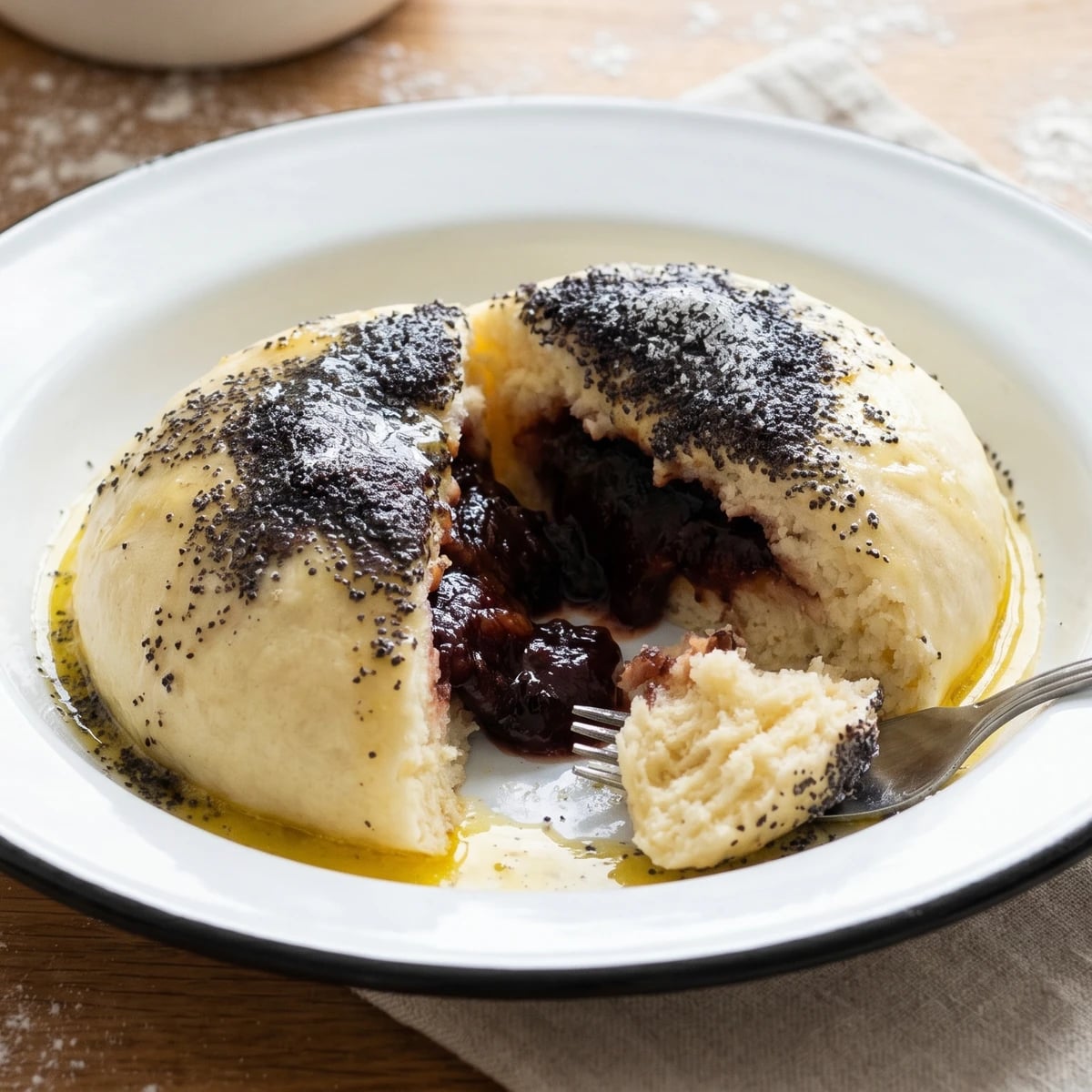
The Alpine yeast dumpling that stands or falls on patience: soft dough, thick plum Powidl, melted butter, and poppy sugar, proved twice so it rises light instead of sulking in the pot.
Germknödel belongs to the Alpine south, to ski huts, winter tables, and the sweet main dish that nobody in the north pretends is supper. In Bavaria and Austria it comes big as a fist, filled with Powidl, the thick plum preserve, and buried under melted butter with Mohnzucker, poppy sugar. In the Palatinate they will start talking about Dampfnudeln with a salty crust. In Saxony you hear Hefeklöße. Im Norden anders, im Süden anders. This one is the southern soft dumpling, no crust, no packet, no apology.
The trick is not the filling. The trick is the dough. Yeast dough for a dumpling has to prove twice because the first rise builds strength and the second fills the shaped Knödel, dumpling, with gas in the right place. Skip that second rise and the outside swells while the middle stays heavy around the Powidl. Das braucht seine Zeit.
Steam it gently, not at a hard boil. A hard boil knocks the dumpling about and tightens the dough before the centre has lifted; steady covered steam lets it swell without tearing. Keep the lid on until the time is up. Lift it early and the temperature drops, the skin wrinkles, and you learn manners from a saucepan.
Use real Powidl if you can, or a very thick plum butter cooked down from Zwetschgen, the oval prune plums. Thin jam leaks and turns the centre wet. Nicht aus dem Glas if the glass is full of syrup pretending to be fruit. Thick, dark, almost spoon-standing. Then butter, poppy, sugar. Schön ist, was schmeckt.
The word Germ is the Austrian and Bavarian word for yeast, and Germknödel belongs to the southern German and Habsburg-Bohemian family of yeast-raised dumplings that became common in 19th-century bourgeois and inn cooking. Its Powidl filling points east: the name comes from Czech povidla, a long-cooked plum preserve made when late-summer Zwetschgen could be kept through winter without wasting the crop. The regional split is still visible today: Alpine kitchens serve the filled Germknödel soft with butter, poppy sugar, or vanilla sauce, while Palatine Dampfnudeln are often unfilled and cooked to a salty crust.
Quantity
300g
plus extra for shaping
Quantity
7g instant / 21g fresh
Quantity
40g
Quantity
1 pinch
Quantity
150ml
lukewarm
Quantity
1 large
Quantity
50g
melted and cooled
Quantity
1 teaspoon
finely grated
Quantity
120g
Quantity
60g
for serving
Quantity
40g
Quantity
35g
Quantity
1 tablespoon
for steaming water if using a pot
Quantity
1 pinch
for steaming water
| Ingredient | Quantity |
|---|---|
| plain flourplus extra for shaping | 300g |
| instant yeast or fresh yeast | 7g instant / 21g fresh |
| sugar | 40g |
| fine salt | 1 pinch |
| whole milklukewarm | 150ml |
| egg | 1 large |
| unsalted buttermelted and cooled | 50g |
| lemon zestfinely grated | 1 teaspoon |
| thick Powidl or plum butter | 120g |
| unsalted butterfor serving | 60g |
| ground poppy seeds | 40g |
| icing sugar | 35g |
| granulated sugar (optional)for steaming water if using a pot | 1 tablespoon |
| saltfor steaming water | 1 pinch |
Warm the milk to blood heat, about 35C, because yeast wakes in warmth and dies when you scald it. Mix the flour, yeast, sugar, and salt in a bowl, then add the milk, egg, melted cooled butter, and lemon zest. Work it into a soft dough and knead 8 to 10 minutes, until it turns smooth and pulls from the bowl; that kneading builds the skin that holds the gas later.
Cover the dough and leave it warm until doubled, about 60 minutes. Don't rush this rise. The yeast is feeding and filling the dough with fine bubbles, and those bubbles become the light crumb you want instead of a boiled lump.
Turn the dough onto a lightly floured board and divide it into 4 pieces. Flatten each piece into a thick round, put about 30g Powidl in the centre, then pull the dough up around it and pinch the seam shut hard. Seal it well because thin jam leaks, but even good Powidl will find a lazy seam.
Set the dumplings seam side down on floured parchment, cover loosely, and let them rise 25 to 35 minutes until puffy and lighter under your fingers. This second rise matters most. It lifts the filled dumpling from the inside, so the dough steams fluffy all the way to the Powidl.
Set a steamer over simmering water, or use a wide pot with 2cm water, the tablespoon of sugar, and a pinch of salt, with a greased insert above it. Put the dumplings in with room between them, cover tightly, and steam 18 to 20 minutes. Keep the water at a steady simmer, not a hard boil, because rough heat tightens the outside and can tear the seam before the middle has risen.
While the dumplings steam, melt the serving butter gently and mix the ground poppy seeds with the icing sugar. When the time is up, lift the lid away from you and take the dumplings out carefully. Spoon over the butter first so the poppy sugar clings, then shower on the poppy mixture. Eat them at once, while the crumb is soft and the Powidl sits dark in the middle.
1 serving (about 230g)
Culinary guides, cultural storytelling, and the editorial depth that makes cooking meaningful.
Discover Culinary Explorer
Chef Klaus
The Baden-Wuerttemberg apple fritter that lives between weeknight dessert and Sunday coffee, built on tart rings, a light batter, and oil kept steady.

Chef Klaus
The old sweet supper that saves yesterday's loaf: stale bread drinks eggy milk, the pan stays moderate, and butter browns the outside only after the centre has set.

Chef Klaus
The Carnival doughnut lives by proofing and fat temperature: a light yeast round floats high, cooks through with one pale belt, then takes its jam without turning greasy.

Chef Klaus
The Advent apple that works because the fruit is cored clean, packed tight, and baked gently until the skin splits and the filling bastes it from inside.