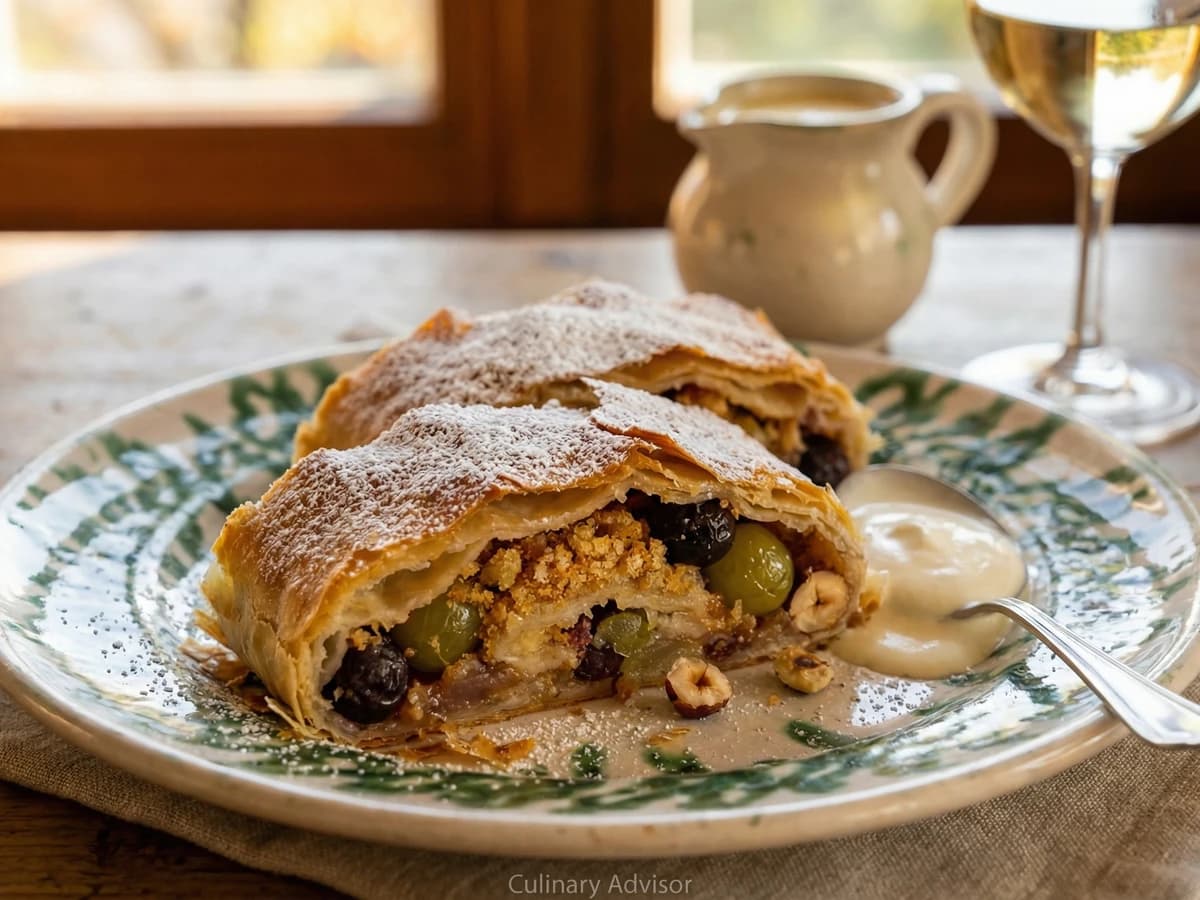
Little yeast puffs fried golden and craggy, dusted in powdered sugar, torn open and flooded with warm Vanillesauce. The Viennese called them mice. You'll call them gone.
Pastries & Cookies
Austrian
Comfort Food
Special Occasion
1 hr
Active Time
25 min cook•1 hr 25 min total
Yield4 servings (about 20 pieces)
Gebackene Mäuse look like they crawled out of a fairy tale. Small, golden, bumpy, irregular, dusted in powdered sugar, piled on a plate in a warm heap. The name means 'baked mice,' which is one of those Viennese jokes that makes you smile every time you say it. They don't look much like mice, honestly. They look like little golden clouds with crispy shells. But the Viennese have always named their Mehlspeisen with more personality than precision, and once you've watched a batch of these bob and puff in hot oil, turning themselves over with a life of their own, you understand the impulse to give them a creature's name.
I first made these with Gretel in my grandmother Eva's kitchen on a grey February afternoon. Fasching, carnival season, when Austrian kitchens fill with the smell of frying dough. Gretel dropped spoonfuls of batter into the pot with a confidence I found terrifying at the time. The oil was hot. The dough was sticky. She didn't measure the spoonfuls. 'They should all be different,' she told me. 'That's what makes them Mäuse and not factory doughnuts.' She was right. The irregular shapes fry unevenly in the best possible way: some edges turn deeply golden and crisp while the crevices stay soft and pale. You tear them open and pour warm vanilla sauce into the crack. It pools inside. That first bite is the whole reason this recipe has survived centuries.
The dough is a simple yeast batter, softer than bread dough, richer with egg yolks and butter. You beat it hard with a wooden spoon until it goes glossy and elastic, then let it rise until it doubles and fills the bowl with that sweet, yeasty smell that means something good is about to happen. The frying takes courage the first time but it's not difficult. Keep the oil at the right temperature, don't crowd the pot, and trust the dough to do its work. These are Mehlspeisen at their most generous and joyful: simple ingredients, honest technique, and a result that makes people close their eyes when they take the first bite.
Gebackene Mäuse belong to the tradition of Schmalzgebackenes, foods fried in rendered fat, which stretches back to medieval Austrian kitchens. The word 'gebacken' in Viennese German covers both baking and frying, which is why Wiener Schnitzel is also described as gebacken despite never seeing the inside of an oven. These yeast puffs were historically associated with Fasching (carnival season) and feast days throughout the Habsburg lands, when deep-frying in lard signaled abundance and celebration. Gretel Beer included them in her writing as one of the Viennese Mehlspeisen that deserved to be remembered beyond Austria's borders.
The technique, the tradition, and the story behind every dish.
raisins (optional)soaked in rum for at least 1 hour
50g
neutral oil or lardfor deep frying
about 1 liter
powdered sugar
for dusting
whole milk (for vanilla sauce)
500ml
vanilla pod
1
egg yolks (for vanilla sauce)
3
granulated sugar (for vanilla sauce)
40g
cornstarch (Maizena)
20g
Equipment Needed
•Deep heavy pot for frying (at least 20cm diameter, 15cm deep)
•Kitchen thermometer
•Two tablespoons for shaping
•Slotted spoon
•Wire cooling rack
•Wooden spoon or dough scraper for beating
Instructions
1
Activate the yeast
Warm the 150ml milk until it's just body temperature. If it feels hot on your wrist, it's too hot and will kill the yeast. Crumble the fresh yeast into the warm milk with a teaspoon of the sugar and stir gently until dissolved. Let it sit for ten minutes. When the surface gets foamy and smells like bread, the yeast is alive and ready.
Fresh yeast gives the best rise and the sweetest, most delicate flavor. You can find it in the refrigerated section of most European grocery shops. If you're using dried yeast, dissolve the 7g in the warm milk the same way and give it five extra minutes.
2
Make the dough
Put the flour in a large bowl and make a well in the center. Pour in the yeast mixture, the two egg yolks, the remaining sugar, the Vanillezucker, the melted butter, lemon zest, and a pinch of salt. Stir it together with a wooden spoon until combined, then beat the dough vigorously for about five minutes. You're not kneading here. You're beating. The dough is too soft and sticky to knead on a surface. Use the spoon or a dough scraper and work it hard until it becomes smooth, elastic, and starts pulling away from the sides of the bowl in glossy strands. This is how the gluten develops. If you skip this step, your Mäuse will be dense instead of light.
3
Let the dough rise
Cover the bowl with a clean tea towel and put it somewhere warm. Near the oven, on top of the fridge, wherever your kitchen holds a bit of warmth. Let it rise for forty-five minutes to an hour, until it has doubled in size and looks pillowy and alive. If you're adding rum-soaked raisins, fold them in gently now, after the rise. Don't add them before or the rum will interfere with the yeast's work.
Gretel always said you can tell a dough has risen enough by pressing two fingers into it. If the indent springs back slowly, it's ready. If it snaps back immediately, give it more time.
4
Make the vanilla sauce
While the dough rises, make the Vanillesauce. Split the vanilla pod lengthwise and scrape out the seeds with the back of your knife. Heat the 500ml milk in a saucepan with the vanilla pod and seeds until it just begins to tremble at the edges. Don't boil it. In a separate bowl, whisk together the three egg yolks, the 40g sugar, and the cornstarch until pale and smooth. Pour a ladleful of the hot milk into the egg mixture, whisking constantly. This tempers the eggs so they don't scramble. Then pour the egg mixture back into the saucepan with the rest of the milk, still whisking. Cook over low heat, stirring without stopping, until the sauce thickens enough to coat the back of a spoon. Remove the vanilla pod. Keep the sauce warm.
If you don't have a vanilla pod, use two teaspoons of good Vanillezucker in the sauce. It's not quite the same, but Vanillezucker was how Gretel and Eva made their custards for everyday cooking, and it works beautifully.
5
Heat the frying oil
Pour the oil or lard into a deep, heavy pot. You need at least eight centimeters of depth. Heat it to 170°C (340°F). Use a thermometer if you have one. If you don't, drop a tiny piece of dough into the oil. It should sink briefly, then rise to the surface surrounded by gentle bubbles. If it sits on the surface immediately and the oil spits, the temperature is too high. If it sinks and stays down, too low. Getting this right matters. Too hot and the outside burns before the inside cooks through. Too cool and the dough absorbs oil and turns greasy.
6
Fry the Mäuse
Dip two tablespoons in the hot oil to coat them. This keeps the dough from sticking. Scoop a walnut-sized portion of dough with one spoon and use the second spoon to push it off into the oil. Work in batches of four or five. Don't crowd the pot or the temperature drops and everything suffers. The Mäuse will sink, then float up and begin to puff. They'll roll themselves over as one side gets heavier than the other, but help them along with a slotted spoon to brown evenly. Fry for about four minutes total, turning once or twice, until they're deep golden all over and sound hollow when you tap them. They should be craggy and irregular. That's where the name comes from. They look like plump little mice.
Lard gives a cleaner fry and a more traditional flavor than oil. If you can get good lard from your butcher, use it. This is how they were fried in Viennese kitchens for centuries and the taste is noticeably better.
7
Drain and dust
Lift the finished Mäuse out with a slotted spoon and drain them on a wire rack set over a tray. Don't use paper towels. The paper sticks to the hot dough and tears off in patches that nobody wants to eat. Let them rest for just one minute, long enough to stop dripping but not long enough to cool down.
8
Serve immediately
Pile the warm Mäuse onto a plate. Dust them generously with powdered sugar. Pour the warm Vanillesauce into a small pitcher or bowl alongside. Each person takes a few Mäuse, tears them open, and spoons the vanilla sauce over the soft, steaming insides. The contrast between the crisp golden shell and the pillowy, yeasty interior is what this dish is about. Eat them fast. They don't wait. Mahlzeit!
Chef Tips
•The dough should be sticky. If it's firm enough to shape with your hands, you've added too much flour and the Mäuse will come out heavy instead of airy. Trust the two-spoon method and let the oil do the shaping for you.
•Keep your oil temperature steady between 165°C and 175°C throughout frying. Every batch of cold dough drops the temperature, so bring the oil back up before adding the next round. A thermometer takes the guesswork out of it.
•Make more than you think you need. I've never seen a plate of Gebackene Mäuse survive longer than ten minutes at a table. Double the dough recipe if you're feeding more than four people.
•The Vanillesauce should be warm, not hot. If it's too hot, it thins out and runs off the Mäuse instead of pooling inside when you tear them open. Let it cool just enough to coat a spoon thickly.
Advance Preparation
•The Vanillesauce can be made several hours ahead and kept warm in a bain-marie, or refrigerated and gently reheated. Press cling film directly onto the surface to prevent a skin from forming.
•Raisins should be soaked in rum at least one hour ahead. Overnight is even better.
•Gebackene Mäuse cannot be made ahead. They must be fried and served immediately. A cold Maus is a sad Maus.
Frequently Asked Questions
Nutrition Information
1 serving (about 340g)
Calories
880 calories
Total Fat
43 g
Saturated Fat
11 g
Trans Fat
0 g
Unsaturated Fat
31 g
Cholesterol
265 mg
Sodium
135 mg
Total Carbohydrates
108 g
Dietary Fiber
3 g
Sugars
43 g
Protein
17 g
Where cooking meets culture.
Culinary guides, cultural storytelling, and the editorial depth that makes cooking meaningful.