
Chef Lupita
Acitrón de Cidra Conventual
Puebla's convent-style acitrón, made from cidra peel instead of endangered biznaga, built through repeated syrup soakings until the cubes turn firm, translucent, and ready for rosca or chiles en nogada.
A cooking platform built around craft, culture, and the stories behind what we eat.
Created by
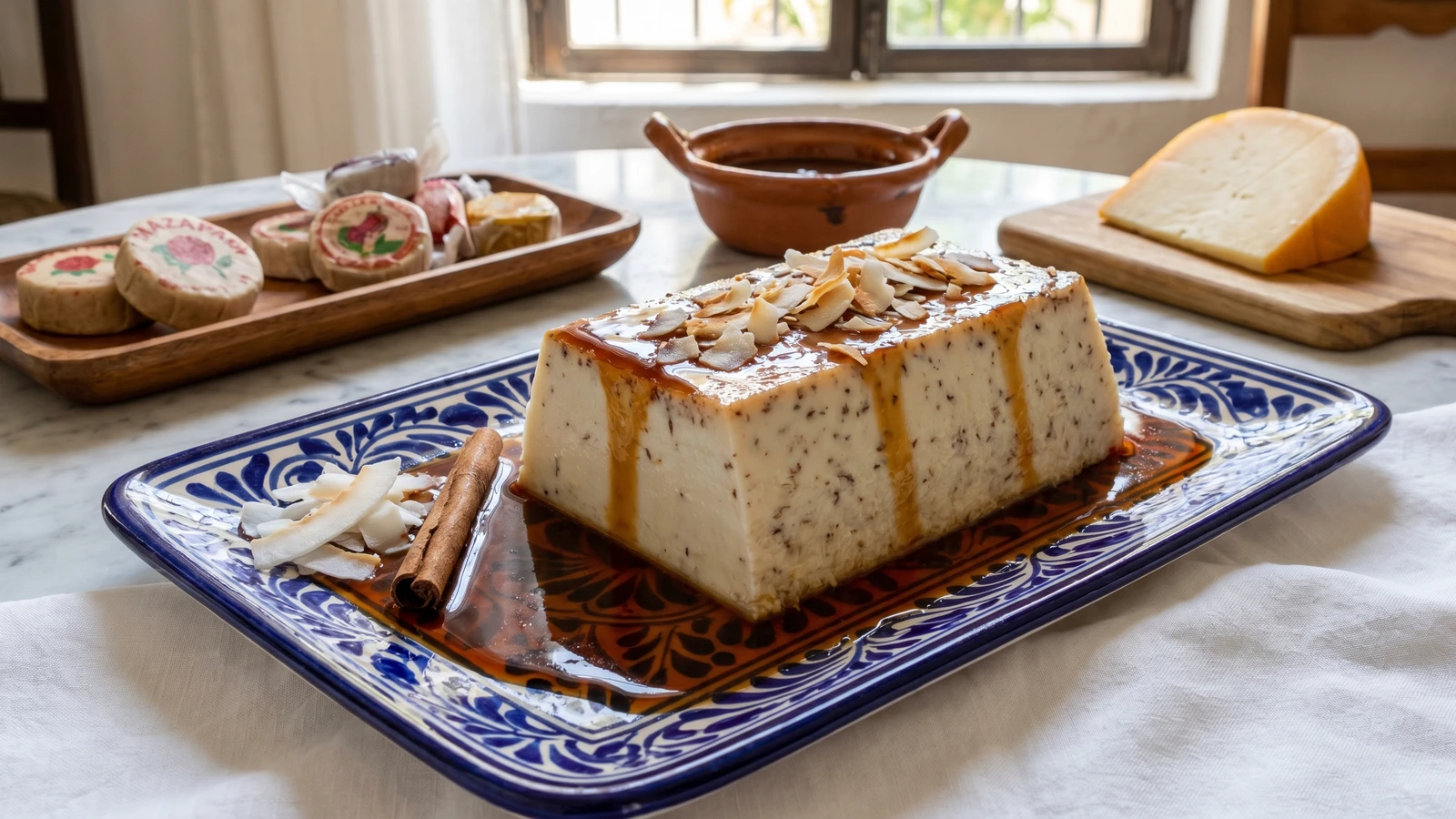
Yucatan's flan de coco, built on steeped coconut and dark caramel, baked low and slow in a bano maria until the custard sets into something silken and unmistakably peninsular.
This is a Yucatecan flan. Not a generic Mexican flan, not a Spanish flan. The Peninsula has its own dessert tradition, shaped by the coconut palms that line its coast from Progreso to Tulum, by the Lebanese pastry influence that arrived with 19th-century immigration to Merida, and by the dulcerias of the Lucas de Galvez market that have been making flan de coco the same way for three generations.
Coconut is not a garnish on this flan. It is the dish. You steep coco rallado in evaporated and coconut milk with a stick of canela, and you let it sit until the coconut has given up everything it has to the dairy. Skip the steeping and you have a flan with coconut in it. Do the steeping and you have flan de coco. There is a difference and the senoras of Merida will tell you so without being asked.
My mother did not make flan de coco. She was from Jalisco and her flan was the napolitano kind, with cream cheese and a pale caramel. I learned this version from a woman named Dona Felipa who sold dulces from a wooden bandeja near the Plaza Grande in Merida. She made me write down the proportions in pencil and told me to take the caramel darker than I thought I should. She was right about the caramel. She was right about most things. Saber cocinar es saber vivir.
The coconut palm is not native to Yucatan; it was introduced along the Mexican coasts during the colonial period, with Pacific and Caribbean varieties arriving by separate trade routes between the 16th and 18th centuries, and it took root along the Peninsula's coast as a domesticated cash crop. Flan itself is a Spanish import, descended from the Roman tyropatina by way of medieval Iberian convent kitchens, and it arrived in New Spain in the 16th century as a sugar-and-egg confection of the colonial elite. The Yucatecan version with coconut emerged in the 19th century, when the Peninsula's geographic isolation from central Mexico and its strong Caribbean trade ties pushed local cooks toward ingredients the rest of the country did not have ready access to, and when Lebanese immigrant families in Merida brought a pastry sensibility that favored milk-based custards perfumed with nuts and tropical fruits.
Quantity
1 cup
Quantity
2 tablespoons
Quantity
1 1/2 cups
preferably fresh or frozen, not sweetened
Quantity
1 can (14 ounces)
Quantity
1 can (12 ounces)
Quantity
1 cup
full fat, shaken well
Quantity
5
Quantity
2
Quantity
1 teaspoon
Quantity
1/4 teaspoon
Quantity
1 stick
for steeping
Quantity
for serving
| Ingredient | Quantity |
|---|---|
| granulated sugar (for the caramel) | 1 cup |
| water | 2 tablespoons |
| unsweetened shredded coconut (coco rallado)preferably fresh or frozen, not sweetened | 1 1/2 cups |
| sweetened condensed milk | 1 can (14 ounces) |
| evaporated milk | 1 can (12 ounces) |
| unsweetened coconut milkfull fat, shaken well | 1 cup |
| large eggs | 5 |
| large egg yolks | 2 |
| Mexican vanilla extract | 1 teaspoon |
| kosher salt | 1/4 teaspoon |
| canela (Mexican cinnamon stick)for steeping | 1 stick |
| toasted coconut flakes (optional) | for serving |
Combine the evaporated milk, coconut milk, shredded coconut, and the stick of canela in a heavy saucepan. Bring to a bare simmer over medium-low heat, stirring so the coconut does not catch on the bottom. The moment small bubbles ring the edge of the pan, pull it off the heat. Cover and let the mixture steep for 30 minutes. This is where the dish becomes Yucatecan. The coconut needs time to give up its flavor to the milk. No me vengas con atajos.
While the coconut steeps, set a 9-inch round cake pan or a flan mold beside the stove. In a small heavy saucepan, combine the sugar and water. Set over medium-high heat. Do not stir. Swirl the pan occasionally as the sugar dissolves and starts to color. Watch carefully. The sugar will pass from clear to pale gold to deep amber in less than a minute at the end. The moment it turns the color of a dark roasted coffee bean, pull it off the heat and pour it into the cake pan. Tilt the pan to coat the bottom evenly. Work fast. The caramel sets hard within seconds.
Set the oven to 325F. Bring a kettle of water to a simmer. Set the caramelized pan inside a larger roasting pan that will hold it with room to spare. The bano maria is not optional for flan. Direct heat scrambles the eggs and you end up with a custard that weeps. Gentle, surrounding heat is what gives you the silken set that defines a proper flan.
Fish the canela stick out of the steeped milk and discard it. In a large bowl, whisk the whole eggs and yolks with the salt until just combined, no foam. Whisk in the condensed milk and the vanilla. Pour the warm coconut milk mixture in slowly, whisking the whole time. Add it cold and you waste the steeping. Add it boiling and you cook the eggs. Warm, not hot, is the rule.
Here you make a choice. Strain the custard through a fine-mesh sieve for a glass-smooth flan with the coconut flavor but no texture. Or pour it in unstrained for a flan with visible coco rallado suspended throughout, the way the senoras of the Lucas de Galvez market make it. Both are correct. The unstrained version is more traditional in Merida home kitchens. Asi se hace y punto.
Pour the custard over the set caramel in the cake pan. Set the roasting pan with the cake pan inside it on the middle rack of the oven. Carefully pour the simmering water from the kettle into the roasting pan until it reaches halfway up the sides of the cake pan. Bake for 60 to 75 minutes. The flan is ready when the edges are set and the center jiggles like firm gelatin when you nudge the pan. A knife inserted an inch from the edge should come out clean. The center will still look soft. That is correct. It firms as it cools.
Lift the cake pan out of the water bath and let it cool on a rack to room temperature, about an hour. Cover with plastic wrap and refrigerate for at least 4 hours, preferably overnight. A warm flan is not a finished flan. The custard needs the cold to set its texture and the caramel needs the time to liquify back into a dark syrup. La cocina no es decoracion, es trabajo.
Run a thin knife around the edge of the flan. Invert a serving plate with a slight rim over the cake pan. In one confident motion, flip them together. Lift the pan straight up. The flan should drop onto the plate and the dark caramel should pool around it. If it sticks, set the pan in a shallow tray of hot water for 30 seconds and try again. Scatter the toasted coconut flakes over the top and serve cold, with the caramel pooling at the edges of each slice.
1 serving (about 205g)
Culinary guides, cultural storytelling, and the editorial depth that makes cooking meaningful.
Discover Culinary ExplorerChef Lupita
Puebla's convent-style acitrón, made from cidra peel instead of endangered biznaga, built through repeated syrup soakings until the cubes turn firm, translucent, and ready for rosca or chiles en nogada.

Chef Lupita
Ciudad de México's Tulyehualco alegría is popped huautli folded into piloncillo honey, pressed with peanuts, pepitas, and raisins, then cut into the rectangular bars that built a pueblo's identity.

Chef Lupita
Oaxaca's pre-Columbian amaranth bar, popped on a hot comal and bound with piloncillo, honey, and the sacred Zapotec grain that the Spanish tried, and failed, to outlaw.

Chef Lupita
Querétaro's mercado candy of popped amaranto pressed with dark piloncillo syrup, pepitas, pecans, and cacahuate, a Bajío sweet that respects the seed before it decorates the table.