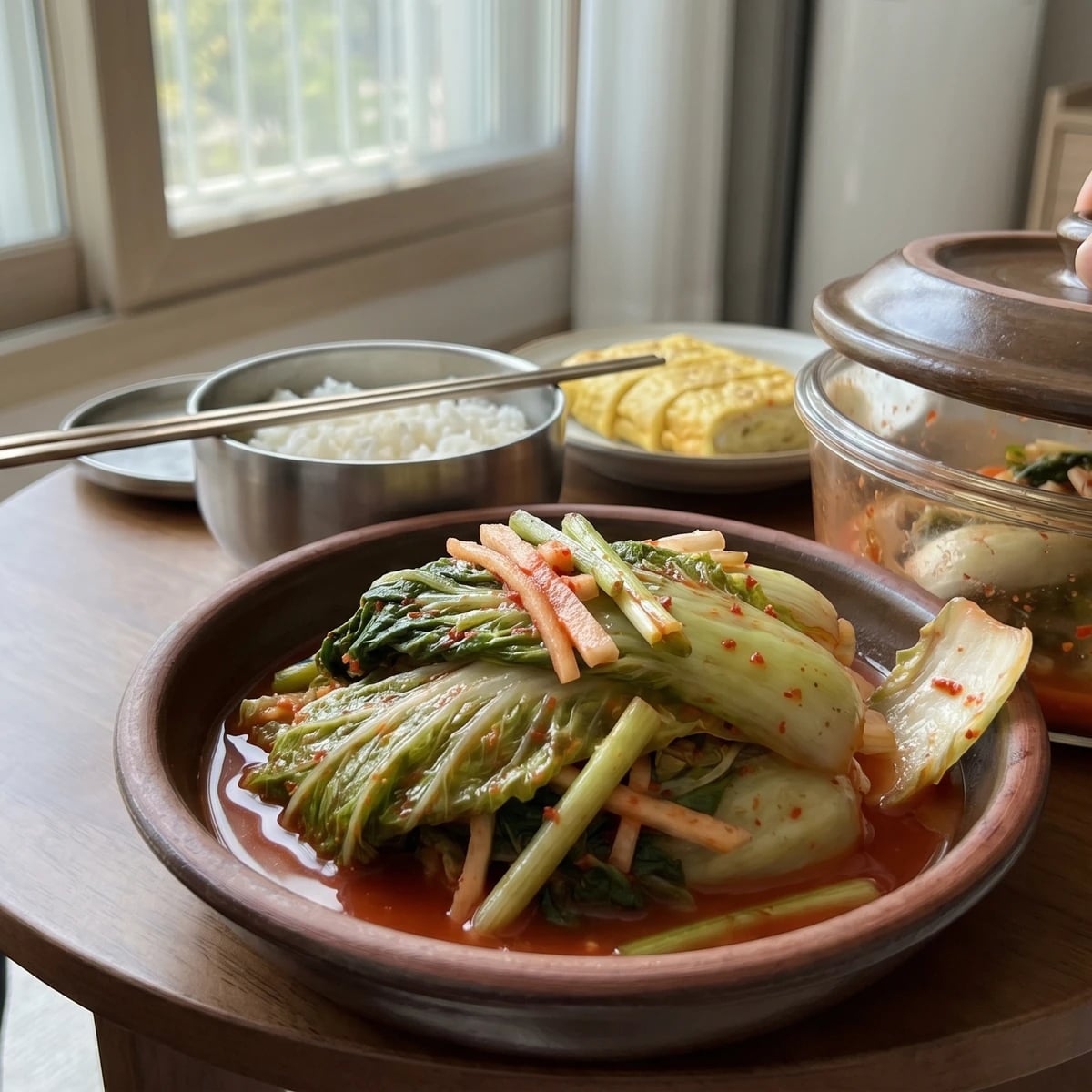
The quick kimchi of tender young cabbage, lightly salted and handled by hand, made for the weeks when the old jar runs low and the market still gives you green leaves.
Sauces & Condiments
Korean
Quick Meal
Budget Friendly
35 min
Active Time
5 min cook•2 hr 40 min total
YieldAbout 1.2 kg kimchi, 8 to 10 small servings
Eolgari tells you the season at the market. The heads are loose, the leaves are young, and the stems still snap easily, so you don't treat them like winter napa cabbage. Heavy hands bruise this kimchi before it ever reaches the jar.
This is the kimchi I make when the deep winter jar is nearly finished and the table needs something bright beside rice, soup, and a fried egg. It sits close to geotjeori (fresh kimchi), but it can ferment a little if you want that sour edge. The work tonight is not hard. It asks for restraint: salt only until the stems bend, rinse quickly, drain well, and fold the seasoning through without crushing the leaves.
My teacher Master Seong-nyeo used to say that tender greens show a careless cook faster than meat does. She was right. Measure the salt and the fish sauce, then taste before the kimchi goes into the container. 손맛 is real; I measure it anyway, so it can be handed on.
Eolgari-baechu refers to young, loose-headed cabbage harvested before full maturity, commonly used in quick kimchi and soups when large winter napa cabbages are not the point of the season. Unlike kimjang kimchi, which is tied to late-autumn preservation, eolgari-kimchi belongs to everyday market cooking: small batches, short salting, and quick eating. Its place grew stronger with modern refrigeration, because families could make tender green kimchi often instead of relying only on one winter store.
The technique, the tradition, and the story behind every dish.
•Clean 1.5-liter kimchi container, glass box, or small onggi
Instructions
1
Trim the cabbage
Separate the eolgari leaves and rinse away grit, especially near the root ends. Cut into 2-inch lengths, keeping tender stems and leaves together. Do not chop them fine. Young cabbage collapses as it salts, and small pieces turn limp too quickly.
2
Salt gently
Dissolve the coarse sea salt in 6 cups cold water in a large bowl, then add the cabbage and turn it with both hands. Let it sit 45 to 60 minutes, turning once halfway through. The stems should bend without snapping but still feel crisp. This short brine seasons the cabbage evenly without grinding salt into tender leaves.
3
Rinse and drain
Rinse the salted cabbage once in cold water, no more. Drain in a colander for 30 minutes, lifting and loosening the leaves once so water does not hide underneath. Too much rinsing washes away flavor; too little draining waters down the seasoning.
4
Cook the paste base
Whisk the sweet rice flour with 1/2 cup water in a small pan. Cook over medium-low heat for 3 to 5 minutes, stirring, until it turns glossy and lightly thickened. Cool it completely. This little porridge helps the seasoning cling to the cabbage instead of sliding to the bottom of the container.
5
Mix the seasoning
Stir the cooled porridge with gochugaru, fish sauce, chopped saeujeot, maesil-cheong, grated onion, garlic, and ginger. Let it sit 10 minutes so the chili flakes bloom and soften. Taste a fingertip of the paste. It should be salty and full, but not harsh, because the cabbage will dilute it.
6
Fold with care
Put the drained cabbage, radish matchsticks, scallions, and red chili in a wide basin. Add the seasoning paste and fold from the bottom with open hands until every leaf is lightly coated. Do not knead. Eolgari is not winter cabbage, and it does not forgive rough handling.
7
Pack and settle
Pack the kimchi into a clean 1.5-liter container, pressing just enough to remove large air pockets while keeping the leaves loose. Leave at least 1 inch of headspace. Let it sit at cool room temperature for 4 to 8 hours if you want a light tang, then refrigerate. For geotjeori style, refrigerate immediately and eat the same day.
Open the container over a sink after room-temperature fermentation, because active kimchi can release brine. Once refrigerated, eat within 10 days while the stems are still crisp.
8
Serve small
Serve chilled in a small banchan dish, cutting any long stems with kitchen scissors if needed. Scatter sesame seeds only when serving it fresh, not before storing. The kimchi should taste green, lightly salty, and clean, with the chili carrying the cabbage rather than burying it.
Chef Tips
•Buy eolgari with pale green stems, perky leaves, and no slippery spots near the root. If the stems are thick and tough, cook baechu-doenjang-guk (cabbage soybean paste soup) instead. Cook the month you're standing in.
•Coarse Korean sea salt is best for salting. Fine table salt makes it too easy to oversalt the leaves before the stems have time to bend.
•The sweet rice porridge is a small step, but it matters. Without it, the seasoning slips off tender leaves and the bottom of the container becomes red water.
•This is safe to simplify in the vessel, not in the salting. A glass storage box works if you do not have an onggi, but the cabbage still needs its full salting and draining time.
•For a vegetarian version, replace fish sauce and saeujeot with 3 tablespoons Korean soup soy sauce and 1 tablespoon mashed cooked rice or extra porridge. The flavor will be cleaner and less deep, but it will still be honest kimchi.
Advance Preparation
•The seasoning paste can be mixed 1 day ahead and refrigerated. Bring it to cool room temperature before folding it into the cabbage so it spreads evenly.
•Eolgari-kimchi is best from the day it is made through day 5. After that it softens, still useful for kimchi-guk or quick fried rice, but no longer the crisp young cabbage kimchi it began as.
•Do not freeze this kimchi. The tender stems thaw watery and lose their snap.
Frequently Asked Questions
Nutrition Information
1 serving (about 120g)
Calories
70 calories
Total Fat
1 g
Saturated Fat
0 g
Trans Fat
0 g
Unsaturated Fat
1 g
Cholesterol
5 mg
Sodium
1050 mg
Total Carbohydrates
12 g
Dietary Fiber
3 g
Sugars
5 g
Protein
3 g
Where cooking meets culture.
Culinary guides, cultural storytelling, and the editorial depth that makes cooking meaningful.