Culinary Explorer

A cooking platform built around craft, culture, and the stories behind what we eat.
Discover Culinary Explorer
Enchiladas Suizas Capitalinas

Enchiladas Suizas Capitalinas

Created by

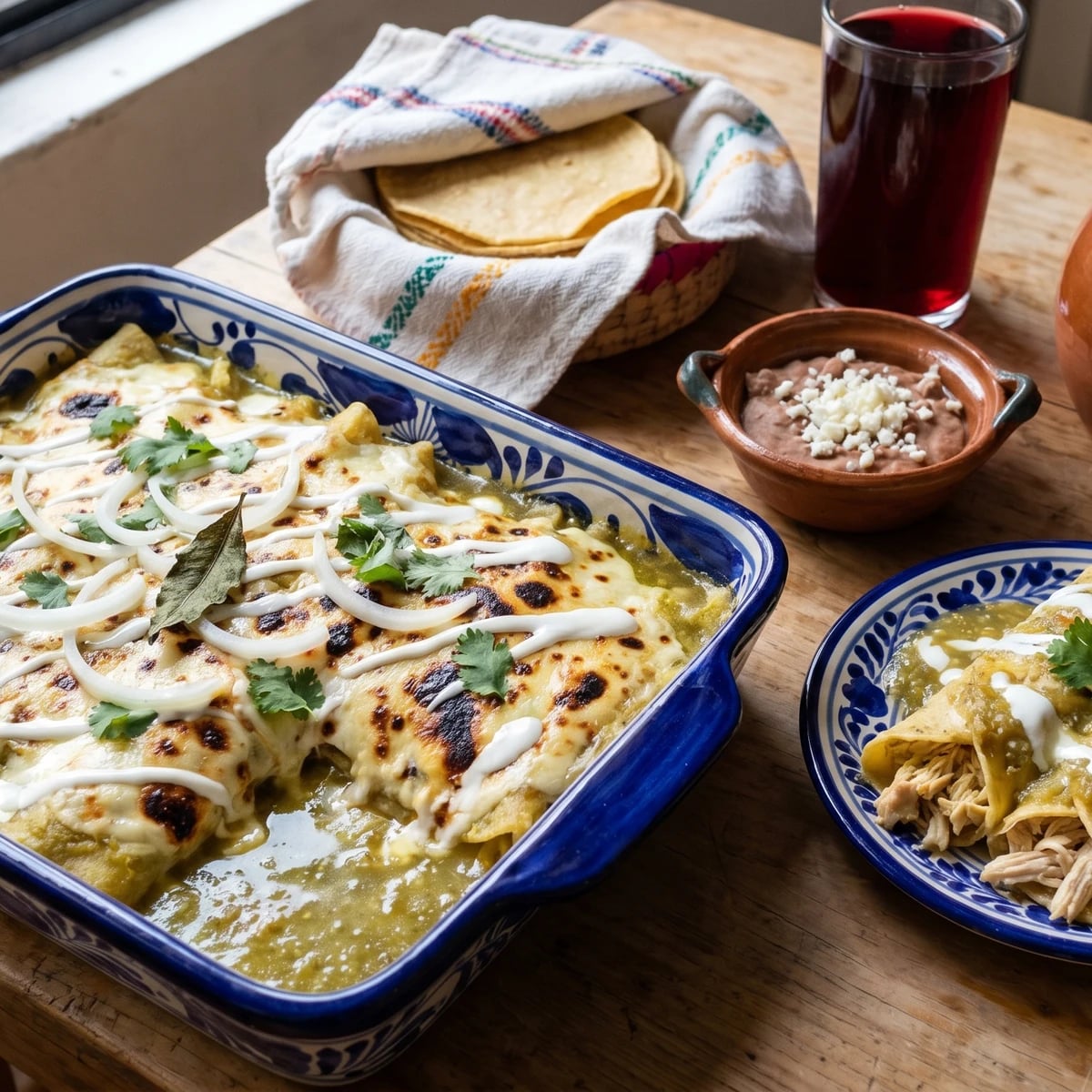
Ciudad de Mexico's mid-century classic, made famous at the Sanborns counter in the Casa de los Azulejos: chicken-stuffed corn tortillas drowned in a tomatillo-and-crema salsa verde, blanketed in queso Chihuahua, broiled gold.

Breakfast & Brunch
Mexican
Comfort Food
Make Ahead
Dinner Party
40 min
Active Time
45 min cook1 hr 25 min total
Yield4 to 6 servings

This dish is from Ciudad de Mexico. Not from a state with a deep pre-Columbian root, not from a mercado abuela's notebook. From the Centro Historico, from the Sanborns lunch counter at the Casa de los Azulejos, from the mid-century moment when CDMX cooks looked at salsa verde and decided to fold dairy into it. The Swiss in the name does not mean the dish is Swiss. It means it is white with cream, suiza, the way the capitalinos in the 1950s thought of Switzerland: cows and dairy and white-on-white.

There are two non-negotiables. The salsa verde gets charred, not raw. Roast the tomatillos and the chile serrano and the poblano on a dry comal until the skins blister, then blend with cilantro and epazote, then fry the puree in manteca until it darkens. That is the body of the dish. The second non-negotiable is queso Chihuahua, not mozzarella, not Monterey Jack, not the yellow cheese on top of bad Tex-Mex enchiladas. Chihuahua melts clean, browns honestly, and tastes like the cheese a Mennonite community in northern Mexico has been making since the 1920s. Cada estado, su propia cocina, even when the dish itself was assembled in the capital.

My mother did not grow up with enchiladas suizas. She was from Jalisco, where enchiladas come in red mole de tomate and are eaten on the street. The first time she ate them was at the Sanborns on Madero in 1968, and she came home and wrote the recipe in her notebook from memory before she lost the taste of it. She added more epazote than the menu version, more chile, less sugar in the crema. That is how it sits in her notebook, and that is how I make it. Saber cocinar es saber vivir.

Enchiladas suizas were popularized by Sanborns, the Mexican department store and restaurant chain, beginning in the 1950s at its flagship Casa de los Azulejos location on the Calle de Madero in the Centro Historico of Ciudad de Mexico. The dish was an emblem of the mid-century capitalino style that reinterpreted regional Mexican antojitos through the lens of the cosmopolitan middle class, leaning on imported French and Swiss dairy techniques newly available through the country's expanding industrial cream and cheese production. The name 'suiza' does not denote a Swiss origin but rather a domestic Mexican shorthand of the period: any dish heavy on cream and melted cheese was labeled 'Swiss-style,' a marketing convention that stuck despite having no connection to Switzerland's actual cuisine.

The technique, the tradition, and the story behind every dish.

Discover Culinary Explorer

Ingredients

whole chicken

Quantity

1 (about 3 1/2 pounds)

cut into pieces

white onion

Quantity

1 medium

halved (plus 1/2 cup finely diced for serving)

head of garlic

Quantity

1

halved crosswise

bay leaves

Quantity

2

kosher salt

Quantity

1 tablespoon, plus more to taste

fresh tomatillos

Quantity

1 1/2 pounds

husked and rinsed

fresh chile serrano

Quantity

3

stemmed (use 2 for less heat)

fresh chile poblano

Quantity

1

stemmed and seeded

white onion (for the salsa)

Quantity

1/2 medium

roughly chopped

garlic cloves

Quantity

3

peeled

fresh cilantro leaves and tender stems

Quantity

1 cup, packed

fresh epazote

Quantity

1 small bunch (about 4 sprigs)

manteca de cerdo (pork lard)

Quantity

2 tablespoons

crema mexicana

Quantity

1 cup

do not substitute sour cream

whole milk

Quantity

1/2 cup

corn tortillas

Quantity

12

hand-pressed if you can

neutral oil

Quantity

1/4 cup

for softening the tortillas

queso Chihuahua

Quantity

10 ounces

coarsely grated (about 2 1/2 cups)

thinly sliced raw white onion (optional)

Quantity

for serving

crema mexicana (for serving) (optional)

Quantity

for serving

Equipment Needed

  • Heavy 6-quart stockpot for poaching the chicken
  • Cast iron comal or heavy dry skillet for charring the tomatillos and chiles
  • High-powered blender
  • Wide cazuela or deep skillet for frying the salsa
  • 9-by-13 inch baking dish (talavera or stoneware), broiler-safe
  • Tongs and a slotted spoon

Instructions

  1. 1

    Poach the chicken

    Place the chicken pieces in a heavy pot. Cover with cold water by two inches. Add the halved onion, halved head of garlic, bay leaves, and 1 tablespoon of salt. Bring to a gentle simmer over medium heat. Skim the gray foam that rises in the first ten minutes. Lower the heat and cook at lazy bubbles for 35 to 40 minutes, until the meat pulls cleanly off the bone. Cold water draws the flavor out. A rolling boil shreds the chicken and clouds the broth. No me vengas con atajos.

  2. 2

    Shred and reserve

    Lift the chicken out and let it cool until you can handle it. Strain the broth and reserve two cups for the salsa; freeze the rest for next week's sopa. Pull the meat off the bones in coarse shreds, not minced. Discard the skin and bones. Season the meat with a pinch of salt and a few spoonfuls of broth so it stays moist. Cover and set aside.

  3. 3

    Roast the tomatillos and chiles

    Heat a dry comal or heavy skillet over medium-high. Lay the tomatillos, serranos, and poblano directly on the hot surface. Char them on all sides, turning with tongs, until the skins blister and blacken in patches and the tomatillos soften and lose their bright green for a duller olive color. About eight to ten minutes. This is a Ciudad de Mexico salsa verde, the charred version, not the raw molcajete kind. The roast gives the dish the smoky undertone that the Sanborns version never had and that the home version always did.

    Do not peel the poblano. The blistered skin will go into the blender and give the salsa body. A perfectly clean poblano is a poblano with no character.
  4. 4

    Blend the salsa verde

    Transfer the charred tomatillos and chiles to a blender along with the chopped raw onion, the three peeled garlic cloves, the cilantro, the epazote leaves stripped from their stems, and one cup of the reserved chicken broth. Blend until smooth but with a little texture, not pureed to baby food. Taste it now. It should be sharp, herbaceous, and slightly bitter from the charred skin. Pregúntale a las señoras del mercado, they will tell you the same thing.

  5. 5

    Fry the salsa

    In a wide cazuela or deep skillet, melt the manteca over medium heat. When it shimmers, pour in the salsa verde all at once. Stand back; it will spit. Cook for eight to ten minutes, stirring often, until the salsa darkens by a shade, the color deepens from bright green to a sage olive, and the fat just starts to separate at the edges. La manteca es el sabor. Skip this step and you have a thin watery sauce; do it right and you have the body that holds the enchiladas together.

  6. 6

    Marry with the crema

    Lower the heat to the lowest setting. Stir in the crema mexicana and the half cup of milk. Add another splash of chicken broth if the salsa is too thick to coat a spoon. Warm through for two minutes. Do not boil. Crema mexicana breaks if it boils. This is the suiza, the Swiss part of the name, the dairy that turns a sharp salsa verde into something rich enough to be its own meal. Taste for salt. It will probably need another good pinch.

  7. 7

    Soften the tortillas

    Heat the neutral oil in a small skillet over medium until it shimmers. Pass each tortilla through the oil for five seconds per side, just enough to soften and seal it so it won't tear or absorb too much salsa. Drain on a plate lined with paper towels. Hand-pressed tortillas need this less; store-bought tortillas need it badly. A dry tortilla cracks and bleeds salsa. A wet tortilla turns to paste. The oil pass is the middle path.

  8. 8

    Fill and roll

    Heat the broiler. Spread about half a cup of the salsa verde suiza across the bottom of a 9-by-13 inch baking dish. One at a time, dip a softened tortilla briefly in the warm salsa, lay it flat, and place about three tablespoons of shredded chicken in a line down the middle. Roll it tight and place seam-side down in the dish. Continue until you have twelve enchiladas lined up shoulder to shoulder. Do not overstuff. A torpedo of chicken with a thin skin of tortilla is not an enchilada, it is a burrito with bad manners.

  9. 9

    Drown and cover with cheese

    Pour the remaining salsa verde suiza generously over the rolled tortillas. Drown them. The word enchilada means bathed in chile, and a stingy hand here insults the dish. Scatter the grated queso Chihuahua evenly across the top, edge to edge. Chihuahua melts cleanly and browns the way these enchiladas need; it is not a stand-in for Monterey Jack, the other way around.

    Mozzarella is not Chihuahua. Manchego from the Mexican supermarket counter (not the Spanish kind) is an acceptable substitute, queso asadero will also work. Yellow cheddar is a Tex-Mex shortcut. Esto no es comida de un solo Mexico, but it is also not Tex-Mex.
  10. 10

    Broil until gold

    Slide the dish under the broiler with the rack about six inches below the element. Watch it the whole time. Three to five minutes is enough. The cheese should melt completely and develop deep golden patches with a few darker freckles where it touched the heat hardest. The salsa underneath should bubble at the edges of the dish. Pull it out the moment the top is gold. A burned cheese top is a sad enchilada.

  11. 11

    Serve immediately

    Bring the whole dish to the table. Plate two or three enchiladas per person, spoon extra salsa from the dish over them, and finish each plate with a drizzle of crema mexicana and a small handful of thinly sliced raw white onion. The cold onion against the hot, melted top is the contrast that makes the dish. Serve with frijoles refritos on the side and a tall glass of agua de jamaica. Recetas probadas y garantizadas.

Chef Tips

  • If you cannot find fresh epazote, leave it out entirely. Dried epazote is dust and adds nothing. The salsa will still be good without it, just less Ciudad de Mexico. La epazote is the herb that tells you which side of the Rio Bravo you are cooking on.
  • Crema mexicana is not sour cream. It is thinner, less acidic, and does not break as fast under heat. If your supermarket carries it (Cacique and Lala are reliable brands), use it. If they do not, thin sour cream with a tablespoon of whole milk and a half teaspoon of lime juice, but understand you are making a compromise, not an upgrade.
  • Hand-pressed tortillas elevate this dish enormously. If you have a tortilla press and a bag of masa harina from Maseca or Bob's Red Mill, the extra fifteen minutes is worth it. The store-bought corn tortillas in plastic bags tear under the salsa and turn gummy. La cocina no es decoracion, es trabajo.
  • Assemble and broil at the last possible moment. Enchiladas suizas wait poorly. The longer they sit assembled, the more the tortillas absorb salsa and turn to mush. Have everything ready and roll just before broiling.

Advance Preparation

  • The chicken can be poached and shredded one day ahead, refrigerated in a little of its broth so it stays moist.
  • The salsa verde suiza can be made up to one day ahead through the crema step. Reheat gently over low heat, do not boil, before assembling.
  • Do not assemble the enchiladas more than thirty minutes before broiling. The tortillas will absorb the salsa and turn to paste. This is a make-the-components-ahead dish, not a make-the-finished-dish-ahead dish.

Frequently Asked Questions

Nutrition Information

1 serving (about 520g)

Calories
950 calories
Total Fat
61 g
Saturated Fat
25 g
Trans Fat
0 g
Unsaturated Fat
32 g
Cholesterol
230 mg
Sodium
1150 mg
Total Carbohydrates
42 g
Dietary Fiber
7 g
Sugars
5 g
Protein
57 g

Note: Chef personas and recipes are created with AI assistance. Cook with care: follow safe food-handling practices, check doneness with a thermometer when needed, and adapt for allergies and your kitchen.

Where cooking meets culture.

Culinary guides, cultural storytelling, and the editorial depth that makes cooking meaningful.

Discover Culinary Explorer

More from Central Mexican Breakfast & Almuerzo

Browse the full collection