Culinary Explorer

A cooking platform built around craft, culture, and the stories behind what we eat.
Discover Culinary Explorer
Empanadas de Maíz con Queso Tabasqueñas

Empanadas de Maíz con Queso Tabasqueñas

Created by

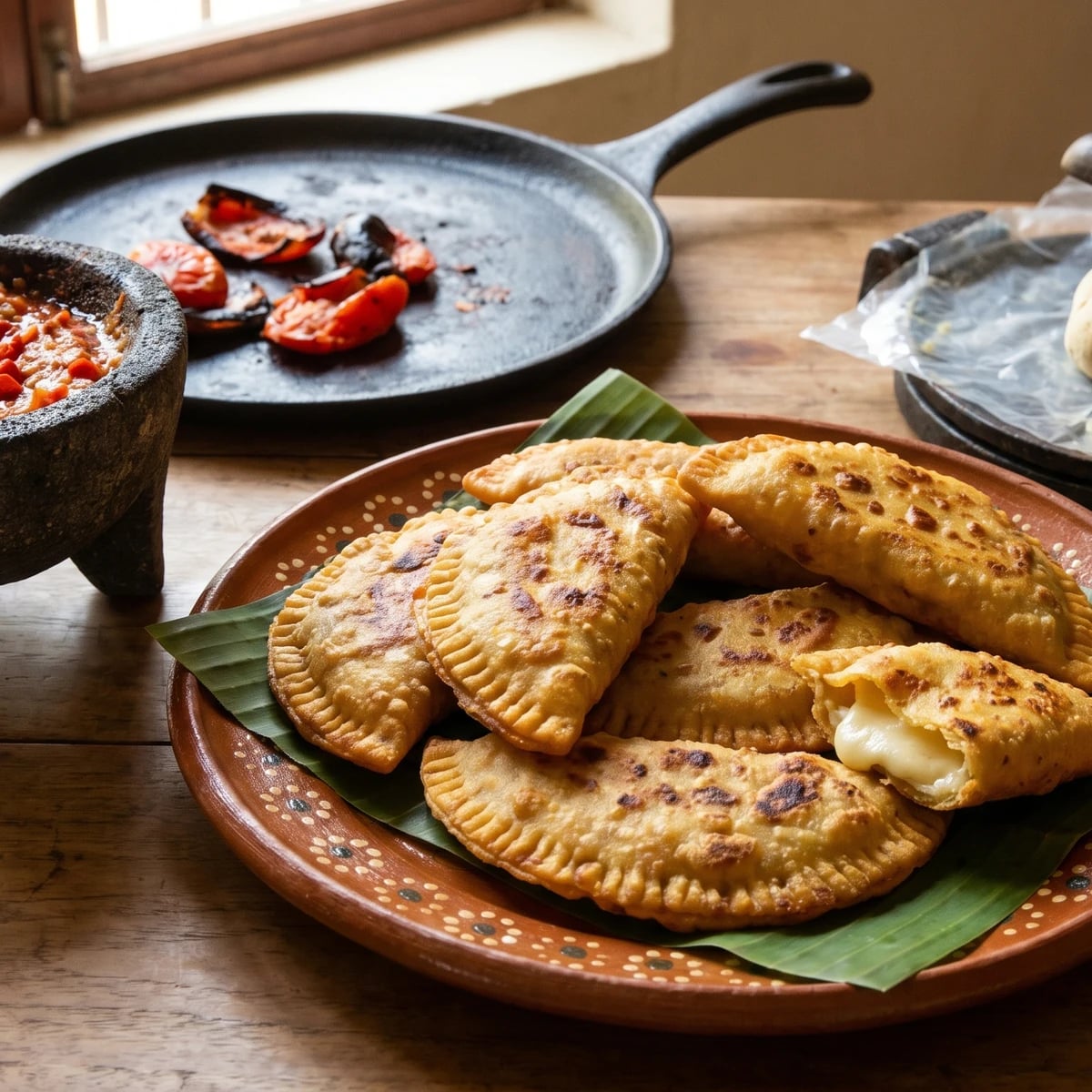
Tabasco's lowland corn empanadas, pressed thin around fresh queso, sealed by hand, and fried in manteca de cerdo until crisp enough for a mercado breakfast.

Appetizers & Snacks
Mexican
Game Day
Potluck
Comfort Food
35 min
Active Time
20 min cook55 min total
Yield12 empanadas

Tabasco, the lowland Maya south, is where these empanadas live: in Villahermosa markets, in Chontalpa kitchens, near the Grijalva and Usumacinta water that make the state so green it almost looks excessive. This is not a northern flour empanada. This is corn masa, fresh queso, and hot lard. Cada estado, su propia cocina.

The filling is modest because the masa is doing real work. You press it thin, fill it with queso fresco or a young local queso de poro when you can find it, seal it tight, and fry it in manteca de cerdo until the surface blisters and turns gold. Vegetable oil will fry it, yes. It will not taste like the empanadas from a Tabasco mercado. La manteca es el sabor.

The chile amashito belongs on the table in the salsa, not inside the empanada. Tiny, red, sharp, and native to Tabasco, it gives heat in quick little bites. I learned this version from a señora near the Mercado Pino Suárez who pressed the masa so thin I thought it would tear. It didn't. Her hands knew what the recipe card could not teach. Saber cocinar es saber vivir.

Corn masa empanadas in southeastern Mexico descend from the older Mesoamerican practice of shaping nixtamalized corn around a filling before cooking it on a comal or in fat. In Tabasco, the dish adapted to the lowland dairy and market breakfast culture of the 19th and 20th centuries, when fresh cheeses became common in daily cooking alongside corn, chaya, plantain, and river fish. Chile amashito, also called mashito or piquín in Tabasco, is a small wild or semi-cultivated Capsicum annuum used most often in table salsas rather than cooked into the main dish.

The technique, the tradition, and the story behind every dish.

Discover Culinary Explorer

Ingredients

fresh nixtamal masa or masa harina

Quantity

2 cups

if using masa harina, mixed with 1 1/2 cups warm water

fine sea salt

Quantity

1/2 teaspoon, plus more to taste

manteca de cerdo

Quantity

2 tablespoons

softened, for the masa

queso fresco or young queso de poro from Tabasco

Quantity

10 to 12 ounces

crumbled

manteca de cerdo

Quantity

2 cups

for frying

fresh chile amashito

Quantity

6

stemmed, for salsa

ripe Roma tomatoes

Quantity

2

small garlic clove

Quantity

1

unpeeled

sea salt

Quantity

1/4 teaspoon, plus more to taste

sour orange juice

Quantity

1 tablespoon

or 2 teaspoons lime juice mixed with 1 teaspoon orange juice

warm corn tortillas or banana leaf squares (optional)

Quantity

for holding the fried empanadas

Equipment Needed

  • Tortilla press lined with thick plastic
  • Cast iron comal
  • Volcanic stone molcajete
  • Wide clay cazuela or heavy Dutch oven for frying
  • Kitchen spider or tongs
  • Wire rack or brown paper for draining

Instructions

  1. 1

    Prepare the masa

    Put the masa in a bowl with the salt and the 2 tablespoons of softened manteca de cerdo. Knead with your hand for 3 to 4 minutes, until the fat disappears into the dough and the masa feels soft, moist, and smooth. It should not crack when you press it between your fingers. If it cracks, add warm water one teaspoon at a time. If it sticks badly, dust in a spoonful of masa harina. The masa tells you what it needs.

  2. 2

    Roast the salsa

    Heat a dry comal over medium. Roast the Roma tomatoes and the unpeeled garlic clove, turning often, until the tomato skins blister and the garlic softens. The tomatoes should slump slightly and smell sweet, not burned. Peel the garlic. This is the base for the chile amashito salsa, the little fire that belongs beside the empanadas.

  3. 3

    Grind the amashito

    In a molcajete, grind the chile amashito with the salt until the skins break and the chile releases its sharp perfume. Add the peeled garlic and grind to a paste. Add the roasted tomatoes and crush them into a rough salsa. Stir in the sour orange juice. Taste for salt. The salsa should be bright and direct. Do not blend it smooth. A Tabasco table salsa has texture.

    Chile amashito is small but serious. Start with 4 chiles if your guests are not used to it, then put the rest on the table for the people who know how Tabasco eats.
  4. 4

    Portion the dough

    Divide the masa into 12 balls, each about the size of a small lime. Keep them covered with a damp kitchen towel so they do not dry out. Dry masa cracks at the edge and leaks cheese into the lard. Then you are cleaning the pot instead of eating breakfast.

  5. 5

    Press the rounds

    Line a tortilla press with two pieces of thick plastic cut from a clean food bag. Press one masa ball into a round about 5 inches wide, thinner than a tortilla for tacos but not so thin that you can see through it. Lift the top plastic carefully. The edges should be even enough to seal but still look hand-pressed. La cocina no es decoración, es trabajo.

  6. 6

    Fill and seal

    Place 2 tablespoons of crumbled queso slightly off center on the masa round. Fold the plastic over to bring the masa into a half-moon, then press the edge firmly through the plastic to seal. Open the plastic and pinch any weak spots with your fingers. Do not overfill. More cheese looks generous until it bursts in the lard. The señora at the mercado knows restraint for a reason.

  7. 7

    Heat the lard

    Melt the 2 cups of manteca de cerdo in a wide heavy cazuela or Dutch oven over medium heat. The fat should be about 1 inch deep and reach 350F if you are using a thermometer. Without a thermometer, drop in a pea-sized bit of masa. It should bubble immediately and rise slowly, not darken in five seconds. Too cold and the empanadas drink fat. Too hot and the outside burns before the cheese warms.

  8. 8

    Fry until crisp

    Fry 2 or 3 empanadas at a time, sliding them into the lard away from your body. Cook for 2 to 3 minutes per side, turning once, until the masa is golden with tiny blisters and the edges feel firm when tapped with tongs. A little cheese may perfume the fat. A lot of cheese means you did not seal them. No me vengas con atajos.

  9. 9

    Drain and serve

    Lift the empanadas onto a rack or a plate lined with brown paper. Sprinkle with a few grains of salt while the surface is still glossy from the lard. Serve hot with the chile amashito salsa in a small molcajete or clay bowl. Eat them with your hands. This is mercado food, not a fork-and-knife ceremony. Así se hace y punto.

Chef Tips

  • Fresh nixtamal masa from a tortillería gives the best texture. Masa harina works, but it is a compromise, not an upgrade. Knead it well and let it rest 15 minutes before pressing.
  • Queso fresco is correct when it is fresh, milky, and not watery. If you find young queso de poro from Tabasco, use it. Do not use cheddar, Oaxaca cheese, or supermarket shredded cheese. Wrong melt, wrong flavor, wrong state.
  • Chile amashito belongs to Tabasco's table salsas. If you cannot find it, use chile piquín as the nearest relative and understand what you are missing: amashito has a quick, bright heat tied to that lowland cuisine.
  • Fry in manteca de cerdo. Vegetable oil makes a thinner flavor and a harder crust. The old cooks were not confused about fat. La manteca es el sabor.
  • These empanadas should be eaten hot. They are still good warm, but once the masa cools completely, the crust loses its mercado bite.

Advance Preparation

  • The chile amashito salsa can be made up to 4 hours ahead and kept covered at room temperature. Stir before serving.
  • The masa can be mixed 2 hours ahead and kept covered with a damp towel. Knead in a few drops of warm water if it feels dry before pressing.
  • Do not fill the empanadas too far ahead. The queso releases moisture and weakens the seal. Press, fill, seal, and fry in the same rhythm.

Frequently Asked Questions

Nutrition Information

1 serving (about 90g)

Calories
245 calories
Total Fat
17 g
Saturated Fat
8 g
Trans Fat
0 g
Unsaturated Fat
9 g
Cholesterol
30 mg
Sodium
350 mg
Total Carbohydrates
17 g
Dietary Fiber
2 g
Sugars
1 g
Protein
7 g

Note: Chef personas and recipes are created with AI assistance. Cook with care: follow safe food-handling practices, check doneness with a thermometer when needed, and adapt for allergies and your kitchen.

Where cooking meets culture.

Culinary guides, cultural storytelling, and the editorial depth that makes cooking meaningful.

Discover Culinary Explorer

More from Chiapas & Tabasco Appetizers & Snacks

Browse the full collection