
Chef Lupita
Almendrados Conventuales Poblanos
Puebla's convent almond cookies, made from blanched almonds, sugar syrup, egg yolks, canela, and patient hands, the kind of sweet that belongs beside coffee in talavera, not in a plastic bakery box.
A cooking platform built around craft, culture, and the stories behind what we eat.
Created by
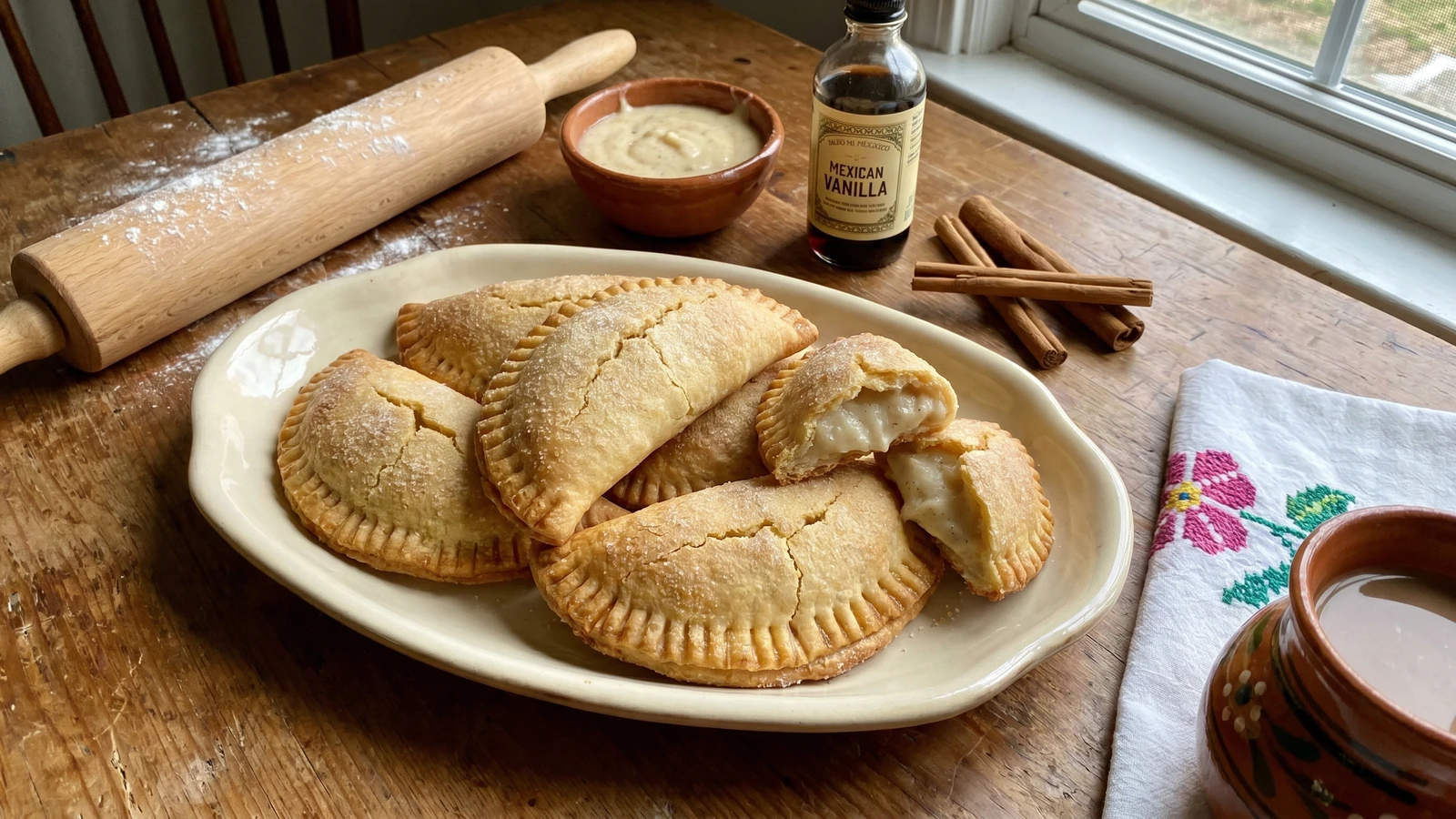
Aguascalientes empanadas de leche are tender galletas made with manteca de cerdo, sealed around thick milk custard, scented with canela and Mexican vanilla, then sugared warm.
Aguascalientes, in the north-central Bajío between Zacatecas and Jalisco, is where these empanadas de leche belong. They are not little fruit pies and they are not fried fairground empanadas. They are baked galletas, tender from manteca de cerdo, folded around a milk custard that smells of canela and vainilla. No chile here. Learn that now. Mexican cooking is not one flavor trick.
At Mercado Terán in the city of Aguascalientes, the women who sell dulces know the test: the filling must stand on the spoon before it ever touches the dough. Loose custard leaks, burns, and makes you blame the oven. Cold, thick filling stays where you put it. That is the technique the señoras perfected, not because it looks clever, because it survives the tray.
The geography is in the ingredients. Wheat from the Bajío, milk from dairy country, canela and vanilla arriving through older trade routes into the central pantry. The dough takes fresh lard, clean-smelling and pale. Butter makes a different cookie. Shortening makes a dull one. La manteca es el sabor.
My mother did not make these; she was jalisciense. But in her notebook she kept one line under empanadas dulces: la leche debe quedar espesa antes de cerrar. The milk must be thick before sealing. She was right, and the señora in Aguascalientes who corrected my first batch said the same thing. Recetas probadas y garantizadas.
Aguascalientes was founded in 1575 on the Camino Real de Tierra Adentro, the silver route that tied the Bajío to Zacatecas and moved wheat, cattle, sugar, and spices through the region. Empanadas de leche belong to the state's panadería and home dulcería tradition, using a wheat dough and milk filling instead of the pumpkin empanadas common farther north or the cajeta pastries associated with Celaya. Vanilla, first cultivated by Totonac peoples in Veracruz, and canela, brought through colonial trade, met the Bajío's dairy and wheat economy in sweets like this; the Feria Nacional de San Marcos, first held in 1828, helped keep portable local dulces in public view.
Quantity
3 cups
divided
Quantity
3/4 cup
Quantity
1 (3-inch) stick
Quantity
1/4 teaspoon
Quantity
3
Quantity
1/3 cup
Quantity
2 teaspoons
Quantity
4 cups
plus more for rolling
Quantity
1/2 cup
Quantity
1 teaspoon
Quantity
1/2 teaspoon
Quantity
1/2 teaspoon
Quantity
1 cup
cool and pliable
Quantity
2
Quantity
1/4 cup, plus 1 to 2 tablespoons if needed
Quantity
1 teaspoon
Quantity
1/2 cup
Quantity
1/2 teaspoon
| Ingredient | Quantity |
|---|---|
| whole milk for fillingdivided | 3 cups |
| granulated sugar for filling | 3/4 cup |
| Mexican canela stick | 1 (3-inch) stick |
| fine sea salt for filling | 1/4 teaspoon |
| large egg yolks | 3 |
| cornstarch (maicena) | 1/3 cup |
| Mexican vanilla extract for filling | 2 teaspoons |
| all-purpose flourplus more for rolling | 4 cups |
| granulated sugar for dough | 1/2 cup |
| baking powder | 1 teaspoon |
| fine sea salt for dough | 1/2 teaspoon |
| ground Mexican canela for dough | 1/2 teaspoon |
| fresh pork lard (manteca de cerdo)cool and pliable | 1 cup |
| large eggs | 2 |
| cold whole milk for dough | 1/4 cup, plus 1 to 2 tablespoons if needed |
| Mexican vanilla extract for dough | 1 teaspoon |
| granulated sugar for finishing | 1/2 cup |
| ground Mexican canela for finishing | 1/2 teaspoon |
Set aside 1/2 cup of the milk. Pour the remaining 2 1/2 cups into a heavy saucepan with the sugar, canela stick, and salt. Warm over medium-low heat until the sugar dissolves and the milk smells clearly of canela, about 5 minutes. Do not boil it hard. Milk catches on the bottom when the cook wanders away.
In a bowl, whisk the egg yolks, maicena, and reserved 1/2 cup cold milk until completely smooth. Slowly whisk in 1 cup of the hot milk to temper the yolks, then pour everything back into the saucepan. Cook over medium-low heat, scraping the corners of the pan, until the custard is thick enough to mound on a spoon and leave a clean trail on the bottom, 5 to 7 minutes. Remove the canela stick and stir in the vanilla off the heat.
Spread the custard into a shallow dish and press parchment or plastic directly against the surface. Refrigerate until cold and firm, at least 1 hour. Hot filling melts the lard in the dough before the empanada reaches the oven. That is how seams open. No me vengas con atajos.
Whisk the flour, sugar, baking powder, salt, and ground canela in a large bowl. Add the cool lard and rub it into the flour with your fingertips until the mixture looks sandy and holds together when squeezed. Beat the eggs with the cold milk and vanilla, then add to the bowl. Mix only until a soft dough forms. If dry flour remains, add milk 1 teaspoon at a time. Do not knead it like bread; this is a tender galleta dough.
Divide the dough into two disks, wrap, and refrigerate for 30 minutes. The rest firms the lard and lets the flour relax. If you skip it, the dough fights the rolling pin and the empanadas shrink. Así se hace y punto.
Heat the oven to 350F. Line two baking sheets with parchment. On a lightly floured surface, roll one disk of dough to about 1/8 inch thick. Cut 4 to 4 1/2 inch rounds with a cutter or a small saucer. Reroll scraps once, not five times. Overworked dough bakes tough.
Place 1 scant tablespoon of cold milk custard just off center on each round. Moisten the edge lightly with water, fold the dough over the filling, and press out the trapped air before sealing. Crimp with a fork or make a small repulgue with your fingers. Prick the top once with a toothpick. If custard squeezes out while sealing, you used too much.
Arrange the empanadas 1 inch apart on the prepared sheets. Bake for 18 to 22 minutes, rotating the sheets once, until the edges are lightly golden and the bottoms have a little color. The tops should stay pale, not brown like a cookie forgotten in the oven. Let them rest on the sheet for 5 minutes.
Mix the finishing sugar with the ground canela. While the empanadas are still warm enough for sugar to cling, dust them generously or turn them gently in the sugar. Move to a rack and cool until the custard settles. Serve on a clay platter with café de olla or a glass of cold milk. Cada estado, su propia cocina.
1 serving (about 100g)
Culinary guides, cultural storytelling, and the editorial depth that makes cooking meaningful.
Discover Culinary ExplorerChef Lupita
Puebla's convent almond cookies, made from blanched almonds, sugar syrup, egg yolks, canela, and patient hands, the kind of sweet that belongs beside coffee in talavera, not in a plastic bakery box.

Chef Lupita
Ciudad de Mexico's panaderia banderillas are long sticks of hojaldre pressed with sugar, baked until amber, and finished with a hard glaze for coffee at the kitchen table.

Chef Lupita
Mérida's pale egg-yolk-and-vanilla kisses, tiny cookies built on eight yolks and a perfume of orange blossom, sandwiched with guava paste and dusted heavy with powdered sugar.

Chef Lupita
Hidalgo's bisquet de nata carries Pachuca's mining history into the breakfast table: a Cornish-style bread softened by Mexican nata, split warm and eaten with café de olla.