
Chef Lupita
Almendrados Conventuales Poblanos
Puebla's convent almond cookies, made from blanched almonds, sugar syrup, egg yolks, canela, and patient hands, the kind of sweet that belongs beside coffee in talavera, not in a plastic bakery box.
A cooking platform built around craft, culture, and the stories behind what we eat.
Created by
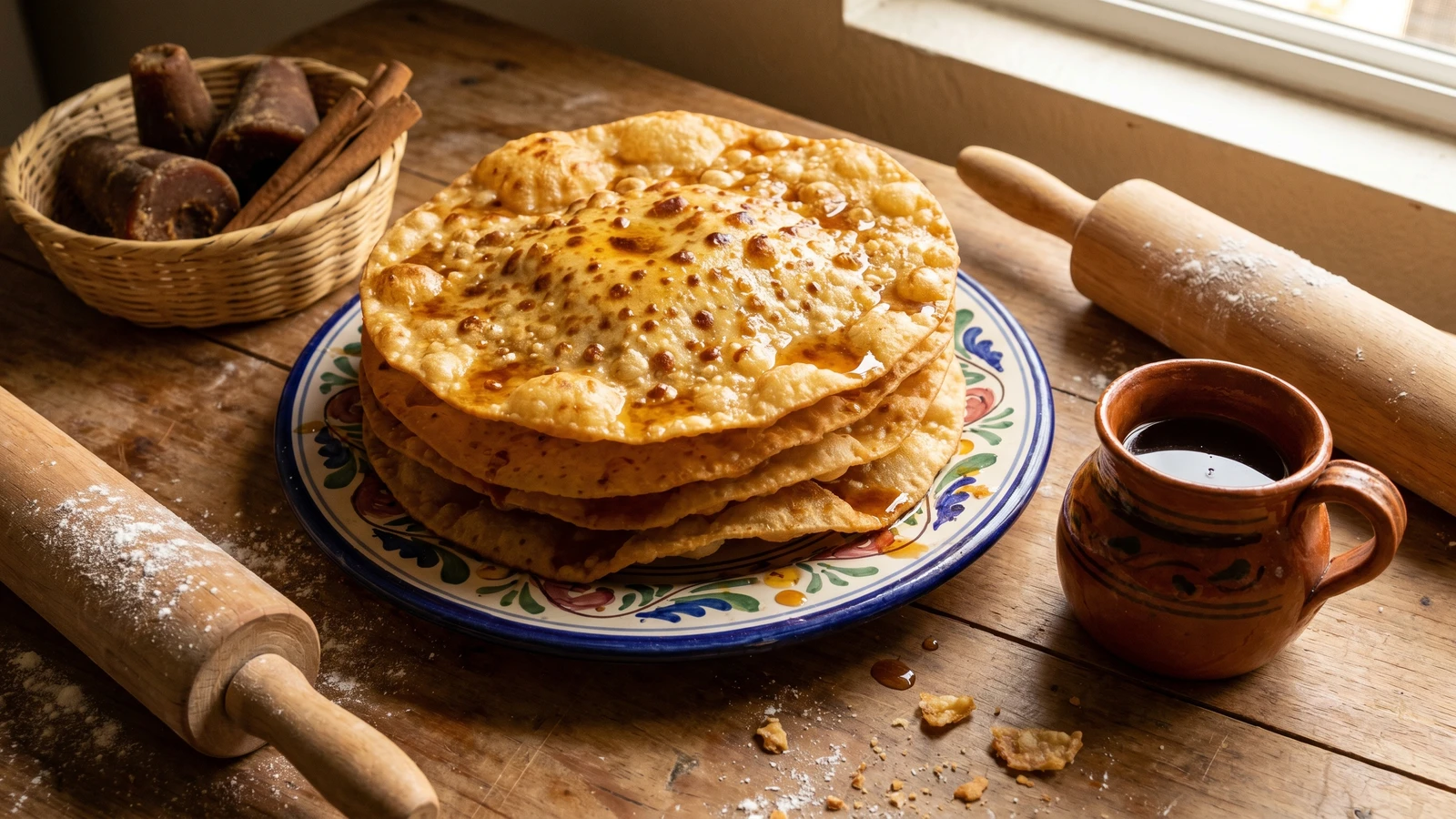
Guanajuato's holiday buñuelos, thin wheat dough rested with tomatillo husks and canela milk, fried crisp and finished with a dark miel de piloncillo.
Guanajuato, in the Bajío, makes buñuelos for the cold months, for Christmas tables, for fairs, for the days when a family wants something crisp and generous with piloncillo running down the edges. In León, Celaya, Dolores Hidalgo, and the towns between, you see them stacked high, thin as market paper and fried golden. This is not a doughnut. Do not make it thick.
Buñuelos came to Mexico through Spanish convent cooking in the colonial period, but Mexican cooks changed them with local sweeteners, regional aromatics, and fairground serving rituals. In the Bajío, especially Guanajuato and neighboring Querétaro, the thin disc style became tied to Christmas, posadas, and late-year ferias where piloncillo syrup is poured over the buñuelo just before eating. The use of tomatillo husks in the resting liquid is an old household technique: the husks help the wheat dough stretch thin without tearing, a practical trick carried by women who made dozens at a time.
Quantity
2 cups
Quantity
1
for the milk infusion
Quantity
10
cleaned and rinsed
Quantity
4 cups, plus more for rolling
Quantity
1 teaspoon
Quantity
1/2 teaspoon
Quantity
2
room temperature
Quantity
3 tablespoons melted, plus 2 pounds for frying
Quantity
1 tablespoon
Quantity
1 teaspoon
Quantity
1 pound
chopped
Quantity
2 cups
Quantity
1
for the syrup
Quantity
2
Quantity
1 strip
Quantity
1
halved
| Ingredient | Quantity |
|---|---|
| whole milk | 2 cups |
| Mexican cinnamon stick (canela)for the milk infusion | 1 |
| dried tomatillo huskscleaned and rinsed | 10 |
| all-purpose wheat flour | 4 cups, plus more for rolling |
| baking powder | 1 teaspoon |
| fine sea salt | 1/2 teaspoon |
| large eggsroom temperature | 2 |
| pork lard (manteca de cerdo) | 3 tablespoons melted, plus 2 pounds for frying |
| granulated sugar | 1 tablespoon |
| vanilla extract | 1 teaspoon |
| piloncillochopped | 1 pound |
| water | 2 cups |
| Mexican cinnamon stick (canela)for the syrup | 1 |
| whole cloves | 2 |
| orange peel | 1 strip |
| small guava (optional)halved | 1 |
Place the milk, one cinnamon stick, and the cleaned tomatillo husks in a small saucepan. Warm over low heat until the milk smells clearly of canela, then turn off the heat. Let it steep for 20 minutes. Strain and let the milk cool until just warm. The tomatillo husks are not for flavor. They help the dough relax and stretch. Pregúntale a las señoras del mercado.
In a large bowl, whisk the flour, baking powder, salt, and sugar. Make a well in the center. Add the eggs, melted lard, vanilla, and 1 1/4 cups of the warm infused milk. Mix with your hand until a rough dough forms. Add more milk one tablespoon at a time only if dry flour remains at the bottom of the bowl.
Turn the dough onto a lightly floured table and knead for 8 to 10 minutes. It should become smooth, elastic, and a little tacky, not sticky. If it fights you, let it sit for five minutes and continue. Wheat dough needs rest before it obeys. No me vengas con atajos.
Divide the dough into 18 to 20 small balls, each about the size of a golf ball. Rub them lightly with a little melted lard, cover with a clean kitchen towel, and rest for 45 minutes. This rest is what lets you roll the buñuelos thin enough to crisp. Skip it and you will tear the dough or make heavy buñuelos.
While the dough rests, combine the piloncillo, water, cinnamon stick, cloves, orange peel, and guava if using in a saucepan. Simmer over medium-low heat for 20 to 25 minutes, stirring now and then, until the piloncillo dissolves and the syrup coats a spoon lightly. Strain out the spices and fruit. Keep the syrup warm. It should be dark, glossy, and fragrant, not watery.
Roll one dough ball at a time on a floured surface into a thin circle, 8 to 9 inches wide. Turn it often and dust lightly so it does not stick. If you know the old way, stretch it over a clean towel-covered bowl or over your knee covered with a cloth, pulling gently from the center outward. The center should look almost translucent. That thinness is the point.
Melt the lard in a wide heavy pot to 350F. Slide in one buñuelo. Press it gently under the fat with tongs so it bubbles evenly, then turn once. Fry 45 to 60 seconds per side, until golden with darker freckles at the edges. Drain on a rack or on brown paper. La manteca es el sabor. Vegetable oil will fry them, yes, but it will not taste like the feria.
Stack the buñuelos loosely so they stay crisp. Spoon warm miel de piloncillo over each one only when serving, or set the syrup in a small clay jarro at the table so each person pours their own. Once syrup touches the buñuelo, the clock starts. Eat it while it cracks under your teeth. Así se hace y punto.
1 serving (about 85g)
Culinary guides, cultural storytelling, and the editorial depth that makes cooking meaningful.
Discover Culinary ExplorerChef Lupita
Puebla's convent almond cookies, made from blanched almonds, sugar syrup, egg yolks, canela, and patient hands, the kind of sweet that belongs beside coffee in talavera, not in a plastic bakery box.

Chef Lupita
Ciudad de Mexico's panaderia banderillas are long sticks of hojaldre pressed with sugar, baked until amber, and finished with a hard glaze for coffee at the kitchen table.

Chef Lupita
Mérida's pale egg-yolk-and-vanilla kisses, tiny cookies built on eight yolks and a perfume of orange blossom, sandwiched with guava paste and dusted heavy with powdered sugar.

Chef Lupita
Hidalgo's bisquet de nata carries Pachuca's mining history into the breakfast table: a Cornish-style bread softened by Mexican nata, split warm and eaten with café de olla.