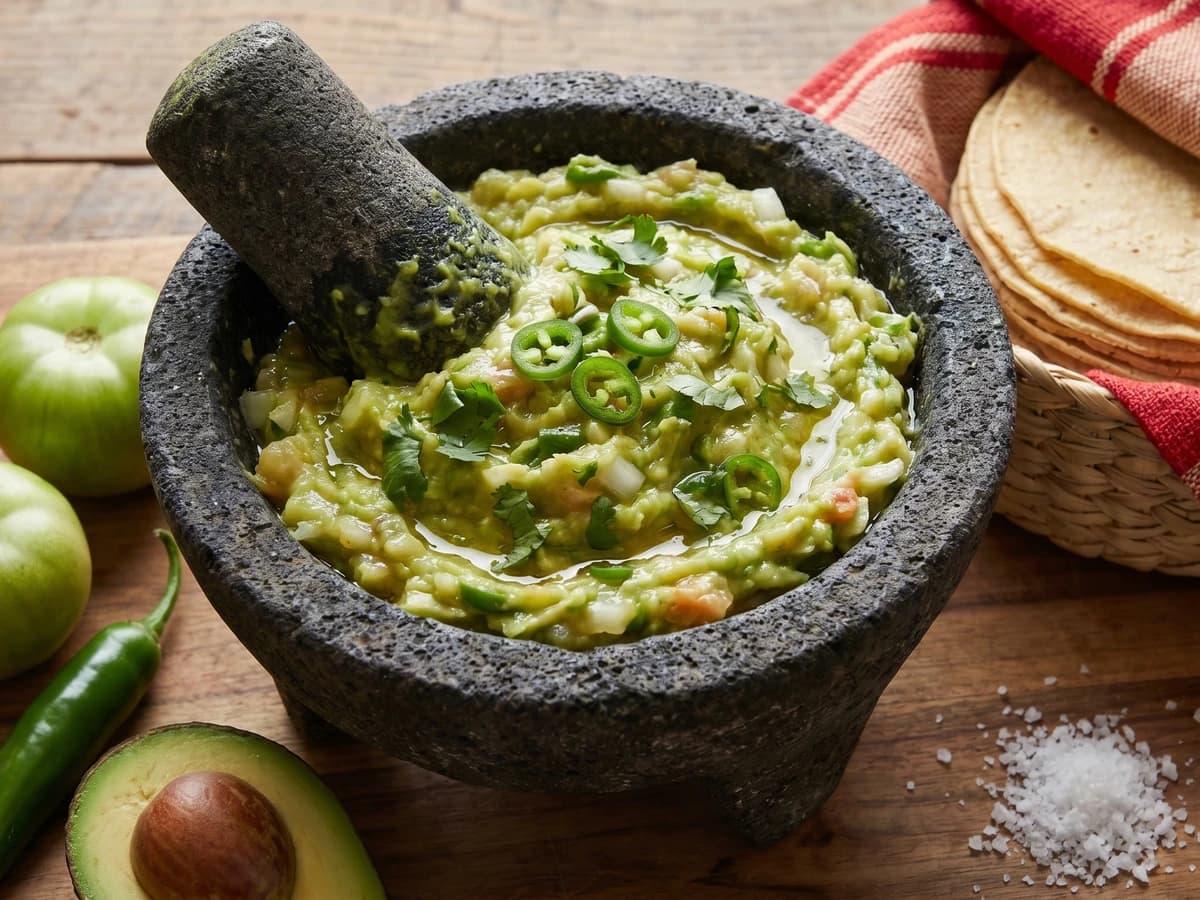
Ensenada's Mercado Negro classic: masa empanadas filled with fresh blue crab sauteed with tomato, onion, and chile guero, fried in lard until crisp on the outside and steaming sweet inside.
Appetizers & Snacks
Mexican
Special Occasion
Dinner Party
Make Ahead
45 min
Active Time
30 min cook•1 hr 15 min total
Yield12 empanadas, 4 to 6 servings
These empanadas come from Ensenada, in the northern half of Baja California, and specifically from the Mercado Negro de Mariscos, the seafood market on the harbor where the boats unload jaiba and the women at the back stalls have been frying empanadas in cazos of lard for three generations. This is not a Mexico City dish. This is not a Sinaloa dish. This is Baja, where the cold Pacific water gives the crab a sweetness that the Gulf can not match, and where the masa empanada, fried instead of baked, is the proper vehicle.
The filling is restrained on purpose. White onion, tomato, garlic, chile guero, a little oregano, fresh crab. That is the recipe. No cheese. No cream. No ten ingredients. The crab carries the dish and everything else stays out of its way. Use chile guero if you can find it because that is what the Ensenada cooks use, and the slight fruity heat is part of the regional signature. Jalapeno will work in a pinch. Poblano will not. The chile needs to be sharp, not vegetal.
The masa is corn, not flour. I know flour empanadas exist in northern Mexico and I respect them, but the empanada de jaiba ensenadense is masa de maiz fried in lard, and the contrast between the crisp corn shell and the sweet warm crab is the entire point. My mother never made these. She was from Jalisco and Jalisco does not have a coast like Ensenada has a coast. I learned them from a senora named Dona Petra at a stall called Mariscos La Guerrerense's neighbor, in 2009, and I wrote her recipe in the back of my notebook in red pen. Saber cocinar es saber vivir. Cada estado, su propia cocina, y esta es de Baja.
Baja California's empanada de jaiba tradition emerged in Ensenada in the mid-20th century, as the Mercado Negro de Mariscos established itself as the working harbor's central seafood market and the surrounding stalls developed a streetside fried-snack culture built around the day's catch. Blue crab (Callinectes sapidus and the local Callinectes bellicosus) is harvested from the cold Pacific waters and the upper Sea of Cortez, where Baja's fisheries have operated since the indigenous Kumeyaay peoples gathered shellfish along the coast. The fried masa empanada filled with seafood is itself a regional adaptation of the broader Mexican empanada tradition: where central states bake their empanadas with wheat flour and Hidalgo's pastes carry a Cornish mining inheritance, Baja's coastal cooks settled on a corn shell fried in lard, a format better suited to a market stall and a diner eating standing at the counter.
The technique, the tradition, and the story behind every dish.
finely diced (or 1 chile jalapeno if guero is not available)
dried Mexican oregano
Quantity
1 teaspoon
crumbled between the palms
bay leaf
Quantity
1
fresh cilantro
Quantity
1/4 cup
chopped
fresh lime juice
Quantity
1 tablespoon
kosher salt
Quantity
to taste
freshly ground black pepper
Quantity
to taste
masa harina (Maseca or Minsa)
Quantity
2 cups
warm water for the masa
Quantity
1 1/2 cups, plus more as needed
kosher salt for the masa
Quantity
1 teaspoon
manteca de cerdo (soft) for the masa
Quantity
2 tablespoons
lard or neutral oil for frying
Quantity
about 4 cups
lime wedges (optional)
Quantity
for serving
salsa de chile de arbol or salsa macha (optional)
Quantity
for serving
shredded green cabbage (optional)
Quantity
for serving
Ingredient
Quantity
fresh blue crab meat (jaiba azul)picked over for shell, lump and claw mixed
1 pound
manteca de cerdo (pork lard) for the filling
3 tablespoons
white onionfinely diced
1 small
garlic clovesminced
3
Roma tomatoesfinely diced and drained of excess juice
2 medium
fresh chile guerofinely diced (or 1 chile jalapeno if guero is not available)
2
dried Mexican oreganocrumbled between the palms
1 teaspoon
bay leaf
1
fresh cilantrochopped
1/4 cup
fresh lime juice
1 tablespoon
kosher salt
to taste
freshly ground black pepper
to taste
masa harina (Maseca or Minsa)
2 cups
warm water for the masa
1 1/2 cups, plus more as needed
kosher salt for the masa
1 teaspoon
manteca de cerdo (soft) for the masa
2 tablespoons
lard or neutral oil for frying
about 4 cups
lime wedges (optional)
for serving
salsa de chile de arbol or salsa macha (optional)
for serving
shredded green cabbage (optional)
for serving
Equipment Needed
•Tortilla press lined with cut squares of freezer-bag plastic
•Wide heavy skillet for the sofrito
•Deep heavy pot or cazo for frying
•Frying thermometer
•Wire rack set over a sheet pan
•Slotted spoon or kitchen spider
Instructions
1
Pick the crab
Spread the crab meat on a sheet pan in a thin layer. Run your fingers through it slowly, in good light, looking for shell fragments and the thin papery cartilage that hides between the lumps. There is always shell. The cooks at the Mercado Negro do this with their grandmothers' patience because no diner forgives a piece of shell in an empanada. Refrigerate the picked crab while you build the rest.
If you cannot find fresh blue crab from the Pacific or the Sea of Cortez, pasteurized lump crab from a refrigerated tin is the next step down. Do not buy imitation crab. That is not jaiba, that is a costume.
2
Build the sofrito
Melt 3 tablespoons of lard in a wide skillet over medium heat. Add the diced white onion with a pinch of salt and cook until translucent and just starting to soften at the edges, about four minutes. Add the garlic and the chile guero. Cook for one minute more, until the kitchen smells sharp and grassy. La manteca es el sabor. The lard carries the flavor of the chile and the onion in a way that vegetable oil never will.
3
Cook down the tomato
Add the drained tomato, the bay leaf, and the oregano. Cook over medium heat for six to eight minutes, stirring often, until the tomato breaks down and the mixture looks dry rather than soupy. A wet filling will burst the empanada in the fryer. You want a sofrito that holds its shape on a spoon.
4
Fold in the crab
Pull the pan off the heat. Discard the bay leaf. Let the sofrito cool for two minutes so you do not cook the crab any further. Fold in the crab meat, the chopped cilantro, and the lime juice. Taste for salt and pepper. The filling should taste clean, oceanic, and a little bright from the lime. Spread it on a plate to cool completely while you make the masa.
Never let the crab boil in the sofrito. You are warming it, not cooking it. Boiled crab turns rubbery and loses the sweet flavor that justifies the whole dish.
5
Mix the masa
In a wide bowl, combine the masa harina, salt, and the soft lard. Pour in the warm water in a steady stream, mixing with your hand until the dough comes together. Knead for two minutes inside the bowl. The masa should feel like soft clay: smooth, not sticky, holding the print of your finger without cracking. If it cracks at the edges when you press it, add water a tablespoon at a time. If it sticks to your hand, add a little more masa harina. Cover with a damp cloth and let it rest for ten minutes.
6
Press the empanadas
Divide the masa into 12 equal balls, about the size of a small lime. Line a tortilla press with two squares of plastic cut from a freezer bag. Place a ball of masa in the center and press to a six-inch round, no thicker than a tortilla. Peel the top plastic off. Place a heaping tablespoon of crab filling on one half, leaving a half-inch border. Lift the bottom plastic and fold the masa over the filling. Press the edge to seal, then run a finger or a small bowl rim along the curve to crimp it cleanly. Set on a tray under a damp cloth and continue with the rest.
If the masa cracks when you fold it, the dough is too dry. Wet your hands and knead a little water back in. A cracked empanada will leak in the fryer and ruin the oil.
7
Heat the fat
Pour enough lard or neutral oil into a deep heavy pot to come up two inches. Heat over medium-high to 350 degrees F. Test with a small piece of masa: it should sizzle steadily and rise to the surface within seconds without browning instantly. Too cool and the masa drinks the oil. Too hot and the outside burns before the masa cooks through.
8
Fry to mahogany
Slide two or three empanadas into the fat at a time, never crowding the pot. Fry for three to four minutes per side, turning once, until the masa is deep golden brown with darker freckles where the surface caught the heat. The crust should be firm enough to tap with a finger. Lift onto a wire rack set over a sheet pan. Salt them lightly the moment they come out of the oil while the surface is still glistening. Serve hot. Asi se hace y punto.
9
Serve at the counter
Pile the empanadas on a platter with lime wedges, a bowl of salsa de chile de arbol or salsa macha, and a heap of shredded cabbage. At the Mercado Negro the diner squeezes the lime over the empanada, drags it through the salsa, and eats it standing up before it cools. Do the same. An empanada de jaiba that has gone soft is an empanada de jaiba that lost its window.
Chef Tips
•Sourcing is the entire game. If your crab is not fresh, do not make this dish today. Make it the day you find good crab. Mexican grandmothers cook with what the mercado is selling, not what looks good on a Pinterest board.
•Drain the diced tomato in a sieve for ten minutes before it goes into the pan. Excess water in the filling will steam the inside of the empanada and split the seam in the fryer. A dry filling fries cleanly.
•Lard for frying is not optional if you want the flavor of the Mercado Negro stalls. Neutral oil works and is what most home cooks will use, but the version fried in manteca tastes the way these are supposed to taste. Save the strained lard from carnitas and use it here.
•Chile guero is sometimes labeled chile caribe or chile largo at Mexican mercados in the United States. It is pale yellow, about the length of a finger, with a fruity heat. Do not substitute bell pepper. There is no point.
•These do not reheat well. The masa goes from crisp to leathery within an hour. Fry only what you will eat at one sitting. The filling can be made a day ahead, the masa fresh on serving day.
Advance Preparation
•The crab filling can be made one day ahead and refrigerated, covered. Bring to cool room temperature before filling the empanadas so the masa does not soften from the cold.
•Empanadas can be assembled (filled and crimped) up to two hours ahead and held on a tray under a damp cloth in the refrigerator. Fry just before serving.
•These do not freeze well. The crab loses its sweetness and the fried masa goes leathery. Make them the day you eat them.
Frequently Asked Questions
Nutrition Information
1 serving (about 280g)
Calories
585 calories
Total Fat
37 g
Saturated Fat
10 g
Trans Fat
0 g
Unsaturated Fat
26 g
Cholesterol
85 mg
Sodium
950 mg
Total Carbohydrates
41 g
Dietary Fiber
5 g
Sugars
2 g
Protein
21 g
Where cooking meets culture.
Culinary guides, cultural storytelling, and the editorial depth that makes cooking meaningful.