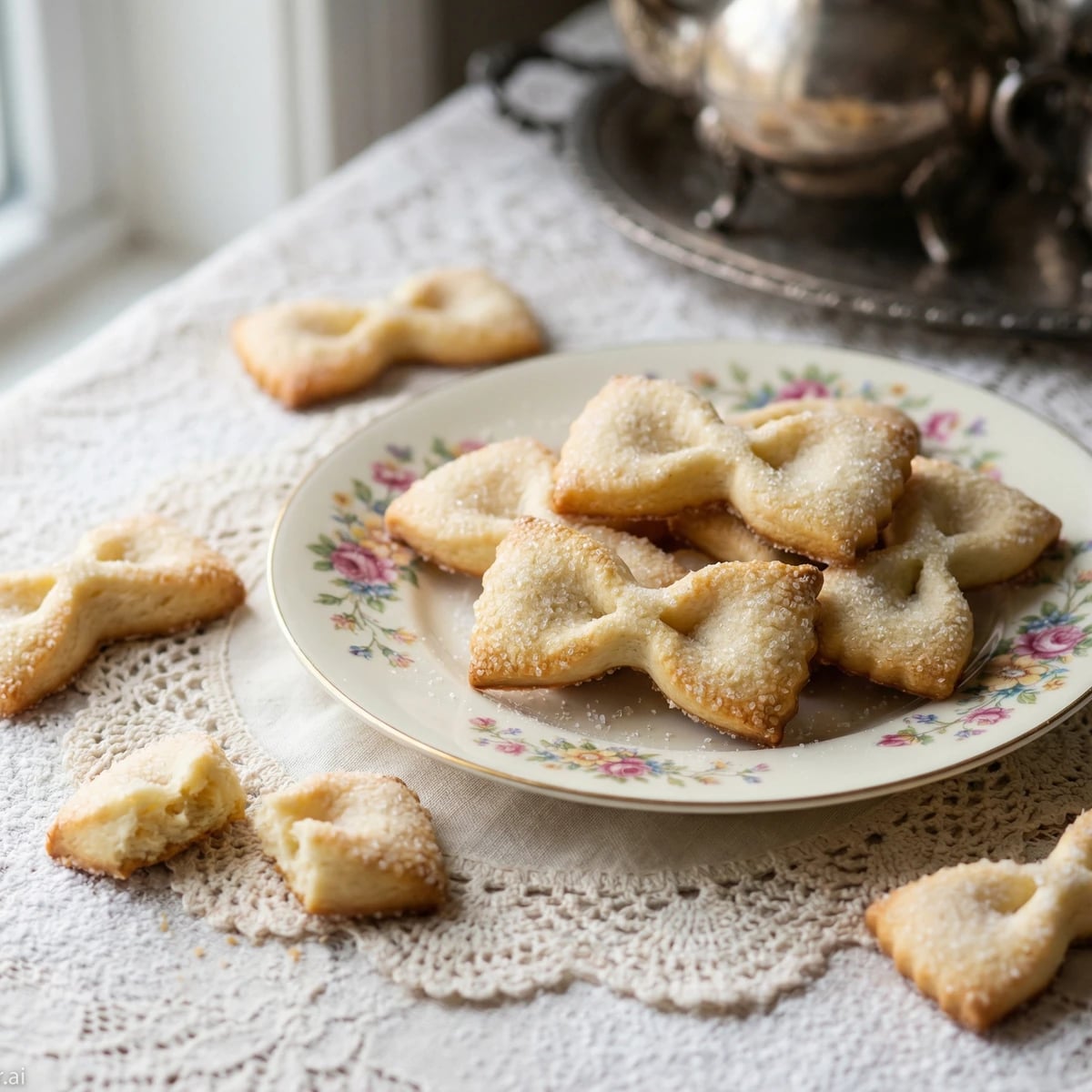
Impossibly light bow-tie cookies that shatter at first bite, dusted in sugar and carrying the weight of generations. These pareve wonders earned their nickname 'nothings' because they seem to disappear the moment they touch your tongue.
Pastries & Cookies
Jewish
Holiday
Make Ahead
30 min
Active Time
15 min cook•45 min total
Yield36 cookies
The first time I encountered kichel was in a Brooklyn bakery where the woman behind the counter called them gornisht mit gornisht. Nothing with nothing. She was being modest. These cookies represent centuries of ingenious baking, the kind that transforms four humble ingredients into something that defies physics.
Kichel arrived in America with Ashkenazi immigrants who carried their recipes like treasures. The word itself comes from the German küchen, meaning little cake, but that translation misses the point entirely. These aren't cakes. They're crispy, twisted bow-ties of sweetened dough so light they practically float off the plate. Bakers called them nothings because the texture dissolves on your tongue, leaving only sweetness and the faint richness of egg.
The genius of kichel lies in its pareve nature. No butter, no milk. Just eggs, oil, flour, and sugar. This means they can appear at any Jewish table, meat or dairy, without causing a moment's hesitation. Generation after generation of home bakers have twisted these doughs at kitchen tables, teaching children the simple motion that transforms a rectangle of dough into something beautiful.
Don't let the simplicity fool you. The technique matters. Roll the dough thin enough to read a newspaper through it, but not so thin it tears. The sugar coating caramelizes slightly in the oven, creating that signature crunch. Your first batch might not be perfect. Make them anyway. By the third batch, your hands will know what to do.
The technique, the tradition, and the story behind every dish.
In a large bowl, beat the eggs with a whisk or electric mixer until they turn pale yellow and increase noticeably in volume. This takes three to four minutes by hand, two minutes with a mixer. The eggs should look frothy and lighter in color than when you started. This aeration is the secret to kichel's impossible lightness.
Room temperature eggs whip to greater volume. If you forgot to take them out, submerge the whole eggs in warm water for five minutes.
2
Add oil and sugar
With the mixer running on medium speed, drizzle in the vegetable oil slowly. Add the half cup of sugar and the salt. Continue beating until the mixture is smooth and slightly thickened, about one minute more. The batter should look glossy and unified, not separated.
3
Form the dough
Add the flour all at once and stir with a wooden spoon or spatula until a soft dough forms. It will be slightly sticky but should pull away from the sides of the bowl. Turn the dough onto a lightly floured surface and knead gently, just five or six times, until smooth. Do not overwork it. Rough handling develops gluten and makes tough kichel.
4
Rest the dough
Wrap the dough in plastic and let it rest at room temperature for fifteen minutes. This relaxes the gluten and makes rolling much easier. Meanwhile, preheat your oven to 350°F (175°C) and line two baking sheets with parchment paper. Pour the remaining cup of sugar into a shallow dish.
5
Roll the dough thin
Divide the dough in half. On a well-floured surface, roll one portion into a rectangle about 12 by 16 inches. The dough should be thin enough that you can almost see your hand through it. Work from the center outward, adding flour as needed to prevent sticking. Thin dough equals crispy kichel. Thick dough equals chewy disappointment.
If the dough springs back stubbornly, let it rest another five minutes under a clean kitchen towel.
6
Cut and shape
Using a sharp knife or pizza cutter, trim the edges to create a clean rectangle. Cut the dough into strips about 2 inches wide, then cut each strip into rectangles roughly 2 by 4 inches. Make a short slit (about 1 inch) in the center of each rectangle, cutting parallel to the short sides. Pick up one rectangle, push one end through the slit, and pull gently to create the classic bow-tie twist.
7
Coat in sugar
Press each twisted kichel gently into the sugar dish, coating both sides. The sugar should cling to the surface. Place the coated cookies on your prepared baking sheets, leaving an inch between them. They don't spread much, but they need room for the air to circulate.
8
Bake until golden
Bake for 12 to 15 minutes, rotating the pans halfway through. The kichel are done when the edges turn golden brown and the centers look dry and slightly puffed. They will crisp further as they cool. Remove from the oven and let them rest on the baking sheet for two minutes before transferring to a wire rack.
9
Cool completely
Let the kichel cool completely on the rack before storing. They need at least twenty minutes. Taste one while still warm if you must, but know that the texture improves as they cool and the sugar coating sets into its characteristic crackle.
Chef Tips
•The oil must be neutral in flavor. Vegetable, canola, or safflower oil all work. Save the olive oil for another recipe.
•Humidity is the enemy of crispy kichel. On damp days, bake them a minute or two longer and store with a paper towel in the container to absorb moisture.
•For an old-fashioned variation, add a teaspoon of vanilla extract or the finely grated zest of one lemon to the egg mixture. Both were common in different regional traditions.
•Some bakers sprinkle poppy seeds over the sugar-coated kichel before baking. A tablespoon scattered across the batch adds visual interest and a subtle crunch.
Advance Preparation
•The dough can be wrapped tightly and refrigerated for up to two days. Bring to room temperature before rolling.
•Baked kichel keep for two weeks in an airtight container at room temperature. Do not refrigerate, as moisture will soften them.
•For longer storage, freeze baked kichel in a single layer, then transfer to a freezer bag. They keep frozen for three months. Thaw at room temperature and crisp briefly in a 300°F oven if needed.
Frequently Asked Questions
Nutrition Information
1 cookie (about 16g)
Calories
72 calories
Total Fat
2 g
Saturated Fat
0 g
Trans Fat
0 g
Unsaturated Fat
2 g
Cholesterol
18 mg
Sodium
17 mg
Total Carbohydrates
13 g
Dietary Fiber
0 g
Sugars
13 g
Protein
1 g
Where cooking meets culture.
Culinary guides, cultural storytelling, and the editorial depth that makes cooking meaningful.